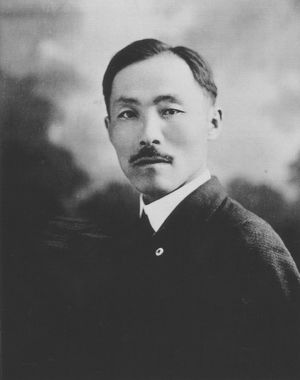
Almost a century-old blackmail suggesting that the late Ahn Chang-ho, commonly known as Dosan, was found at the U.S. immigration department recently. UC Riverside’s Ethnic Studies professor Edward T. Chang found the original copy of the blackmail in the Northern California government records.
Chang’s recent finding is expected to serve as a valuable record to confirm the details of Ahn’s time in the U.S. over three separate incidents as well as his deportations.
“Ahn’s plan was to visit San Francisco first followed by a two-week stay in Hawaii to discuss Korea’s independent movement,” Chang said. “However, he was suddenly deported by a ferry to Australia. That happening always remained as a mystery. There have been several scholarly researches suggesting that the people from Rhee Syngman’s camp are the ones who blackmailed Ahn. We’ve now found the evidence to back up that claim.”
Chang explained that the blackmail he found was submitted on Dec. 15, 1924 by Charles Hong Lee and Kong Wang to San Francisco’s immigration office, which served as a subdivision below the labor department. The blackmail was found as a coincidence while Chang was looking through the records at the San Bruno government to track the route of first generation Korean-American immigrants who set up the country’s first ever Koreatown in Pachappa Camp.
“Bolshevist leader your office look out…his coming via Honolulu…The person name is Chang Ho Ahn,” the note read.
The writing continued: “He lived in the U.S. for several years as his family currently resides in Los Angeles. He then went over the China where he lived for six years while connected with Bolshevist Government…he is coming to U.S. now.”
The letter then urged the government to deny Ahn’s entry, suggesting “best way to sending back to China quite as possible.”
The identities of Kong Wang and Charles Hong Lee have not been confirmed. Chang said that he looked through the related documents from the immigration office, but could not find further information.
However, Chang hinted that there is a possibility that the followers of Syngman Rhee could have submitted the latter. The letter was submitted a day before Ahn arrived in San Francisco on Dec. 16, 1924, but was not reviewed by the immigration officer. Hence, Ahn was able to enter the U.S. on the following day.
It was not until June 3, 1925 when Ahn was questioned by J.B. Brackie, an immigration officer out of Chicago about his background.
Chang revealed the entirety of the investigation that was launched on Ahn. The officer asked him if he had “interest in the Soviet Union or its government” and also if he ever “suggested during his speeches or lectures that the American government should be more vicious.”
It is presumable that the immigration department reviewed the blackmail and conducted the questioning based on the claims that were made on Ahn.
It has been confirmed since then that San Francisco’s Angel Island immigration department approved Ahn’s request to prolong his stay by eight months on July 22, 1925. However, Chang added that the U.S. government continued to monitor Ahn closely, presumably because of the accusations that he was accused of being a Bolshevist leader.
The Angel Island immigration document filed on Feb. 6, 1926 read, “Make sure Ahn Chang-ho boards the Australia-bound ferry.”
In a separate immigration document on Feb. 23, 1926, the records indicate that Ahn boarded the S.S. Sonoma and was photographed on the scene. Such an evidence proves that the U.S. immigration department kept a close eye on Ahn after ordering his deportation.
Ultimately, Ahn was deported from San Francisco to Hawaii to Australia. During his short, six-hour stay in Hawaii, Ahn gave a speech to about 150 Korean immigrants at a local church before leaving to Australia.
Ahn returned to China shortly after arriving in Australia. He initially planned to visit the U.S. in 1932 to meet his family, but was arrested by the Japanese police for his connection to Yun Bong-gil’s bombing at Hongkew Park in China. Although Ahn was released later, he was arrested again in 1937 before dying in March 1938.
“The blackmail seems to have been submitted by the supporters of Rhee Syngman,” Chang said. “It’s hugely shocking that the Korean-American community cornered Ahn into being a communist. That was a byproduct of fierce competition among the same people.”
By Byung Chang