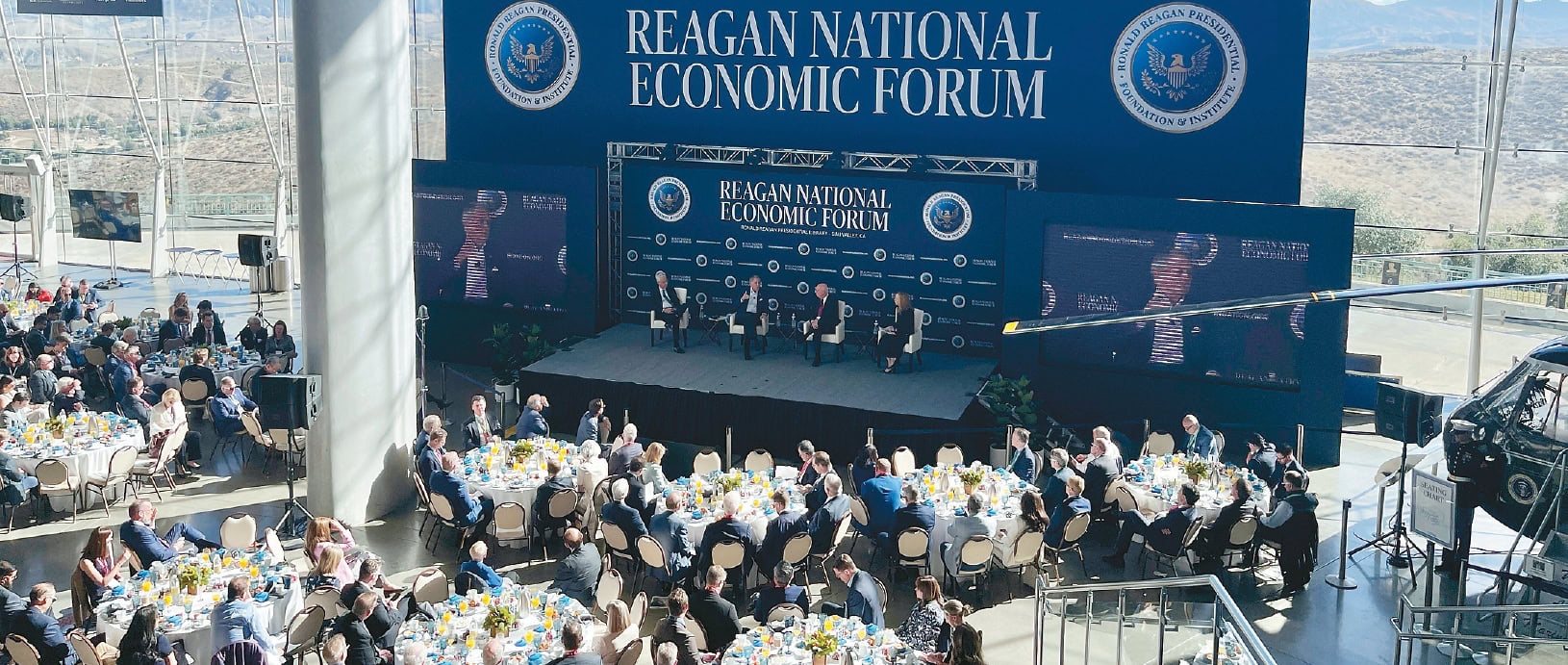
“Strength is more than military power. Economic strength is its foundation.”
The second annual Reagan National Economic Forum, or RNEF, served as a reaffirmation of that principle, echoing a message President Ronald Reagan delivered in his 1984 address to the nation on U.S.-Soviet relations.
The central theme of the forum was clear: a strong economy is inseparable from a strong national security posture. Speakers and attendees repeatedly emphasized that America’s economic power directly shapes its ability to defend its interests at home and abroad.
At 7 a.m. on May 29, more than 500 attendees gathered at the Ronald Reagan Presidential Library in Simi Valley, about 42 miles from Los Angeles. The forum was held as the United States prepares to mark its 250th anniversary and as policymakers, business leaders and experts seek to define a new national blueprint for the years ahead.
The first speaker to take the stage was Paul Atkins, chairman of the Securities and Exchange Commission. In his opening remarks, Atkins stressed that sustainable economic growth requires a firm commitment to free markets and bold regulatory reform.
“Free markets not only create wealth, but also attract people and capital,” Atkins said.
He argued that excessive disclosure requirements and unclear digital asset regulations have discouraged companies from going public and slowed innovation. Atkins said the SEC would work to ease the burden of public listings, clarify cryptocurrency regulations and roll back climate disclosure rules in an effort to restore the global competitiveness of U.S. capital markets.
One of the most anticipated sessions of the day featured Jamie Dimon, chairman and chief executive officer of JPMorgan Chase, often referred to as the “king of Wall Street.” The room filled quickly ahead of his conversation. Even Atkins, after delivering the opening remarks, remained standing for a time to watch the discussion.
Dimon strongly emphasized the link between geopolitical change and economic security. He described the Russia-Ukraine war, instability in the Middle East, the threats posed by Iran and North Korea, and the restructuring of global trade as “tectonic shifts” that outweigh short-term economic concerns.
The future of the free world, he said, depends not only on military strength but also on economic resilience.
Dimon also pointed to the interconnected nature of the U.S. dollar’s status as the world’s reserve currency, American military power and the strength of the U.S. economy. He warned that the United States should not depend on hostile suppliers for resources essential to national security.
In that context, Dimon said JPMorgan Chase is working to provide $1.5 trillion in financing over 10 years to support critical national security sectors, including military equipment, active pharmaceutical ingredients, rare earth minerals and semiconductors. He also identified South Korea, Japan, Australia and the Philippines as key allies with whom the United States should deepen economic and security cooperation.
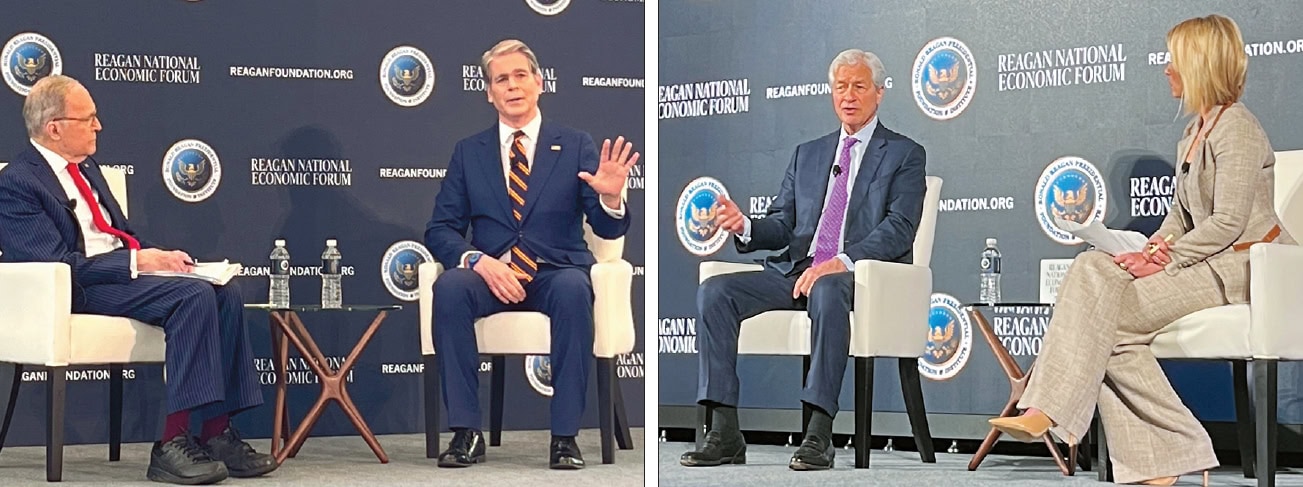
The clearest statement of the day came from Treasury Secretary Scott Bessent, who delivered the keynote address.
“Economic security is national security,” Bessent said.
He warned that deeper dependence on foreign countries for manufacturing, minerals, pharmaceuticals and shipbuilding would ultimately weaken American sovereignty.
“That is a dangerous dependence the United States cannot accept,” he said.
Bessent outlined the Trump administration’s economic security strategy around four pillars: trade policy, critical minerals, shipbuilding and pharmaceutical supply chains. He described reciprocal tariffs and investigations under Section 232 of the Trade Expansion Act as key national security tools, saying the United States would no longer allow itself to become overly dependent on foreign sources for pharmaceutical ingredients, rare earth supplies or shipbuilding capacity.
At the same time, Bessent said the policy does not amount to isolationism or indiscriminate decoupling. He stressed the need to distinguish between “healthy interdependence” and “dangerous overdependence.”
The United States, he said, should strengthen supply chain partnerships with allies and friendly nations while rebuilding domestic production capacity in sectors essential to national security.
The Reagan National Economic Forum is a strictly invitation-only event. Admission is not based simply on wealth or status. Participants attend through recommendations from forum sponsors, invitations from speakers or official invitations from the Reagan Institute, the policy arm of the Ronald Reagan Presidential Foundation and Institute.
Angela Sun, a board member at Western Union, said she attended at the invitation of Gordon Sondland, former U.S. ambassador to the European Union, who has close ties to the Reagan Institute.
“I expect to hear insights from government economic officials, business leaders, scientists, journalists and experts from many different fields on the major theme of economic security,” Sun said.
An executive from Deloitte, one of the forum’s sponsors, said he had traveled from New York the previous day to attend.
“The greatest benefit of an event like RNEF is networking,” he said. “You get to meet people working in different fields, hear what they are focused on now and discuss what you might be able to do together in the future.”
He added that the forum also offers a rare opportunity to hear what lies behind the major issues often discussed in the news.
As he described, the forum was filled with constant networking. Attendees introduced themselves to the people seated next to them as soon as they arrived. If soldiers carry ammunition, the participants here carried business cards.
With each handshake came an exchange of cards, affiliations and areas of interest. Even brief conversations opened the door to future meetings. In many ways, the discussions taking place in the hallways and around the venue became another session of the forum itself.