Dismantling the Complexity Bar: The Push for One-Hour Flight Proficiency
For the vast majority of the population, personal aviation has remained a locked door. Despite the fact that roughly 300 million Americans live within a short drive of underutilized general aviation airports, 90% of regional trips around 200 miles are still conducted via highway. The barrier isn’t a lack of desire—it’s the brutal cognitive load and prohibitive cost of traditional piloting.
Currently, the average purchase price of a personal aircraft hovers around $3.25 million, with annual operating costs sitting near $1 million. On top of that, training programs are so demanding that nearly 70% of student pilots drop out before securing their credentials, leaving a mere 0.2% of the adult population with a pilot’s license.
Looking to shatter this multi-generational barrier is Airhart Aeronautics, an emerging aerospace startup operating out of a dedicated development hangar at Long Beach Airport (LGB). Founded by former SpaceX avionics systems engineer Nikita Ermoshkin (CEO), the company recently hosted a media showcase to unveil its radical blueprint for modern personal transportation: a flight experience redesigned to feel less like a manual cockpit and more like driving an automatic transmission car.
The Cockpit Stripped Bare: Inside the Airhart Sling
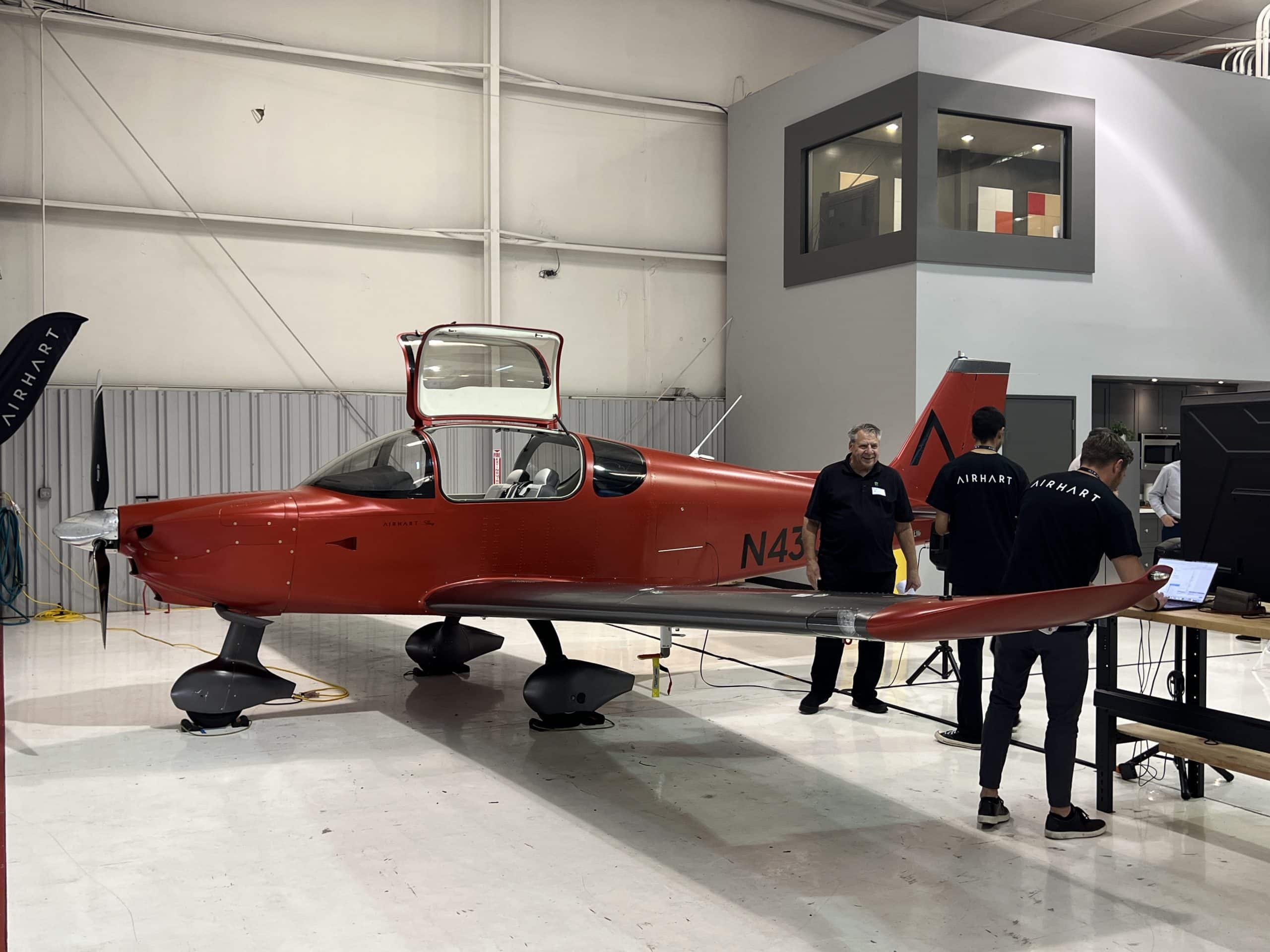
The centerpiece of the Long Beach showcase was the Airhart Sling, a four-seat prototype aircraft developed in structural partnership with lightweight kit manufacturer Sling Aircraft.
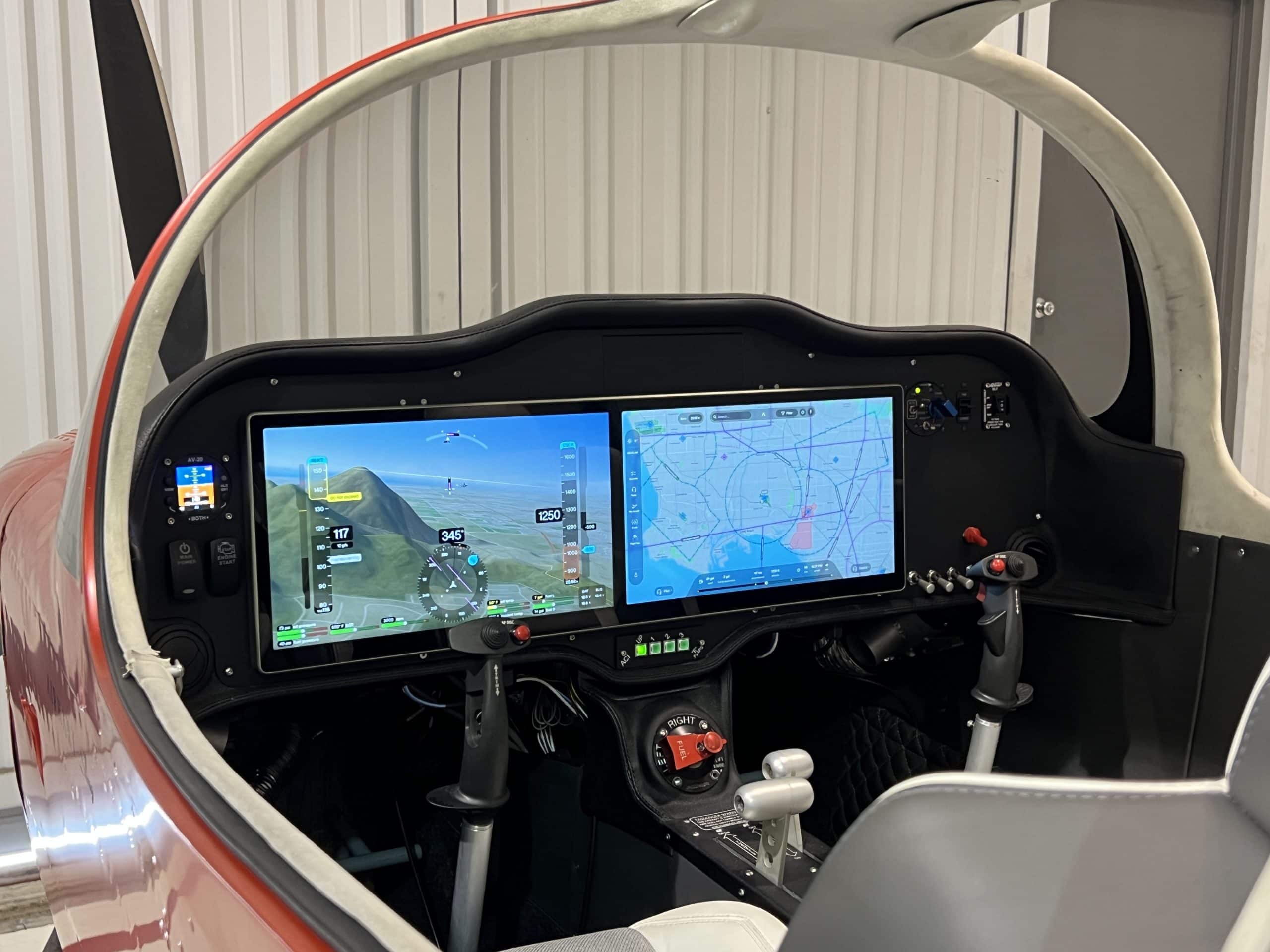
Step inside the cabin, and the dizzying, mechanical wall of dials, switches, and fuses typical of a legacy general aviation cockpit is completely absent. Instead, the console is dominated by an ultra-bright, dual 14-inch touchscreen interface—the largest display cluster in general aviation.
More shockingly, the floorboards are entirely smooth because the traditional rudder pedals have been completely eliminated. Instead of navigating a complex dance of independent inputs—where a pilot must manually balance a control yoke, foot rudders, and a mechanical engine throttle while constantly adjusting trim levels—Airhart consolidates the physical control of the aircraft into two intuitive, hand-operated interfaces:
-
The Airhart Assist Stick: Located on the left, this force-feedback joystick controls 3D vectoring, mapping directly to where you want the nose of the plane to point.
-
The Linear Speed Lever: Located on the right, this acts as an intelligent cruise controller. Pushing it forward increases desired airspeed, while pulling it back slows the aircraft down.
Software as the Copilot: Uncompromising Fly-by-Wire Redundancy
“Humans are exceptionally skilled at high-level risk management, routing decisions, and radio communication,” noted Nate Thuli, President of Airhart Aeronautics. “But humans shouldn’t have to be perfect at complex physical hand-foot coordination while simultaneously calculating crosswind crab angles on a short final approach. We let computers manage the physics so the human can manage the flight.”
During live flight simulator trials at the hangar, media representatives witnessed this software intervention firsthand. When an operator aggressively rolled the flight stick hard to the right—a move that would trigger a dangerous aerodynamic stall or steep spiral dive in a standard aircraft—the Airhart flight computer automatically managed the throttle, coordinated the turn rates, and held a stable altitude, keeping the machine perfectly inside its safe flight envelope.
This system proved equally transformative during the landing phase. During descent, once the operator lined up the basic location and direction vectors, the aircraft smoothly managed its own glide path to touch down gracefully, requiring no complex manual throttle or pitch micro-adjustments.
To ensure this level of software dependence never introduces a single point of failure, the avionics run on a triply-redundant architecture. Dual independent sensor clusters continuously stream diagnostic and positional information from low-cost, automotive-grade MEMS gyroscopes, accelerometers, and GPS units into the system. From there, three hardened flight computers ingest the data simultaneously, running complex aerodynamic algorithms in parallel millions of times per second.
These three separate units constantly vote on the required control surface outputs. If a bit-flip, power interruption, or kernel hang freezes one computer, it is instantly outvoted and bypassed seamlessly. Once the system validates the digital command, it fires the instructions directly to servo actuators that mechanically manipulate the ailerons, elevators, and split rudders.
Navigating the Regulatory Sky: The MOSAIC Tailwind
Airhart’s commercial timeline is accelerating rapidly thanks to sweeping regulatory changes from the Federal Aviation Administration (FAA). The FAA’s newly enacted MOSAIC (Modernization of Special Airworthiness Certification) regulations have fundamentally expanded the boundaries of the Light Sport Aircraft (LSA) category.
Under legacy rules, LSAs were strictly limited to tiny, slow two-seaters. Under the modern MOSAIC framework, the FAA now permits 4-seat configurations, higher clean-stall speeds, and alternative propulsion setups (including hybrid and electric systems). Crucially, MOSAIC includes structural provisions that grant sport pilots the right to operate advanced aircraft with “simplified flight control” schemes like Airhart’s, creating a direct legal pathway to bypass hundreds of hours of traditional training.
The company’s commercial rollout follows a highly structured multi-year development trajectory. After successfully validating its first prototype flight envelope in 2023, Airhart proved its long-distance reliability last year by completing a full transcontinental cross-country flight across the United States.
The startup is currently entering its next phase, kicking off its very first customer deliveries this year. While these initial, hand-built experimental models command a premium price tag, Ermoshkin’s long-term corporate roadmap is focused entirely on scaling production to activate massive industrial cost efficiencies. The ultimate milestone is to establish high-volume manufacturing lines by 2028, with a long-term goal of hitting an annual output of 10,000 units by 2035.
By replacing hyper-inflated, legacy custom aviation electronics with a modular, platform-agnostic fly-by-wire computer system, Airhart aims to eventually push the retail price of a brand-new family airplane down below $100,000—matching the safety of a family minivan and the usability of a standard car to transform general aviation into a mainstream consumer appliance.