A Historic Debut on Soccer’s Biggest Stage
The intersection of cutting-edge technology and global sports reached a historic milestone during the knockout stages of the FIFA World Cup 2026™. In a surprise showcase that stunned thousands of spectators in attendance and millions watching around the globe, Hyundai Motor Group successfully deployed its advanced humanoid robot, Atlas, for a live halftime performance.
The high-profile activation took place at the New York/New Jersey Stadium during a highly anticipated Round of 16 match. This marks the absolute first time a mass-production-ready humanoid robot has been integrated into a live entertainment segment at a sporting event of this scale.
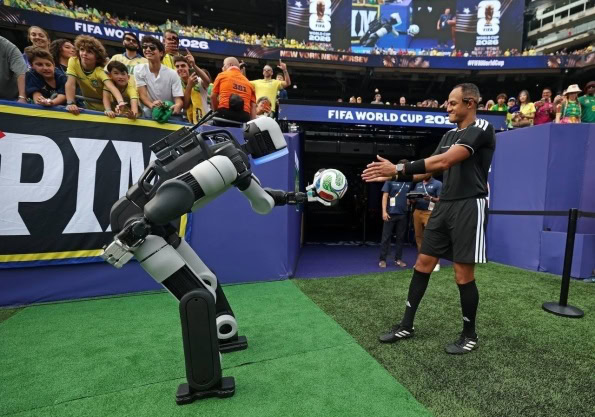
Replicating Icons: From Star Celebrations to Match Protocol
Emerging from the player entrance tunnel just moments before the end of the halftime intermission, Atlas seamlessly executed a series of highly synchronized movements. Developed by Hyundai’s subsidiary, Boston Dynamics, the bipedal robot captivated the stadium by perfectly mimicking the signature goal celebrations of world-renowned soccer icons, including South Korean forward Son Heung-min and England striker Harry Kane.
Beyond purely entertaining the crowd, the demonstration served as a highly practical test of real-time mechanics and dynamic balance. Upon completing its choreography, Atlas utilized its precise navigation, locomotion, and grip-control systems to safely retrieve the official tournament match ball and hand it over directly to the head referee, formally signaling the start of the second half.
The Vision Behind Hyundai’s Advanced Mobility Push
This stadium demonstration serves as a massive proof-of-concept for Hyundai, which acquired a controlling stake in Boston Dynamics to spearhead its future mobility, robotics, and logistics ecosystems. Facing a high-pressure environment filled with intense flash photography, complex terrain, and massive acoustic vibrations, the humanoid robot demonstrated remarkable spatial awareness and mechanical stability.
Industry analysts view the successful World Cup integration as a bold statement of commercial readiness. By pulling its flagship robotics project out of the laboratory and thrusting it directly into a live international broadcast, Hyundai has effectively demonstrated how close autonomous humanoid machines are to safely interacting within everyday human environments.