AP Korean Course Establishment efforts are uniting Korean-American leaders and community members across the United States to expand college-level language options for secondary students nationwide.
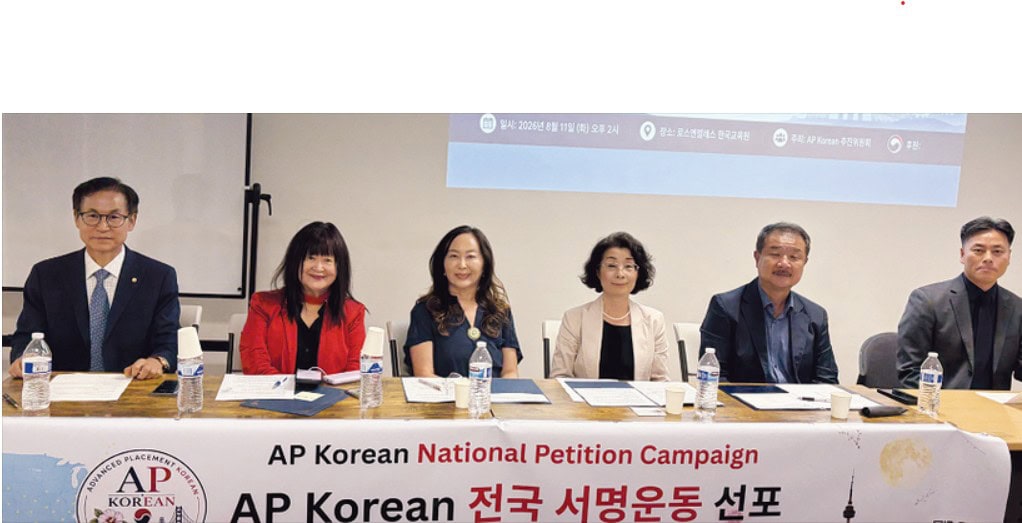
Marking its first anniversary on August 11 at the Korean Education Center in Los Angeles, the AP Korean Steering Committee hosted a press conference to report on its progress over the past year and urged active participation in an ongoing nationwide petition drive.
“A growing consensus is forming that Advanced Placement (AP) Korean must become a standard option within the U.S. formal education system,” said Edward Tae-Han Chang, Executive Chairman of the committee. “To make this a reality, the entire Korean-American community—including educators, students, parents, and business leaders—must unite.”
The Advanced Placement program allows high school students to undertake college-level coursework and earn university credits based on their standardized exam scores. Committee leaders emphasized that establishing an official AP course is vital for Korean to transition from a heritage language course into a globally recognized language open to all students.
Substantial demand already exists across public secondary schools. According to figures released by the committee, approximately 10,600 students are currently enrolled in regular high school Korean language classes across the United States.
Co-Chairman Sung-Won Kim highlighted these figures in comparison to other Asian languages offered by the College Board. Currently, roughly 2,800 students take the AP Japanese exam annually, while around 30,000 students take AP Chinese.
“The number of students enrolled in regular high school Korean classes provides concrete evidence to the College Board that sustainable, long-term demand exists for an AP Korean course,” Kim explained.
Since its launch in August last year, the committee has spearheaded operations through six specialized subcommittees: College Board relations, Korean heritage schools, middle and high school curricula, university and teacher education, fundraising, and public relations.
Over the past 12 months, the group hosted a special seminar at the National Assembly of Korea, signed a Memorandum of Understanding (MOU) with the Gyeonggi Provincial Office of Education, held formal meetings with College Board representatives, and completed its registration as a non-profit organization. The committee plans to launch its official website next week.
Preparations for classroom integration are also advancing. The middle and high school subcommittee, which includes more than 60 Korean-American teachers nationwide, is formulating curriculum frameworks, designing teacher training programs, and outlining an operational roadmap for local school districts.
The committee is currently directing its primary focus toward a nationwide signature campaign launched on August 1, which has already gathered 33,382 signatures. Organizers plan to submit the petition results to the College Board as formal documentation of widespread national support.
Community members and supporters can participate in the petition online through the official website at supportapkorean.org.
By Eunyoung Lee