Korean Independence Activists buried at Rosedale Cemetery near Los Angeles’ Koreatown were honored with South Korean flags and flowers on Aug. 15, marking Korea’s Liberation Day.
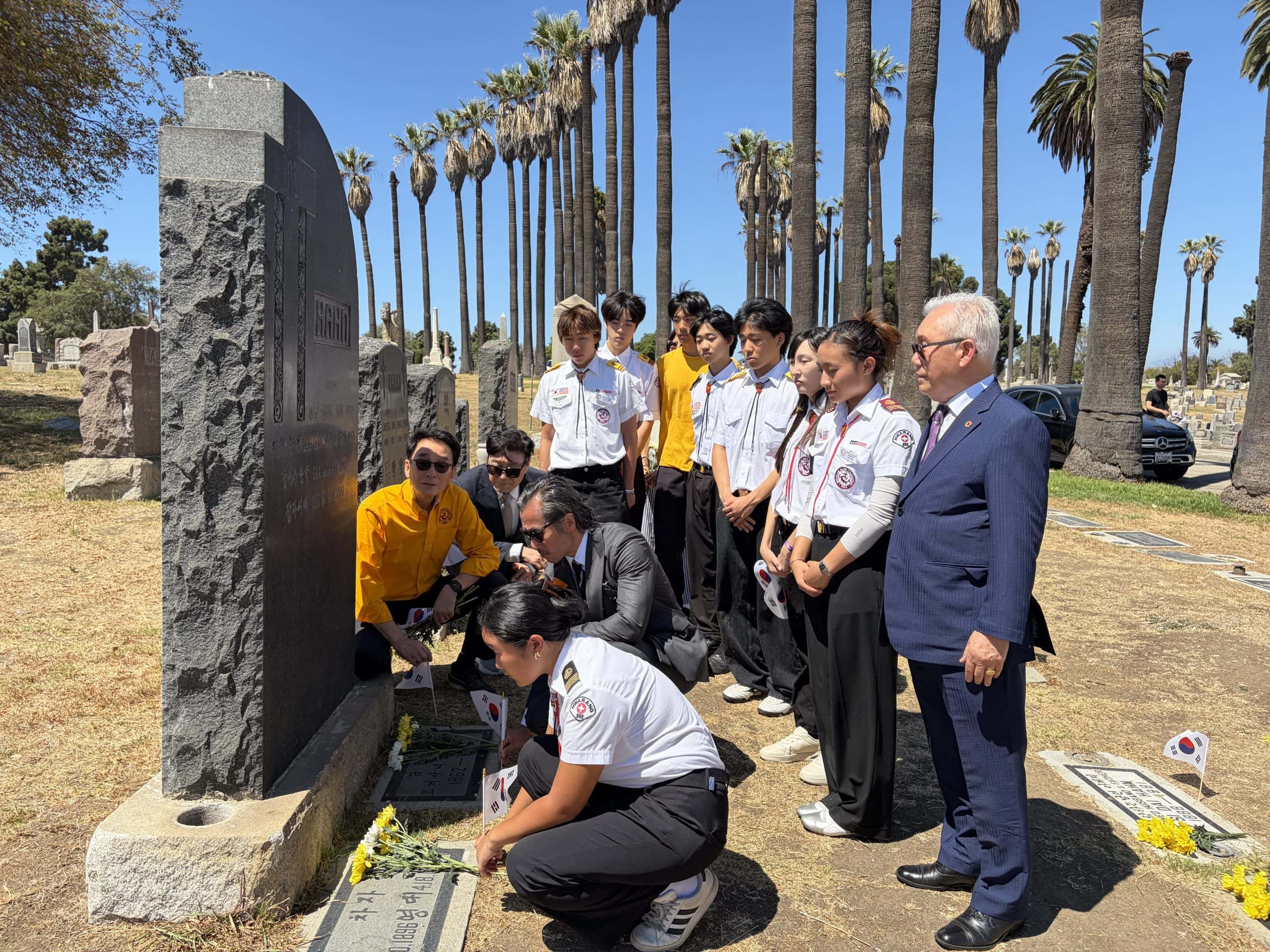
The Hwarang Youth Foundation, led by President Howard Park, visited the graves of 34 Korean independence activists buried at the cemetery, placing South Korean flags and flowers at each gravesite. About 30 people participated, including students and parents from the foundation, representatives of the Korean National Association Memorial Foundation and board members of Dong-Ah Institute of Media and Arts.
The Hwarang Youth Foundation and the Korean National Association Memorial Foundation identified the graves of 11 Korean independence activists at Rosedale Cemetery in 2024.
In May 2025, the Korea Daily joined the effort and launched the “Finding the Graves of Korean Independence Activists” project, expanding the search across the entire cemetery.
The project subsequently located 23 additional graves, with the final four identified in August 2025. The discoveries confirmed the locations of all 34 known Korean independence activists buried at Rosedale Cemetery.
Remembering Korean Independence Activists
Participants visited the graves of several prominent independence activists, including Si-han Ho, Heon-joo Song and Hyung-ho Shin.
Ho’s descendants were located through the Korea Daily’s gravesite project, which also helped bring renewed attention to his independence movement activities. Seventeen historical records documenting his work were recently made public for the first time.
Young-shin Kwon, senior adviser to the Korean National Association Memorial Foundation, guided participants through the cemetery and explained the activists’ contributions.
Kwon said Song served as an interpreter for Korea’s delegation to the Hague Peace Conference before dedicating himself to the Korean independence movement in the United States and supporting the Korean Provisional Government.
He also noted that Shin, who was active in organizations including the Korean National Association, was particularly difficult to locate because only his English name was inscribed on his gravestone.
“Finding a grave is not simply about identifying a burial site,” Kwon said. “It is about restoring the names and contributions of forgotten independence activists and passing their stories on to second-generation Korean Americans.”
Passing History to the Next Generation
Chloe Kim, a student with the Hwarang Youth Foundation who participated in the event, said learning about the independence activists carries special meaning for younger Korean Americans.
“As a second-generation Korean American, I think it is important to learn and remember what these independence activists did for their homeland,” Kim said. “I have never been to Korea, but this volunteer experience helped me gain a deeper understanding of Korean history.”
The foundation plans to install QR codes at the gravesites containing coordinates and information about each activist’s life, independence movement activities and official honors.
It is also discussing with cemetery officials and surviving family members a plan to create durable bronze plaques featuring South Korean flag markers and QR codes.
Park said the foundation hopes to begin installing the markers and QR codes at the 34 gravesites as early as November.
“We want second-generation Korean Americans to continue caring for these graves and carry the spirit of the independence movement forward to future generations,” Park said.