The moment I climbed into a yellow Pony driving-school car with an instructor and pulled onto the road, I was nervous. I had to watch the traffic and signals, shift gears and operate the clutch, all at the same time. I stalled the engine repeatedly whenever I tried to pull away. But the most nerve-racking moment came when I stopped on a hill and worried that the car would roll backward. At the time, stopping and starting again on a hill was one of the most difficult parts of the Korean driver’s test.
For younger generations, this may sound like a strange story. But until the mid-1980s, most cars in South Korea came with a manual transmission as standard equipment. The technology was simple, reliable and fuel-efficient. Automatic transmissions, meanwhile, were expensive imported products and offered poorer fuel economy.
Driving a manual transmission was certainly inconvenient. Drivers had to coordinate the engine’s RPM with the appropriate gear while accelerating and slowing down. Yet at the time, using both hands and both feet while driving was considered perfectly normal.
About a decade later, after moving to the United States, I found manual transmission cars surprisingly difficult to find. Because Americans tended to drive long distances and gasoline was relatively inexpensive, manual transmissions were generally offered as an option rather than the standard choice. According to industry data, manual transmissions accounted for 34.6% of new-car sales in 1980. That share fell to 22.2% in 1990 and 9.7% in 2000. By 2021, it had dropped to just 0.9%, leaving manual transmissions barely hanging on.
The decline was largely driven by rapid advances in automatic transmission technology. Automatics eventually surpassed manuals in both fuel efficiency and shifting speed. At the same time, stricter EPA emissions and fuel-economy regulations and the growth of electric vehicles encouraged automakers to focus even more heavily on automatic transmissions and other technologies. Industry data shows that 143 new models offered a manual transmission option in 2006. This year, that number has fallen to just 28, an approximately 80% decline in two decades.
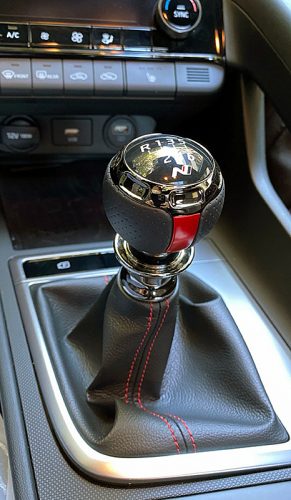
I recently had a chance to drive a high-performance Hyundai Elantra with a manual transmission at a Hyundai media test-drive event. It had been decades since I had pressed a clutch pedal, but instead of feeling awkward, I felt unexpectedly happy. The tactile sensation of shifting gears and matching the engine’s RPM was something I simply could not experience with an automatic transmission.
For a moment, I wanted one.
Then I remembered my daily commute on the notoriously congested 5 Freeway, where I spend about four hours driving round trip. I quickly changed my mind. A manual transmission might bring back the joy of driving, but using one every day in Los Angeles traffic would amount to making life unnecessarily difficult.
That is why the recent resurgence of manual transmissions is so intriguing. The technology that once seemed destined to disappear is attracting a surprising new audience. More young people are learning to drive manuals and actively searching for manual-transmission vehicles.
According to used-car retailer CarMax, searches for manual-transmission vehicles have jumped 48% in recent years, with Gen Z and younger millennials making up the largest share of buyers. What is particularly interesting is that these young drivers are not learning to drive a manual because they have to. They are choosing to do it because they want to.
The phenomenon resembles the renewed interest in film cameras, vinyl records, cassette tapes and CDs. For a generation that grew up surrounded by digital technology, a manual transmission is no longer simply an inconvenient piece of old technology. It has become a distinctive experience.
Its inconvenience can actually become part of the fun. Its rarity can create value. In an era when almost everyone drives an automatic, knowing how to drive a manual transmission can itself become a statement of personal taste and individuality.
Of course, this trend does not mean that manual transmissions are making a broad comeback. As electric vehicles become more common, the space available for manual transmissions will inevitably become smaller. Still, the trend is fascinating because, as we have seen with the broader retro revival, technologies that are disappearing can sometimes acquire new meaning and value precisely because they are becoming rare.
An automatic transmission makes driving easier and more convenient. A manual transmission, however, reminds us what it feels like to actually drive.
As AI and algorithms increasingly take over more of the tasks once performed by people, perhaps we are beginning to crave experiences in which we have to operate, intervene and make decisions ourselves.
Maybe that is the real reason some people are returning to the manual transmission. It is not simply about driving an older technology. It may be about refusing to give up a small piece of human control—to remember that technology should move us, but we should still be the ones in control.
BY NAKI PARK [park.naki@koreadaily.com]