Sometimes, it is the void left behind that reveals the true stature of a person.
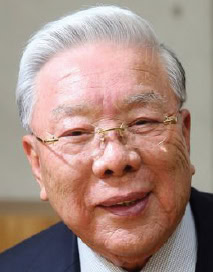
That is especially true of Myung Ki Hong, chairman of the M&L Hong Foundation, whose death marked its fifth anniversary on August 18. Hong was widely regarded as one of the Korean American community’s “elder statesmen” — a leader who brought people and resources together and helped set a direction whenever the community faced a critical moment.
Five years after his death, however, no comparable leadership has emerged to fill that role.
To mark the fifth anniversary of Hong’s passing, The Korea Daily examines in a three-part series the disappearance of such elder leadership, the weakening of the community’s traditional center of gravity and the challenges of generational transition.
Hong began taking a more prominent leadership role in the Korean American community after the 1992 Los Angeles riots. Watching Korean Americans suffer enormous losses while lacking the political and social influence needed to protect their interests convinced him that building political power had to become a community priority.
He encouraged Korean Americans to vote and seek public office and supported Korean American politicians regardless of party affiliation. Among those who received support over the years were Michelle Steel, Rep. Young Kim, former Irvine Mayor Sukhee Kang and David Ryu, who became the first Korean American elected to the Los Angeles City Council.
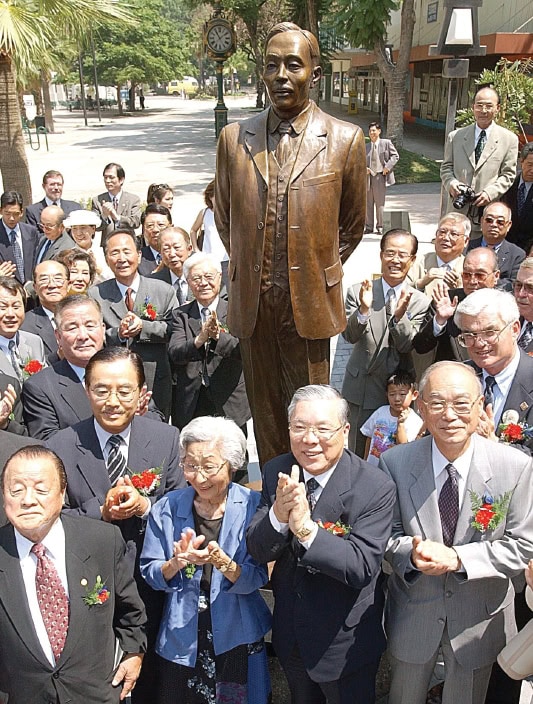
In 2001, Hong established the Bright Future Foundation with $10 million of his own money. He supported education, civil rights and the preservation of Korean American immigrant history through organizations and projects including the Korean Institute of Southern California, the Korean National Association Memorial Foundation and the construction of a statue honoring independence activist Dosan Ahn Chang Ho.
His publicly known donations alone exceeded $20 million.
But Hong’s role cannot be measured simply by the size of his contributions.
When a community issue arose, he gathered people around the table. When money was short, he was often the first to contribute. When an organization faltered, he stepped in and took responsibility. He treated his personal wealth, relationships and social standing as resources that could be used for the broader community.
Work that “someone had to do” often became work that Hong himself took on.
Since his death, a refrain has become increasingly common among Korean Americans: “There are no more great elders.”
Yet viewing the problem simply as a shortage of prominent individuals fails to capture the deeper transformation taking place. It is not merely that several senior leaders have disappeared. The social conditions that once produced such leaders are themselves changing.
“The era when one or two senior figures led the entire community is over,” said Chang Keun Kang, former chairman of KAF. “The first generation should provide financial support and experience, while leaving operations and decision-making to the next generation.”
A community once built on necessity
For earlier generations of Korean immigrants, the Korean American community functioned as a single social and economic ecosystem.
Many worked for Korean-owned businesses. They borrowed from Korean American banks to start companies. They relied on Korean American lawyers and accountants and built relationships through Korean churches and civic organizations.
Those who succeeded often helped newer immigrants get established and gave money back to the community.
For first-generation immigrants who faced significant barriers to entering the mainstream labor market, Koreatown and its networks were both a safety net and a ladder for upward mobility.
Hong’s strong sense of communal responsibility cannot be separated from that era.
The Korean American community was more than a group connected by ethnicity. It was where business, careers and personal relationships intersected. When the community struggled, individuals felt the consequences in their own lives.
But that structure contains a paradox: The more successful an immigrant community becomes, the more likely it is to raise children who no longer need that community to survive.
The second generation inevitably moves from the “small island” of the ethnic community toward the broader mainland of American society.
Korean Americans born or raised in the United States speak English as their primary language, graduate from American universities and enter corporations, law firms, hospitals, academia and other mainstream institutions directly.
Unlike their parents, they do not necessarily need the Korean American community to find jobs, obtain financing or build professional networks. Their lives have also long since expanded beyond Koreatown.
For the first generation, the Korean American community was essential for survival. For the second generation, it is one of several identities and networks they can choose to embrace.
Ironically, the fact that younger Korean Americans can succeed without depending on the ethnic community is itself evidence that their immigrant parents achieved the American dream.
That is why the younger generation’s lower level of involvement cannot simply be dismissed as a lack of interest in their roots or indifference toward the community.
The first generation taught its children to move into the broader American society. Their children did exactly that.
Who inherits what the first generation built?
The more difficult question is what happens next.
Who will inherit the institutions, experience, wealth and networks accumulated by the first generation? And has the Korean American community built a system capable of functioning even as individuals leave and generations change?
Those questions have become more urgent in the years since Hong’s death. Several public-interest initiatives in which he had played a central role have lost momentum or struggled to find new direction.
The answer is not simply to search for another leader like Myung Ki Hong.
The conditions that produced leaders of his generation no longer exist in the same form.
“Generational change should not mean a break,” said Robert Ahn, president of the Korean American Federation of Los Angeles. “It should be a natural passing of the baton.”
Should the void left by one great community elder simply be filled by another?
Or must Korean Americans now build institutions that can continue to function without depending on a single powerful individual?
That is the real question facing the Korean American community as it enters a new era of generational transition.