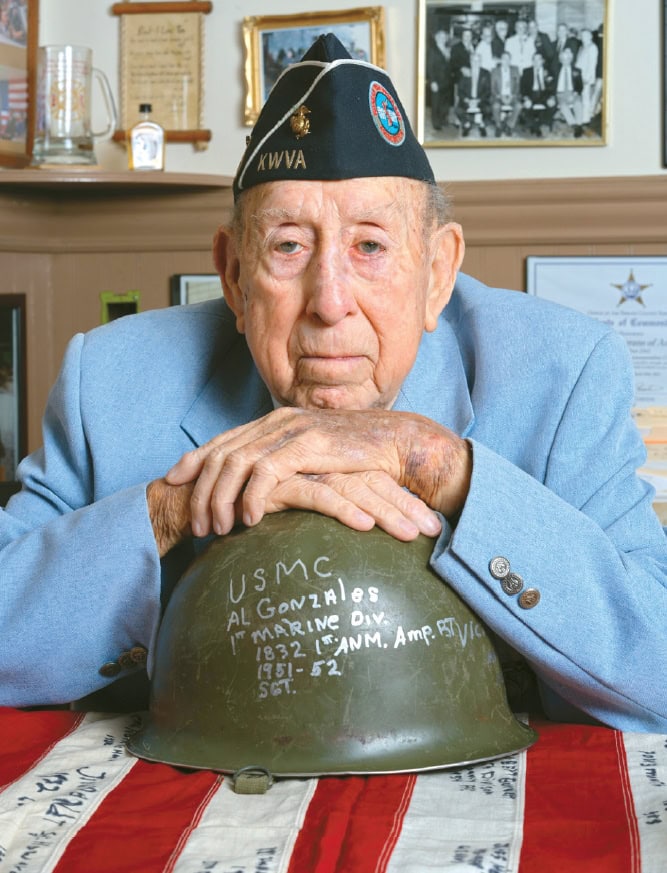
For the aging veterans slowly fading into history, the thunder of war remains an indelible memory.
Seventy-six years ago, young American servicemen gave some of the best years of their lives to defend the freedom of a distant country many of them had barely heard of — Korea. Now, as time takes its toll, the veterans who carried those memories are disappearing one by one.
To commemorate the 76th anniversary of the outbreak of the Korean War on June 25, The Korea Daily is preserving the firsthand accounts of those veterans before their voices are lost, recounting the battles they fought and the legacy they left behind.
“Freedom is not free.”
Albert Gonzales, 95, a Korean War veteran, offered those words in a June 17 interview with The Korea Daily as he reflected on the country he risked his life to defend more than seven decades ago.
The war may now belong to another era, but his conviction remains unmistakably clear: The Korean War must never be forgotten, and the freedom and prosperity built upon the blood and sacrifice of those who fought must now be protected by future generations.
Gonzales grew up in Fort Lee, New Jersey. He was a high school senior when the Korean War broke out in June 1950. At the time, young men were required to register for the draft as they approached graduation.
“I remember reading newspaper reports about the Army suffering heavy casualties on the Korean front,” Gonzales recalled.
Rather than wait to be drafted, he chose to enlist in the U.S. Marine Corps. Shortly after graduating from high school, he put on a military uniform in January 1951.
At the time, virtually all he knew about Korea was that it had once been a Japanese colony. To the young Marine, it was a distant and unfamiliar country.
After completing intensive training at Camp Pendleton in Oceanside, California, Gonzales arrived at the port of Busan in August 1951.
His first impression of Korea remains vivid.
“It was like stepping into a movie,” he said.
Even the traditional clothing worn by Koreans seemed completely unfamiliar.
“I had never in my life seen men and women dressed like that,” he recalled.
Determined to stay and fight
Gonzales had initially been assigned to the infantry. But during a physical examination, military doctors discovered that he had second-degree flat feet, putting him at risk of being discharged.
He refused to accept the idea of simply returning home.
“I didn’t want to go back home like that,” Gonzales said. “If I had, I think I would have felt guilty for the rest of my life.”
Determined to remain in the military, he was eventually assigned to an armored unit.
Among the vehicles he operated was an amphibious armored vehicle Marines called an “Alligator.”
His unit was based in Gimpo and frequently conducted missions around Ganghwa Island and the Han River.
When Chinese forces appeared in the area, Gonzales and his fellow Marines would move toward Ganghwa, engage in fierce combat and then return to their base. The cycle repeated itself.
More than seven decades later, some of those scenes remain impossible for him to forget.
Gonzales remembered Chinese troops as highly organized and formidable combatants, while North Korean forces appeared comparatively less disciplined.
“There were times when a bullet coming toward me barely missed and hit the man next to me,” he said. “Seeing your friends fall right beside you — those tragic moments never leave you.”
His voice still trembles when he remembers them.
Bonds forged in war
Gonzales also holds tightly to memories of the men with whom he shared life and death.
His closest friend was Joe Passantin of Queens, New York.
The two met by chance aboard a train carrying them from New York to military training. They quickly became inseparable.
Their friendship continued for decades after the war, growing into a bond between their families. Gonzales later chose Passantin to serve as godfather to one of his children.
Gonzales returned to the United States in August 1952. After additional military service in the Caribbean, he left the Marine Corps in 1954.
But his family’s connection to Korea did not end with his own service.
Two of his six sons later served with U.S. Forces Korea, one stationed in Seoul and another in Pohang. His granddaughter graduated from Yonsei University in Seoul and now works as a lobbyist with an international career.
For a 95-year-old veteran who remembers Korea as a country devastated by war, its transformation into a global economic and cultural powerhouse is a source of profound pride.
His final message to Korea carries both affection and a warning.
“As someone who spent his youth fighting for Korea, what I sincerely hope is that young Koreans today remember the blood and sweat their parents and grandparents shed to make their country strong, and that they continue what those generations built,” Gonzales said.
“No one knows when or how dangerous forces could emerge that might push Korea back toward communism. Freedom is never free, and protecting it once does not mean it will be guaranteed forever.”
Teaching the next generation
Gonzales has made it a personal mission to teach younger Korean Americans about the war so they do not lose touch with their roots and history.
He visits local high schools to speak directly with students.
“I go to nearby high schools and explain in detail what happened more than 70 years ago in Korea, their ancestral homeland,” he said.
Gonzales believes the Korean War deserves the same attention in the classroom as other defining conflicts in American history.
“The Korean War is a great and important part of history that future generations should study deeply, just as they learn about the American Revolution and the world wars,” he said.
For Gonzales and the rapidly dwindling generation of Korean War veterans, remembrance is about more than preserving the past.
It is about ensuring that those who inherit the freedom they fought for understand what it cost.