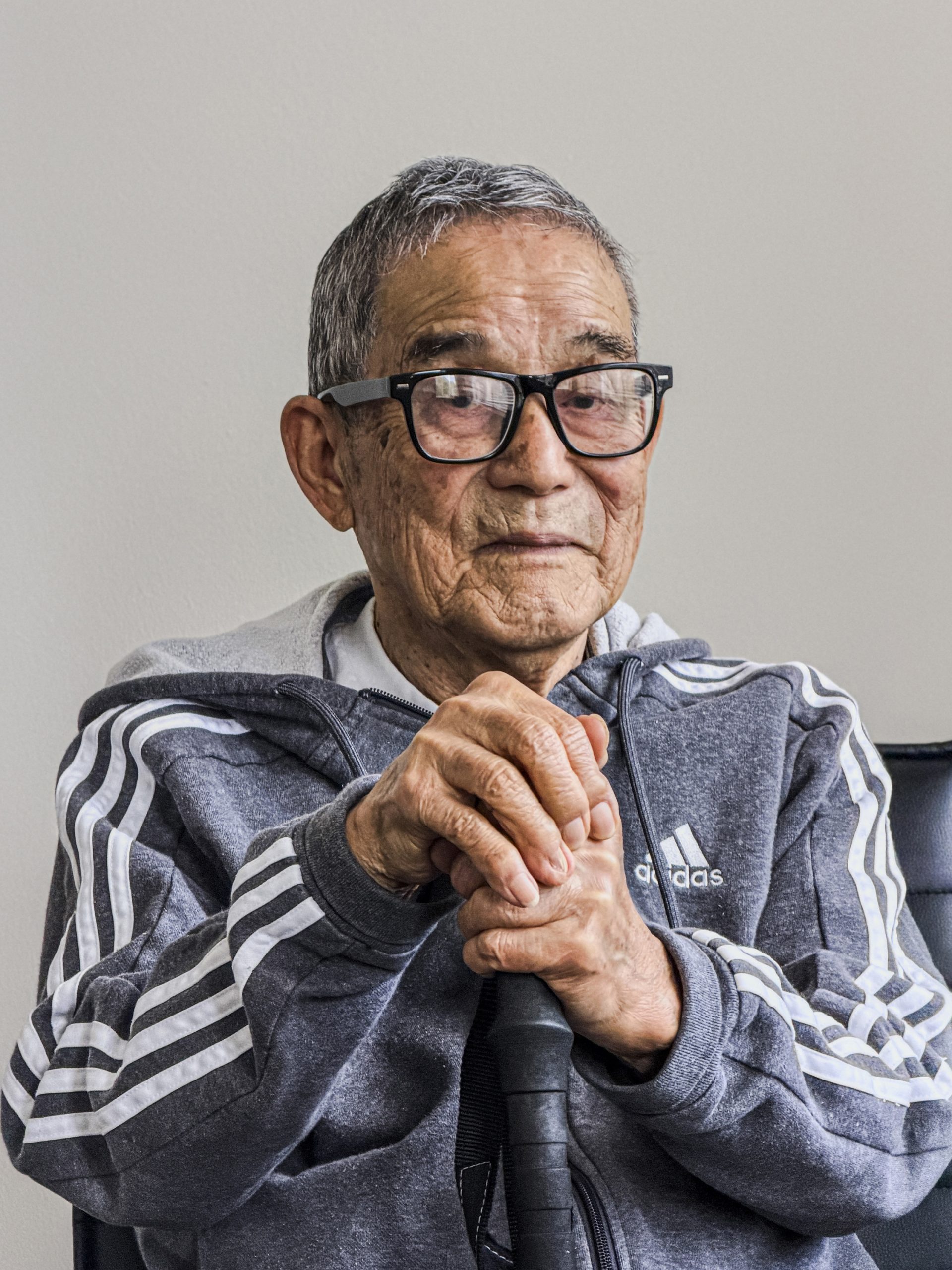
Tsuneto Maki, a 96-year-old Korean War veteran from Hawaii, is deeply troubled that memories of the war are gradually fading with time.
“The Korean War laid the foundation for the values of freedom to take root in the Republic of Korea,” Maki said. “The horrors of that war and the noble sacrifices of its veterans must be passed down not only within the Korean American community, but to younger generations of Americans as well.”
Born in Hawaii in 1929, Maki grew up with a Japanese American mother and a father who was a Japanese national. His maternal grandparents were first-generation immigrants who came to Hawaii from Kumamoto Prefecture, Japan.
Maki recalled that his mother, despite being born in Hawaii, once lost her U.S. citizenship because she had married a foreign national.
It was an era when war, immigration and social inequality converged within the history of a single family.
Maki was drafted into the U.S. Army on June 4, 1951.
“I watched friends my age get called into the military about every two weeks,” he said. “I was always nervous, wondering when my turn would come.”
His brothers were also drawn into the Korean War.
His eldest brother, Taka, volunteered for military service at age 25 and fought with the U.S. Army’s 25th Infantry Division. He was awarded the Silver Star for returning to an area under intense enemy fire to rescue members of his platoon. Maki’s second-oldest brother was also drafted and served at a military base in Hawaii.
From Hawaii to war-torn Korea
Maki completed 14 weeks of basic military training in Hawaii, followed by another 12 weeks of training in Japan.
He then arrived in Busan and entered the Korean War.
Assigned to the U.S. Army’s 7th Infantry Division, Maki initially worked in port logistics at Busan Harbor, loading military supplies onto trains.
The Korea he encountered stood in stark contrast to Japan, which was already undergoing rapid reconstruction following World War II.
“Busan looked devastated and completely undeveloped,” Maki recalled.
He remembered once asking a Korean man why reconstruction had not begun in earnest.
“He told me it was something the Americans would have to take care of,” Maki said.
His duties later changed dramatically when he was transferred to Seoul and assigned to work as an interpreter during prisoner-of-war interrogations.
Maki translated into English the statements of prisoners who spoke Japanese and helped obtain information about their military units and locations.
“Many of the prisoners I questioned were actually from South Korea,” he said. “They were young men who had been captured by the North Korean military and forced into their ranks.”
The stories left a lasting impression on him.
Japan’s colonial rule of Korea had ended only a few years earlier, but Maki said he never experienced hostility or discrimination from Koreans because of his Japanese ancestry.
“The Korean people were always kind to me,” he said. “They treated me exactly the same as the white American soldiers. There was no difference.”
A country he has never seen again
Maki returned to the United States in 1953, around the time the Korean Armistice Agreement brought the fighting to a halt.
He has never returned to Korea.
While living in Los Angeles in 1954, Maki said he called the Korean Consulate to ask how he might visit the country again, but at the time was unable to find someone there who could immediately communicate with him in English.
More than seven decades later, he still remembers wartime scenes around Seoul’s Dongdaemun and Seodaemun districts.
Today, the Korea he once knew only as a country devastated by war has been transformed beyond recognition.
“I’ve only been able to see Korea’s remarkable changes on television,” Maki said. “I would like to see that transformation with my own eyes.”
For Maki, the Korean War is not simply a distant chapter in history.
“The Korean War brought enormous sacrifice from so many people, yet it has not been remembered enough,” he said. “At the very least, we must continue to show respect for the veterans who devoted themselves to their country.”
He urged both the South Korean government and the Korean American community to become more active in programs supporting Korean War veterans.
The war, he said, cannot be allowed to survive only in the memories of an aging generation.
“Younger generations also need to clearly understand the history of the Korean War and the impact it had on the universal values we recognize in the world today,” he said.
“It is time for us to tell the next generation”
As the ranks of surviving Korean War veterans continue to diminish, Maki’s wish is simple.
“I hope future generations will understand the devastation the war left behind,” he said. “The Korean government, the United States and the other allied nations must continue to remember the dedication of the veterans.”
“They need to understand how much sacrifice was required to defend Korea,” he added. “Now it is time for us to pass that story on to the next generation.”
For Maki, remembering the Korean War means more than honoring the past. It means ensuring that the sacrifices that helped preserve South Korea are not lost when the last veterans are gone.