“Too many American service members sacrificed their lives in the Korean War for it to be called the ‘Forgotten War.’”
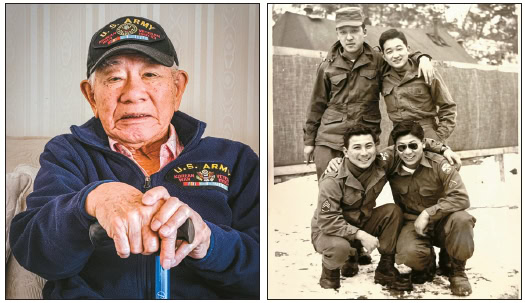
Korean War veteran Norio Uematsu, 95, said the war and the sacrifices made by those who fought in it deserve far greater recognition. He particularly urged the Korean American community to take a more active role in ceremonies and events honoring Korean War veterans.
“When I wear my Korean War veteran cap, Americans often come up to me and say, ‘Thank you for your service,’” Uematsu said. “But in Koreatown, I have heard that only once.”
“I know Korean Americans are grateful,” he added. “But I would like to see more people actually come to commemorative events and show that they remember the veterans.”
Uematsu was born in 1931 in the Cupertino area of Northern California.
His parents came to the United States through Mexico in 1927 amid Japan’s Showa financial crisis and worked on farms around Salinas and Sunnyvale.
His childhood changed dramatically after Japan’s attack on Pearl Harbor.
Beginning in 1942, roughly 120,000 Japanese Americans living on the West Coast were forcibly removed from their homes and incarcerated in detention camps. Uematsu, then about 11, was sent with his family to a camp in Wyoming.
After their release in 1945, the family settled in Brigham City, Utah.
From an incarceration camp to the U.S. Army
Uematsu enlisted in the military in 1949, when he was 17.
“At the time, people were being drafted, so I decided to volunteer instead of waiting,” he recalled. “My father signed the consent form right away, but it took some effort to convince my mother.”
He initially trained in anti-aircraft artillery in Texas.
Then the Korean War broke out.
After additional training in Japan, Uematsu sailed for Korea and arrived in Incheon in July 1951.
The first scenes he witnessed were devastating.
“As soon as I got off the ship, I saw lines of refugees — women, elderly people and children,” he said.
Uematsu had originally been expected to serve in anti-aircraft artillery. But because he could speak conversational Japanese, he was reassigned to the 521st Military Intelligence Service Platoon.
“I told my superior that I couldn’t read or write Japanese, but I could speak it,” Uematsu said. “They pulled me out and assigned me as an interpreter.”
His primary duty was interpreting during interrogations of North Korean prisoners of war.
Uematsu said he participated in the questioning of roughly 100 POWs during the war.
“I was surprised that all of them could speak Japanese,” he said.
“It was sad”
Uematsu remembers those interrogations not with hostility, but with sadness.
“Many of them had not volunteered to go to war,” he said. “It was especially difficult when they talked about their families.”
His memories of serving alongside South Korean troops are much warmer.
Because Korea had emerged from Japanese colonial rule only a few years earlier, many South Korean soldiers at the time could speak Japanese, allowing Uematsu to communicate with them easily.
“Thanks to the Korean soldiers, I was able to eat rice,” he said. “The Korean houseboy assigned to our unit also helped my fellow soldiers and me a great deal.”
Uematsu completed his wartime service and returned to the United States in July 1952.
He later settled in Los Angeles, graduated from college and worked as an engineer for Southern California power and manufacturing companies, including Ling Electronics.
Preserving memories after retirement
After retiring, Uematsu devoted himself to ensuring that the Korean War would not disappear from public memory.
In 1995, he helped establish an organization for Japanese American Korean War veterans.
In 2022, he traveled to Washington, D.C., to attend events surrounding the Korean War Veterans Memorial’s Wall of Remembrance, continuing his effort to preserve the stories of those who served.
For Uematsu, the Korean War is not simply a military conflict from a distant era.
“The Korean War was not just a war in the past,” he said. “It was an event that completely changed the lives of countless people.”
He believes Korean Americans born and raised in the United States also have a responsibility to understand that history.
“Younger generations of Korean Americans must remember this war and the sacrifices of the veterans,” Uematsu said.
For one of the dwindling number of surviving Korean War veterans, remembrance does not require grand gestures.
It begins simply with showing up, listening and acknowledging what was sacrificed.