“Asian American journalists are now in a position to lead the media industry.”
That message resonated among more than 1,200 journalists who gathered June 24-27 in Minneapolis for the annual convention of the Asian American Journalists Association, or AAJA, where speakers and attendees emphasized the growing leadership role of Asian American journalists across U.S. newsrooms.
Founded in 1981 and now in its 45th year, AAJA has more than 2,500 members across 20 chapters in the United States and abroad. It is widely regarded as one of the nation’s most influential journalism organizations, alongside the National Association of Black Journalists.
The Korea Daily, the only Korean-language media organization among AAJA’s member outlets, received an honorable mention at this year’s AAJA Awards for its investigative series on deportees.
The recognition carries particular significance for The Korea Daily as a leading Korean American news organization. The series brought greater attention to marginalized voices, examined deportation through the perspective of immigrants and helped elevate the issue into the broader public conversation.
Jackie Yoo, a producer at ABC News who spoke at the convention, said the ability of Asian American journalists across the country to connect with one another has become increasingly important.
“It is extremely meaningful for Asian American journalists nationwide to be able to build connections with one another,” Yoo said. “In newsrooms, more of us are moving into decision-making positions and creating change.”
Asian American journalists are no longer confined to the margins of mainstream media.
In a nation shaped by immigration, growing numbers of Asian American journalists have entered major news organizations and established themselves as an increasingly important part of newsroom leadership.
This year’s convention drew journalists from many of the country’s largest media organizations, including The New York Times, Los Angeles Times, The Wall Street Journal, ABC, NBC, CNN and Bloomberg.
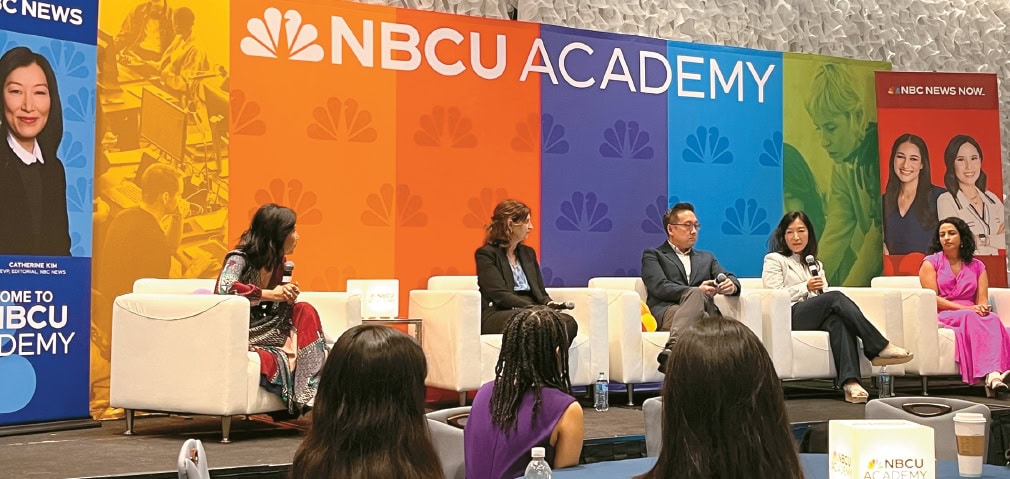
Several prominent Korean American journalists also attended, including Catherine Kim, executive vice president of editorial at NBC News; Eun Yang, an NBC4 Washington anchor; and Minho Kim, a reporter for The New York Times.
Facts and public service remain at the heart of journalism
Terry Tang, executive editor of the Los Angeles Times, said accuracy and public service have become more important than ever as fundamental responsibilities of journalism.
“All reporting, including headlines, must be based on facts and must serve citizens and communities,” Tang said.
Rather than approaching issues through a predetermined lens or bias, she said, journalism should present events as they are, grounded in facts and evidence.
Her remarks underscored a broader concern at the convention: As artificial intelligence increasingly blurs the boundaries between authentic and fabricated information, original reporting conducted by journalists in the field becomes even more valuable.
Journalists must continue to uncover facts that might otherwise go unnoticed and bring them to the public, speakers said.
This year’s convention featured extensive discussions on misinformation in the age of AI, changes inside newsrooms and multiplatform strategies.
Participants also raised concerns that the value of labor-intensive original reporting could become obscured as AI-generated content spreads. Speakers warned that news organizations must remain alert to the potentially harmful effects AI could have on both news production and consumption.
Catherine Kim of NBC News said the rapid growth of AI-generated news content has created an environment in which distinguishing fact from fabrication is becoming increasingly difficult.
“As AI-generated news content increases, it is becoming harder to tell what is real and what is fake,” Kim said. “Because ordinary readers may have difficulty making that distinction, critical thinking, journalistic ethics and strong fundamentals are becoming even more important for reporters.”
Building the next generation of newsroom leaders
Beyond networking, AAJA supports Asian American journalists through mentoring, internships, scholarships and leadership training aimed at strengthening professional development and expanding representation in newsroom decision-making.
The organization also monitors bias and distorted portrayals of Asian Americans in news coverage and has repeatedly spoken out in defense of press freedom and journalists facing intimidation.
In 2019, after a Bloomberg journalist based in South Korea faced personal attacks from South Korea’s Democratic Party following an article about then-President Moon Jae-in, AAJA issued a statement condemning the attacks, warning that they could intimidate journalists and undermine press freedom.
Nearly half a century after its founding, AAJA’s role has evolved alongside the journalists it represents.
The conversation is no longer simply about securing a place for Asian Americans in mainstream newsrooms.
Increasingly, it is about who will help lead those newsrooms — and how journalism can preserve its credibility in an era of rapid technological and social change.