Two hundred and fifty years ago, a founding ideal was proclaimed: “All men are created equal” and are endowed with the rights to “Life, Liberty and the pursuit of Happiness.”
The United States was built on that creed.
Born with the Declaration of Independence on July 4, 1776, America marked its 250th anniversary this year. Over two and a half centuries, it has profoundly shaped modern history as the “land of opportunity,” an experiment in democracy and ultimately the world’s most powerful nation. The Declaration’s language remains at the core of the ideals the nation says it represents.
But behind 250 years of achievement are conflicts and contradictions the country has yet to resolve — and difficult questions about where it goes next.
Racial divisions remain persistent. The Black Lives Matter movement that surged nationwide after George Floyd’s death in 2020. Through reporting from Minneapolis, the series examines America’s enduring racial divide and how the national conversation over race has shifted in the six years since Floyd’s killing.
George Floyd Square, six years later
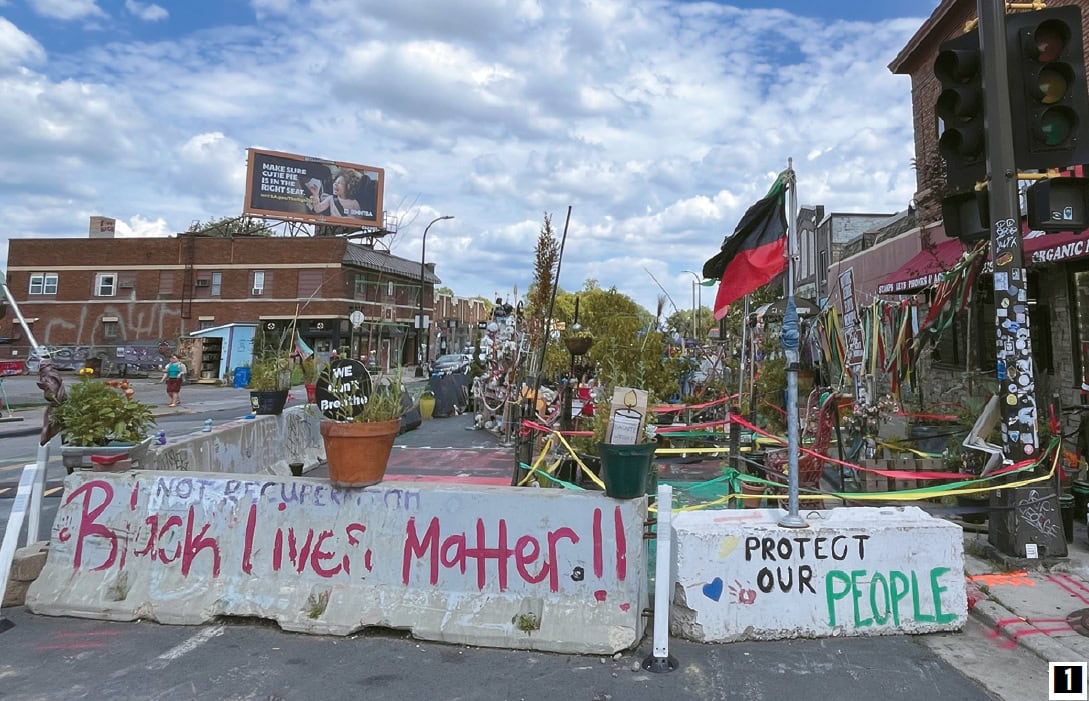
At the intersection of 38th Street and Chicago Avenue in Minneapolis, George Floyd’s final moments remain embedded in the landscape.
Floyd was killed there on May 25, 2020. The intersection is now known as George Floyd Square.
When The Korea Daily visited the site on June 26, a sculpture of a raised fist — a symbol of resistance — stood in the center of the intersection.
Words and phrases associated with solidarity and protest remained painted across nearby walls and pavement: “BLM,” “Freedom,” “Cops Out” and “We.”
At the spot where Floyd died were flowers, stuffed animals, drawings and letters. Whitney Houston’s “Run to You” played through a nearby speaker.
But alongside the memorials were signs of neglect and decline.
Homeless people occupied a bus stop across the street. Nearby restaurants and cafes were so quiet that it was difficult to tell whether some were even open.
DJ Williams, who lives in the area, said the atmosphere is markedly different from the first years after Floyd’s death.
“For the first year or two after George Floyd died, huge numbers of people came here from outside the neighborhood,” Williams said. “Now, most of the people who come are local residents.”
“And there have been second and third George Floyds since then,” he added. “I think that’s why even this case has faded from people’s memories.”
An employee at Unity Foods, the grocery store formerly known as Cup Foods where Floyd had been reported for allegedly using a counterfeit bill, described the economic impact even more bluntly.
“Business in this neighborhood stopped with George Floyd’s death,” the employee said.
The store changed ownership about eight months ago, the employee said, after the former owner concluded that business had become unsustainable.
A memorial — or a tourist attraction?
The following day, as the weekend brought more visitors to the square, Marquis Bowie, a Black Minneapolis resident, moved among them explaining the history of the site.
Acting as an informal guide, Bowie stressed that it was residents — not City Hall — who had protected and maintained the square in the years after Floyd’s death.
But he expressed disappointment at seeing a place created through grief and protest increasingly consumed as a tourist destination.
“Most people just take pictures and leave,” Bowie said. “Very few bring flowers.”
Minneapolis is now carrying out a major reconstruction of George Floyd Square.
Construction began June 8 and covers roughly half a mile of 38th Street and Chicago Avenue. The project includes new sidewalks, pedestrian safety improvements, green space, bicycle infrastructure, transit restoration, lighting and areas for gatherings, art and memorials. The second phase is expected to be substantially completed by the end of 2027.
The central question, however, is what should be prioritized — and who gets to decide.
The city’s plans attempt to accommodate transportation, pedestrian safety, neighborhood businesses, public space and memorialization at the same time. Remembering Floyd is an important element of the project, but it is one among a much broader set of urban priorities.
Whether that debate reaches the heart of America’s racial divide is another question.
Does rebuilding an intersection — even one of enormous symbolic significance — amount to completing the transformation Americans demanded in 2020?
Rose Brewer, a professor at the University of Minnesota, acknowledged the importance of preserving the memorial but drew a distinction between remembering Floyd and achieving the structural change his death was supposed to inspire.
“How much of the discussion and expectation about changing policing and what kind of society we should build has actually been realized is a different question,” Brewer told The Korea Daily on July 27.
The memory remains. The structural transformation demanded in its name is far more incomplete.
Race no longer dominates the national conversation
Six years after nationwide protests convulsed American cities, racial justice no longer occupies the same place at the center of national politics.

Immigration, the border, inflation and partisan conflict have increasingly crowded out the issue. Even during America’s 250th anniversary year, race has not emerged as prominently as might have been expected.
The subdued atmosphere around George Floyd Square reflects that shift.
Concerns about white supremacist activity persist, particularly in the highly polarized political climate of the Trump era. But the landscape itself has also changed. Traditional organized groups such as the Ku Klux Klan have been in long-term decline, even as white supremacist ideas have migrated into newer and often more decentralized networks.
Voting patterns complicate a simple Black-versus-white political narrative as well.
Trump received about 8% of the Black vote in the 2016 national exit poll. Pew Research Center’s analysis of validated voters found that his share reached 15% in 2024, while 83% of Black voters backed Kamala Harris. Trump therefore remained deeply unpopular with most Black voters, but his support among them nevertheless increased substantially compared with his first presidential campaign.
That does not erase racial inequality. But it illustrates why contemporary America is increasingly difficult to explain through a single racial narrative.
Even research on policing has produced findings more complicated than political slogans often suggest.
In a widely debated 2016 study, Harvard economist Roland Fryer found significant racial disparities in nonlethal police uses of force: Black and Hispanic civilians were more than 50% more likely to experience some form of force in the data he studied. Yet his analysis found no racial disparity in officer-involved shootings after accounting for contextual factors — a conclusion that generated intense debate over both its meaning and limitations.
The organizations that grew dramatically during the 2020 racial justice movement have faced scrutiny of their own.
The Black Lives Matter Global Network Foundation received tens of millions of dollars amid the protests and later drew criticism over its finances and transparency, including its purchase of a roughly $6 million Los Angeles property. Federal authorities have investigated possible donor fraud, though no criminal charges had been filed against the foundation in the investigation reported by the Associated Press.
Meanwhile, the Southern Poverty Law Center, one of the nation’s best-known civil rights organizations, was federally indicted in April on allegations that it deceived donors while paying more than $3 million to confidential sources associated with the KKK and other extremist organizations.
That case remains contested. Federal prosecutors characterize the payments as a donor-fraud and money-laundering scheme, while the SPLC says the individuals were informants used to penetrate extremist groups, that information was provided to law enforcement and that the government has misrepresented the program.
The controversy itself reflects the complexity of the current moment: institutions built to monitor extremism are facing questions about how far they can go in doing so, even as the extremist organizations they track continue to evolve.
The old American story of Black-white conflict remains powerful, and racial inequality remains an enduring part of the country’s unfinished history.
But America at 250 can no longer be fully explained through that story alone.
Six years after George Floyd’s death ignited one of the largest protest movements in modern American history, the country has changed.
So has the argument over race.
The raised fist still stands at 38th and Chicago. The flowers are still there. The words painted on walls have not disappeared.
What has changed is the country looking at them.