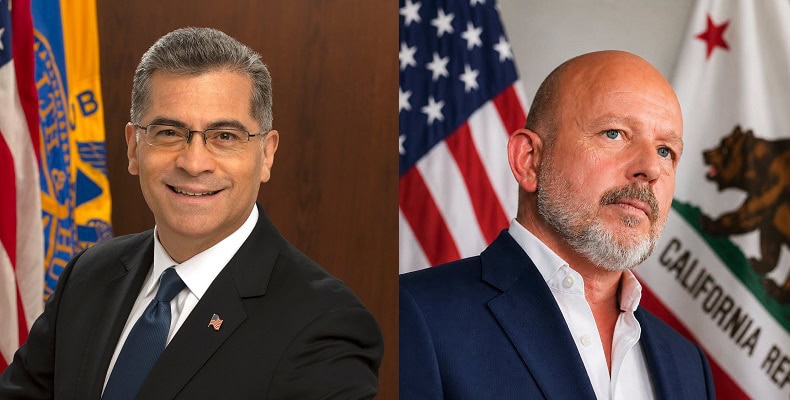
Democrat Xavier Becerra, the former U.S. Health and Human Services secretary, holds a double-digit lead over Republican Steve Hilton ahead of California’s November gubernatorial election, according to a new poll.
A UC Berkeley Institute of Governmental Studies poll co-sponsored by the Los Angeles Times found that 55% of likely voters support Becerra, compared with 37% for Hilton, giving the Democrat an 18-percentage-point advantage. Another 7% remain undecided. The survey was conducted Aug. 3-9.
Becerra also holds a commanding advantage among no-party-preference voters, a potentially crucial swing bloc. Fifty-eight percent support Becerra, compared with 30% for Hilton.
Support is sharply divided along party lines. Among Democrats, 88% back Becerra, while 91% of Republicans support Hilton.
Geographically, Becerra leads in many of California’s traditionally Democratic strongholds, including Los Angeles and San Diego counties, the San Francisco Bay Area and the Central Coast.
Hilton performs better in more conservative areas, including the Central Valley and the North Coast/Sierra region. Orange County and the Inland Empire remain more competitive, with Hilton holding a narrow edge.
The reasons voters gave for supporting each candidate also reflected California’s partisan divide.
Among Becerra supporters, 38% cited his backing of Democratic priorities such as expanding healthcare coverage and protecting LGBTQ+ rights. Another 38% said they support him because they expect him to aggressively challenge the Trump administration.
Hilton’s supporters were driven largely by traditional Republican economic policies. Fifty-five percent cited his support for cutting taxes and reducing government regulation, while 28% said they favored him because he is outside California’s political establishment.
Hilton has proposed eliminating state income taxes on the first $150,000 of Californians’ annual earnings, reducing regulations and expanding oil production in an effort to lower gasoline prices to $3 per gallon.
Becerra also holds an advantage in voters’ overall impressions of the candidates.
Forty-nine percent of likely voters view Becerra favorably, while 43% view him unfavorably. Hilton’s ratings are reversed: 39% have a favorable opinion of him, compared with 50% who view him unfavorably.
Hilton faces an even steeper challenge among independent voters. Among no-party-preference voters, 59% hold an unfavorable view of him and 31% view him favorably, while Becerra’s image among those voters is roughly in line with his positive statewide rating.
“After the unsettled and chaotic primary, this is shaping up to be a fairly standard California general election, where Democrats enjoy a comfortable edge statewide,” said Eric Schickler, a UC Berkeley political science professor and IGS co-director.
For Hilton to make the race highly competitive, Schickler said, he would need to make significant gains among voting groups that traditionally lean Democratic.
The Nov. 3 election will determine the successor to Gov. Gavin Newsom, who cannot seek another term because of term limits. Becerra and Hilton advanced from California’s June 2 primary.
The Berkeley IGS poll was conducted online in English and Spanish among 2,310 likely voters drawn from a broader sample of 4,207 registered California voters. The margin of error for the gubernatorial matchup is plus or minus 2.5 percentage points.