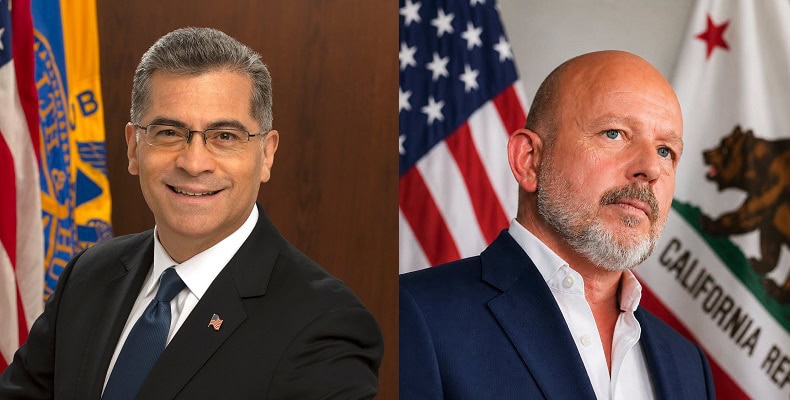
With California’s November 3 gubernatorial election less than three months away, Democrat Xavier Becerra and Republican Steve Hilton are sharpening their policy differences on some of the issues that matter most to voters: housing, the cost of living, energy and healthcare.
Both candidates emphasize their working-class immigrant roots. Becerra is the son of Mexican American working-class parents, while Hilton grew up in Britain as the son of Hungarian immigrants. Both even worked construction jobs as teenagers.
But their prescriptions for California’s future could hardly be more different.
Hilton argues that cutting taxes and regulations and expanding the role of the private sector will help solve California’s housing shortage and affordability crisis. Becerra favors a more active role for state government in housing, healthcare and household costs while promising to continue challenging the Trump administration when federal policies conflict with California priorities.
Their differences are particularly pronounced on housing, taxes, energy and healthcare.
Housing: State intervention vs. deregulation
Becerra says California’s housing shortage requires aggressive state intervention.
He has pledged to declare the housing crisis a state of emergency on his first day in office, direct state agencies to reduce construction costs and accelerate projects already in the pipeline.
His plan calls for expanding down payment assistance for first-time homebuyers and making it harder for large institutional investors to purchase single-family homes that could otherwise go to individual buyers.
Becerra also says he would continue Gov. Gavin Newsom’s aggressive enforcement of state housing laws against cities that fail to plan for or approve their required share of new housing. His campaign says jurisdictions that ignore state housing obligations could face enforcement actions and financial penalties.
Hilton’s approach centers on removing regulations to increase housing supply.
He argues that California’s permitting system, fees and building rules have made it prohibitively expensive to construct smaller, relatively affordable homes.
Hilton has proposed fast-tracking approvals for “starter homes” of around 1,000 square feet, reducing development fees and placing a moratorium on new housing regulations.
He also wants to reform the California Environmental Quality Act, or CEQA, to restrict lawsuits that can delay or stop housing projects.
“We’ve got to allow ourselves to build outwards, not just upwards,” Hilton has said, arguing that California policy has placed too much emphasis on dense multifamily development at the expense of single-family homes.
Cost of living: Crackdowns or tax cuts
The candidates also differ sharply on how to address California’s high cost of living.
Becerra’s broader affordability platform calls for cracking down on price gouging and unjustified rate increases, expanding assistance for childcare and other essential expenses and using state government to intervene when markets fail to keep costs under control.
He points to his record as California attorney general, when he challenged anticompetitive practices by healthcare systems, and his tenure as U.S. Health and Human Services secretary, when Medicare began negotiating prices for high-cost prescription drugs.
Becerra has also recently unveiled a more specific utility proposal called “California Power Hour.” Under the plan, qualifying working-class households would receive up to two hours of free electricity during midday hours, when California often has abundant solar generation. His campaign estimates participating households could save roughly $1,000 a year.
Hilton, meanwhile, is promising direct reductions in taxes and energy costs.
He has pledged to drive gasoline prices toward $3 per gallon, cut household utility bills in half and eliminate state income taxes on the first $150,000 of earnings.
To lower gasoline prices, Hilton proposes increasing California oil production, reducing refinery regulations and rolling back environmental rules he argues add unnecessary costs. His energy plan also calls for easing renewable-energy mandates that he says have driven up electricity rates.
Hilton has also advocated breaking apart PG&E’s monopoly and expanding locally owned or competitive utility options.
His sweeping tax proposal would represent a major reduction in state revenue, however, and would require cooperation from a Legislature where Democrats hold commanding majorities. Hilton has said he would offset tax cuts in part by sharply reducing state spending.
Healthcare draws one of the clearest dividing lines
The candidates are perhaps furthest apart on state-funded healthcare for undocumented immigrants.
California expanded Medi-Cal eligibility in recent years so that low-income residents could qualify regardless of immigration status. Facing rising costs and budget pressure, Newsom and lawmakers later froze new enrollment for undocumented adults.
Becerra says he would reverse those cuts and protect healthcare coverage regardless of immigration status.
His argument is partly economic: providing people with primary and preventive care, he says, costs less over time than leaving them uninsured until medical conditions become severe enough to require expensive emergency-room treatment.
His healthcare plan also proposes expanding CalRx, increasing telehealth access, using California’s purchasing power to negotiate lower drug prices and investing in the healthcare workforce.
Hilton takes the opposite position.
He has pledged to end state-funded Medi-Cal coverage for undocumented immigrants and redirect resources toward lowering healthcare costs for legal residents.
Hilton also says California should increase competition among health insurers and prevent excessive consolidation among hospitals, clinics and other healthcare providers as a way of lowering prices.
A broader debate over the role of government
From housing construction and taxes to electricity prices and healthcare, the Becerra-Hilton contest ultimately reflects a much larger disagreement over the role state government should play in Californians’ lives.
Becerra argues that government should intervene more aggressively when housing, healthcare and other essential markets fail to deliver affordable options, while using California’s legal and regulatory authority to counter the Trump administration.
Hilton argues that California’s government itself has become a major source of the state’s affordability problems and that lowering taxes, reducing regulation and expanding competition would produce better results.
The contrast gives voters a relatively clear choice.
As November 3 approaches, the competition between those two fundamentally different visions of California is likely to become the central policy debate in the race for governor.