〈SERIES〉
- Employment, Income & Business Trends
- Housing & Home Equity
- Investment & Retirement Planning
- Inflation & Living Costs
- Korean American Bank Usage
Persistent High Inflation Expands Household Strain Among Korean Americans
Prolonged inflation continues to weigh heavily on Korean American families, with an increasing majority reporting worsened household finances driven by rising costs for everyday necessities. Facing persistent pressure on essential living expenses, households are adopting defensive spending strategies and increasingly turning to side gigs to generate supplemental income.
According to the 2026 Korean American Economic Life Survey sponsored by Bank of Hope, 76.4 percent of respondents stated that their household financial condition worsened this year due to inflation. This represents a 5.7 percentage point increase from 70.7 percent reported in 2023. Meanwhile, the share of respondents who felt unaffected by rising prices fell from 23.3 percent to 18.0 percent over the same period, while a negligible 0.5 percent reported an improvement in their financial standing.
The survey findings highlight that the cumulative burden of elevated prices poses a greater challenge today than during the initial inflation spikes three years ago. Even as the overall rate of price increases moderates, prices remain elevated at historically high levels, compounding long-term financial pressure on family budgets.
A staggering 80.2 percent of respondents reported higher overall living expenses this year, staying virtually unchanged from 81.9 percent in 2023. The stability of this metric indicates that roughly eight out of ten Korean Americans have experienced uninterrupted cost-of-living pressures for several consecutive years.
Essential Expenses Drive Budget Pressure and Defensive Consumer Spending
Groceries represented the single largest source of financial strain, with 59.4 percent of respondents identifying food prices as their chief budgetary burden. While down slightly from 60.7 percent in 2023, grocery expenses far outstripped all other categories. Gasoline costs ranked second at 20.0 percent, followed by housing costs at 8.3 percent, dining out at 6.3 percent, and utility bills at 4.1 percent. Notably, concerns over gasoline expenses expanded significantly from 13.7 percent in 2023, rising 6.3 percentage points as transportation costs climbed.
These responses indicate that inflationary pressure is heavily concentrated in non-discretionary categories like food and fuel rather than optional lifestyle choices, sharply increasing mandatory fixed overhead for households.
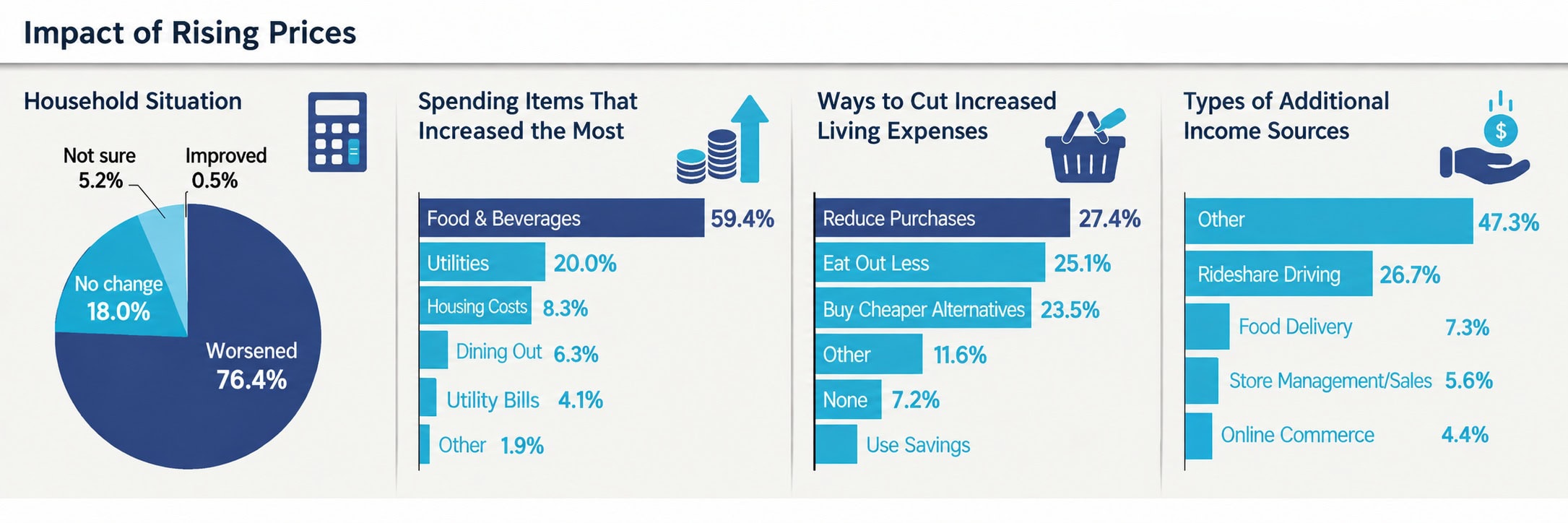
In response to elevated living costs, Korean Americans are altering consumer spending behaviors. To manage higher expenses, 27.4 percent of respondents reported cutting back on overall purchase volumes, 25.1 percent reduced dining out and leisure expenditures, and 23.5 percent shifted to lower-cost alternative products. Combined, these defensive spending adjustments account for 76.0 percent of total responses.
Rather than relying on reserve funds to absorb price increases, consumers are reducing consumption directly. The proportion of households using emergency savings to cover living expenses declined from 8.6 percent in 2023 to 5.2 percent this year, reflecting a structural pivot toward spending reduction over liquidity depletion.
Supplemental Work and Negative Business Outlooks Reflect Broader Uncertainty
To bridge budgetary gaps, a growing share of Korean Americans is taking on secondary employment. The proportion of respondents engaging in side gigs alongside primary jobs reached 16.4 percent this year, up 2.7 percentage points from 13.7 percent in 2023. While the majority still rely on single income streams, roughly one in six workers now depends on multiple income sources.
Rideshare services, such as Uber and Lyft, accounted for the largest share of secondary work at 26.7 percent, expanding from 22.0 percent in 2023. Food delivery represented 7.3 percent of side gigs, store management and sales comprised 5.6 percent, and e-commerce activities made up 4.4 percent.
Ongoing economic friction is also generating persistent anxiety regarding future financial stability. When asked to identify their primary financial concern, 25.5 percent of respondents selected inflation, followed by housing costs at 14.8 percent, monthly debt obligations at 9.5 percent, and retirement savings at 8.8 percent.
Small business owners expressed a similarly cautious economic outlook. The proportion of business operators expecting local commercial conditions to deteriorate over the next year reached 33.1 percent, outnumbering the 18.6 percent who anticipated improvement by nearly two to one. Compared to 2023, negative expectations grew from 31.6 percent, while positive sentiment dropped from 21.0 percent. The shift underscores eroding confidence in a swift economic recovery as cost pressures weigh on both consumer spending and business operations.