The La Opinion Centennial Minority Media milestone marks a century of dedication to serving immigrant communities in Los Angeles. Minority-language media does far more than deliver news; it acts as a vital bridge between differing cultures, languages, and values while reflecting societal shifts through the eyes of immigrant populations.
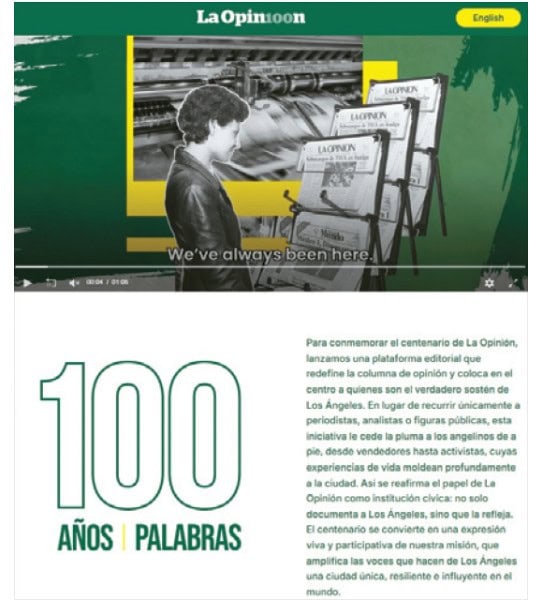
Founded on Mexican Independence Day in 1926, La Opinión—Los Angeles’s flagship Spanish-language daily—has officially reached its 100th anniversary. Among more than ten Spanish-language outlets operating in Los Angeles at the time, La Opinión is the only one that has survived to this day. Throughout a century of turmoil, including the Great Depression, mass deportations of Mexican Americans, and strict anti-immigration measures driven by surges in Central American migration, the publication has recorded the history of the Latino community in its native tongue.
A Lifeline for Immigrants and Civic Rights
For Latino immigrants facing language barriers, La Opinión served as an essential guidebook for daily life, providing crucial information on local news, job openings, housing rentals, and vehicle purchases. Beyond daily survival, it prioritized immigrant rights and civic empowerment, leading the charge against California Proposition 187, which sought to deny public services to undocumented residents. Recognizing these efforts, the National Association of Hispanic Journalists (NAHJ) described La Opinión as “the voice of those living in fear.”
In recent years, the decline of local journalism has given rise to “news deserts,” leaving many communities with limited access to reliable local news. When local newsrooms close or reduce reporting staff, residents lose their primary channel for local issues. This impact is especially severe for minority communities that are frequently overlooked by mainstream media.
Navigating Modern Challenges and the Future of Minority Media
This historical journey resonates deeply with the role of Korean-American media. Korean outlets have translated U.S. policies and systems into accessible language for Korean readers, serving as a vital bridge between Korea and American society. For first-generation immigrants, these outlets helped navigate unfamiliar institutions, while for subsequent generations, they preserved community history and identity.
Today, La Opinión faces severe survival challenges common across the journalism industry. Its editorial and production staff, which once numbered in the hundreds, has shrunk to around 50 employees—a stark illustration of the crisis confronting minority press. In response, La Opinión is adapting by reducing its print edition format while expanding digital and social media outreach to connect with broader audiences.
As generations shift and media consumption habits evolve, the core mission of minority-language media remains unchanged. The enduring history of La Opinión offers a timeless message: while the format of news may evolve, media must continue to serve as the voice of its community.