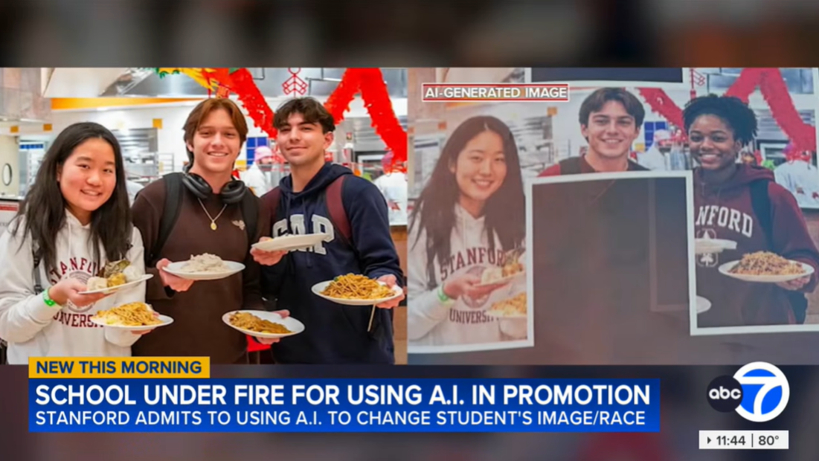
Stanford AI controversy erupted after the prestigious university admitted to using artificial intelligence to alter student photos in its promotional materials without disclosure, violating its own internal policies.
The issue began with a photo of three students taken at a campus dining hall. According to the students involved, the university’s marketing team used AI to modify their appearances and racial identities.
Most notably, a Hispanic student in the original photo was replaced with an AI-generated Black woman, sparking widespread criticism among the student body.
Students Outraged Over Altered Identities and Forced Diversity
Stanford freshman Kavinder Patel pointed out the irony of the situation, stating that the university already prides itself on a diverse student body representing over 60 countries, meaning there was no need to fabricate diversity digitally.
Another student, Jacob Peysner, noted how quickly the altered image spread and questioned the decision-making process behind it. Billy Ramirez, whose face was entirely replaced in the banner, expressed frustration that the university took it upon itself to dictate how students are represented.
“I was mad that Stanford decided for us how we should be portrayed,” Ramirez said. Sophomore Biriana Estrada also questioned the logic, adding that it felt bizarre to use AI to change existing photos of real people.
Stanford Admits Policy Violation and Removes Materials
Facing mounting backlash, Stanford University officially acknowledged that using AI to modify the student images and failing to disclose it violated institutional guidelines.
“Our review determined that AI was used to modify the image in question, which was a violation of university policy,” a university spokesperson stated, confirming that all problematic banners have been removed.
Stanford’s official AI guidelines explicitly prohibit the use of generative AI to create or alter images depicting university community members, events, research, facilities, or achievements. In response to the incident, the administration pledged to ramp up staff training and improve the review process for promotional media.
Students continue to urge the university to prioritize transparency and reflect authentic diversity rather than relying on artificial adjustments.