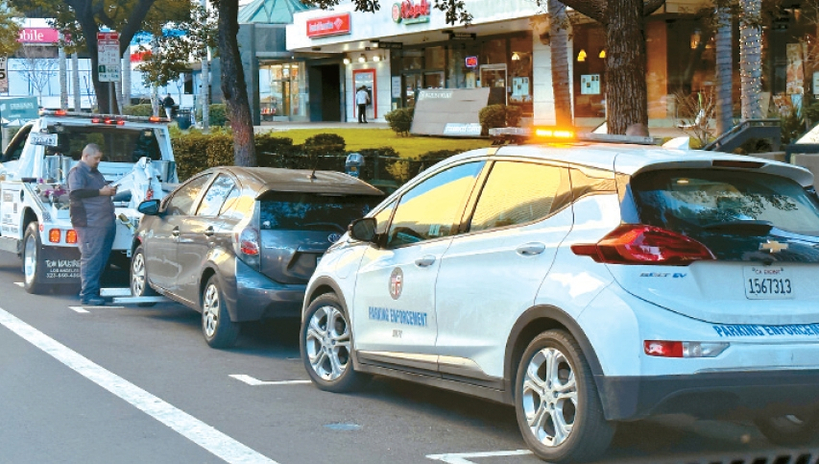
A California towed vehicle auction surplus rule remains in place, meaning money left over from towed vehicle auctions that goes to the Department of Motor Vehicles (DMV) is permanently lost to car owners if not claimed within three years.
While general unclaimed property can be claimed by its original owner at any time even after being transferred to the state, this principle does not apply to funds left over from selling towed vehicles. If the money is not claimed within three years of being transferred to the DMV, the owner’s rights are forfeited.
A bill that sought to eliminate this exception passed the state legislature but was ultimately blocked by Governor Gavin Newsom’s veto.
Governor Newsom recently vetoed Senate Bill (SB) 1029, which aimed to manage towed vehicle auction surpluses like general unclaimed property. As a result, the current system remains in place, where the DMV continues to hold the funds if car owners fail to claim them within three years.
The issue is that many vehicle owners are entirely unaware that they are owed money. Between 2016 and 2024, unclaimed surplus funds generated from approximately 5,300 vehicles and transferred to the DMV exceeded $8 million. Some owners did not even know their vehicles had been auctioned, let alone that money remained after deducting towing and storage fees.
State Senator Kelly Seyarto (Republican-32nd District) authored SB 1029 to close this loophole. The final bill mandated that if vehicle owners do not claim surpluses held by the DMV within three years, the funds would be transferred to the California State Controller’s Office to be managed like general unclaimed property. Under this system, owners could still prove ownership and recover their money even after three years have passed.
Currently, California’s general unclaimed property has no claiming deadline. Unclaimed assets held by the state, such as bank accounts or insurance payouts, can be recovered by owners or heirs upon proving their rights, even years later.
However, towed vehicle auction surpluses face a separate three-year barrier. Ultimately, despite being personal property, owners face restricted opportunities to recover their rights simply because the funds entered the DMV.
Newsom defended his veto by stating that while he agrees with the bill’s intent, the procedures between the DMV and the Controller’s Office were unclear and would only increase administrative costs. He also pointed out that the DMV has already established an unclaimed surplus lookup system.
However, critics pointed out that the lookup system and the expiration of a car owner’s claim rights after three years are two entirely separate issues. If an owner does not know that a surplus was generated, they have no reason to search for it, ultimately losing the chance to reclaim the money even if they discover its existence later.
Comparisons with other unclaimed property also raise fairness concerns. While general unclaimed property can be recovered whenever an owner appears, towed vehicle auction surpluses remain restricted by a three-year limit. Critics question whether it is justifiable to apply a different standard solely for administrative costs.
Vehicle owners already bear towing and storage fees when their vehicles are impounded. If vehicles are subsequently sold and funds remain after covering all these expenses, the remaining money belongs to the original owner. Critics argue that barring owners from recovering these funds simply because a certain period has elapsed severely restricts personal property rights.
With the defeat of SB 1029, regulatory reform has returned to square one.
Although the governor agreed that the money should be returned to car owners, mechanisms to ensure they can fully recover those funds were once again left unestablished.