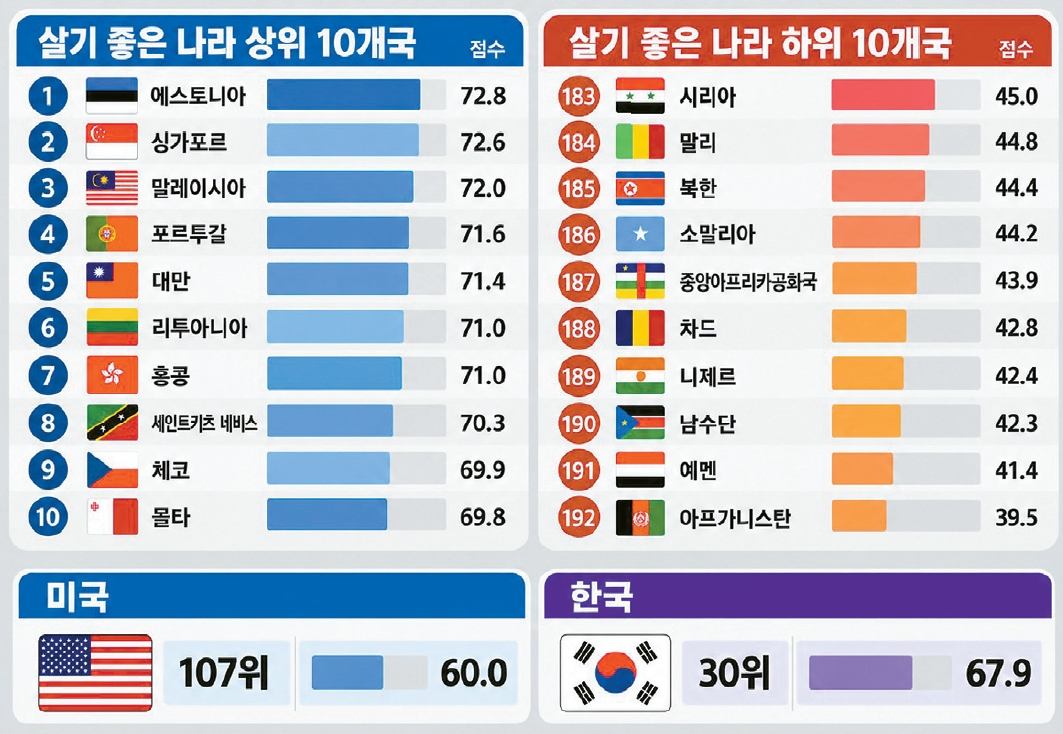
The best countries to live in ranking places the economic superpower United States at a dismal 107th place among 192 surveyed nations.
According to the recently released ‘2026 Global Relocation Index’ by relocation information firm Rumavi, the U.S. scored 60.0 points out of a possible 100, landing in 107th place.
The U.S. ranked lower than Canada (66.8 points), the United Kingdom (65.8 points), Brazil (62.7 points), and even India (60.6 points).
This evaluation was calculated by combining 24 indicators across four categories: finance and taxes, living environment and health, safety and stability, and settlement and opportunities.
While the U.S. was evaluated as having high competitiveness in education, business opportunities, and startup environments, expensive living costs along with relatively low scores in health, living environment, and safety and stability dragged down its overall ranking.
Despite this low ranking, the U.S. remains one of the world’s top immigration destinations, with new immigrants flowing into the country from abroad exceeding 1.3 million in 2025.
Estonia claimed the number one spot as the best country to live in, receiving 72.8 points. Estonia’s achievement, with a population of about 1.3 million, was largely driven by high scores in safety and settlement environments. Rule of law, startup environments, and low youth unemployment were also cited as strengths.
Singapore ranked second with 72.6 points, while Malaysia took third place with 72.0 points. Portugal recorded 71.6 points for fourth place, and Taiwan came in fifth with 71.4 points. Lithuania and Hong Kong tied at 71.0 points to enter the upper ranks, followed by St. Kitts and Nevis in 8th place (70.3 points), the Czech Republic in 9th (69.9 points), and Malta in 10th (69.8 points).
South Korea ranked 30th with a total score of 67.9 points, while North Korea hit near rock bottom at 185th place with a mere 44.4 points. Japan scored 69.1 points for 17th place, and China recorded 58.6 points for 125th place.
European nations accounted for half of the top 20 countries. In particular, not only traditional Western European wealthy nations but also Southern and Eastern European countries with relatively low living cost burdens, such as Portugal, the Czech Republic, and Malta, received favorable evaluations. Baltic states like Lithuania and Latvia were also included in the top 20.
The lowest ranks were concentrated with countries suffering from political instability and vulnerable social and economic systems. African nations accounted for 13 of the bottom 20 countries. Afghanistan recorded the lowest score among surveyed countries with 39.5 points, followed closely by Yemen with 41.4 points.
Democratic Republic of Congo (45.1 points), Eritrea (45.8 points), Burkina Faso (46.6 points), Haiti (47.3 points), and Papua New Guinea (47.5 points) had their rankings pulled down primarily due to political instability, fragile government institutions, low safety and health standards, and a lack of property rights protection.
The results of this survey show that simply having a large economic scale or high national income does not necessarily mean a nation is evaluated as a great place to live. Factors such as taxes, living expenses, safety, medical environments, and the actual conditions for foreigners to settle, work, and live all play a comprehensive role.