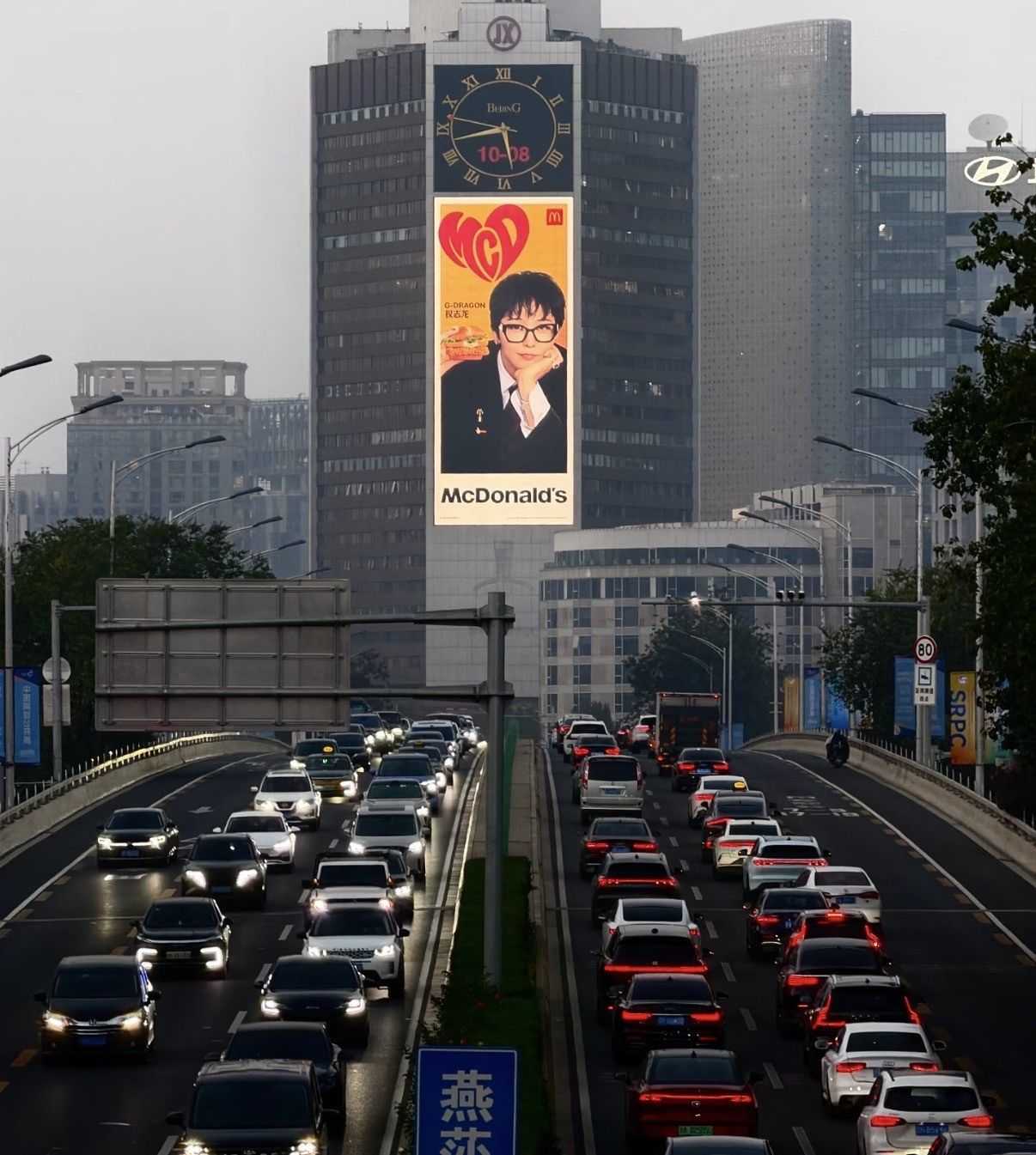
A massive billboard featuring G-DRAGON (Kwon Ji-yong) recently lit up the eastern Third Ring Road in Beijing’s Chaoyang District, marking a notable shift in China’s advertising landscape. From Beijing’s 798 Art Zone to McDonald’s locations across Shenzhen, the singer’s image and iconic daisy symbol have surfaced in prominent urban commercial spaces. This wave of visibility occurs as the informal ‘Hallyu ban’ (limits on Korean pop culture), which has restricted Korean entertainment in China since the 2000 THAAD diplomatic tensions, approaches its tenth year. Observers are closely watching whether these commercial displays might open a new channel for resumed Korea-China cultural exchanges.
The catalyst behind this campaign is McDonald’s joint Asian marketing initiative. On the 8th, McDonald’s China rolled out eight collaborative new products featuring G-Dragon across 8,000 mainland locations. The menu includes items tailored with Korean elements, such as a chicken burger utilizing a Korean-style gochujang butter sauce. According to Chinese advertising media outlet Advertising Gate, over 700 stores nationwide were decorated with G-Dragon themes, while 16 flagship locations in cities like Beijing and Shenzhen featured special interactive zones. A phone booth allowing customers to experience a virtual call with G-Dragon was even installed at the Changhongqiao branch in Beijing.
The significance of this campaign extends beyond a Korean star simply modeling for a global brand. It highlights a major global corporation directly leveraging a Korean artist’s name and image for large-scale promotional efforts in the Chinese market. Items created in collaboration with G-Dragon’s fashion label, PEACEMINUSONE, are also being sold to Chinese consumers. Chinese social media platform Xiaohongshu is already flooded with authentication shots of fans visiting McDonald’s branches to pose alongside G-Dragon posters. Fans have expressed enthusiastic support across various hashtags, demonstrating that Korean pop culture retains strong commercial competitiveness in China.
G-Dragon is not an isolated case. IVE member Jang Won-young appeared as a body care model for Unilever’s lifestyle brand LUX in August. The official LUX Weibo account in China promoted large-scale outdoor advertisements and consumer engagement events featuring her face, while themed stores decorated with her imagery operated in Chengdu and other cities.
BTS member Jin similarly appeared in major Chinese commercial spaces through global luxury brand Gucci’s advertisements, and actor Lee Min-ho was selected as a model for chicken franchise BBQ’s exclusive Chinese market brand earlier this January. Global enterprises and Korean companies alike are leaning on Hallyu stars to target Chinese consumers.
While the Hallyu ban is not an officially legislated decree or a formally announced restriction by the Chinese government, it has operated as a series of customary limits on broadcasting schedules, performance permits, and content distribution. High barriers still remain for large-scale live performances by Korean singers in mainland China and the official distribution of Korean broadcast content.
Nevertheless, the importance of these recent developments should not be underestimated. Korean entertainers in China have long served as cultural symbols intertwined with diplomatic relations. The fact that global consumer brands are now leveraging Korean stars’ recognition and fandom to connect with Chinese shoppers indicates that cultural demand and commercial exchange remain very much alive. It also suggests that cultural exchange may expand through consumption and marketing before official stage performances or broadcast programs fully return.
Whether this trend will broaden into comprehensive Korea-China cultural and artistic cooperation remains uncertain, as advertising campaigns and the official distribution of performances and broadcast content are distinct issues. However, the starting point of cultural exchange does not strictly need to be a stage or a broadcast station. Cooperation mediated through fashion, design, food and beverage, and digital content represents a field where businesses and creators from both nations can relatively easily expand common ground. The McDonald’s campaign pairing G-Dragon’s music and fashion exemplifies this potential.
The practical easing of restrictions must ultimately be confirmed through resumed Chinese concerts for Korean acts, official distribution of films and dramas, and expanded joint projects between production companies from both countries. Institutional backing for cultural arts exchanges is necessary to ensure that shifts in the advertising market can translate into broader cooperation. Restoring cultural exchanges disrupted by diplomatic conflict requires not only government-level consultations but also voluntary private-sector collaboration. The faces of Korean stars reappearing on Chinese streets after a decade may not constitute a formal declaration of the ban’s end, but they certainly signal a renewed knock on the previously closed doors of Korea-China cultural exchange.