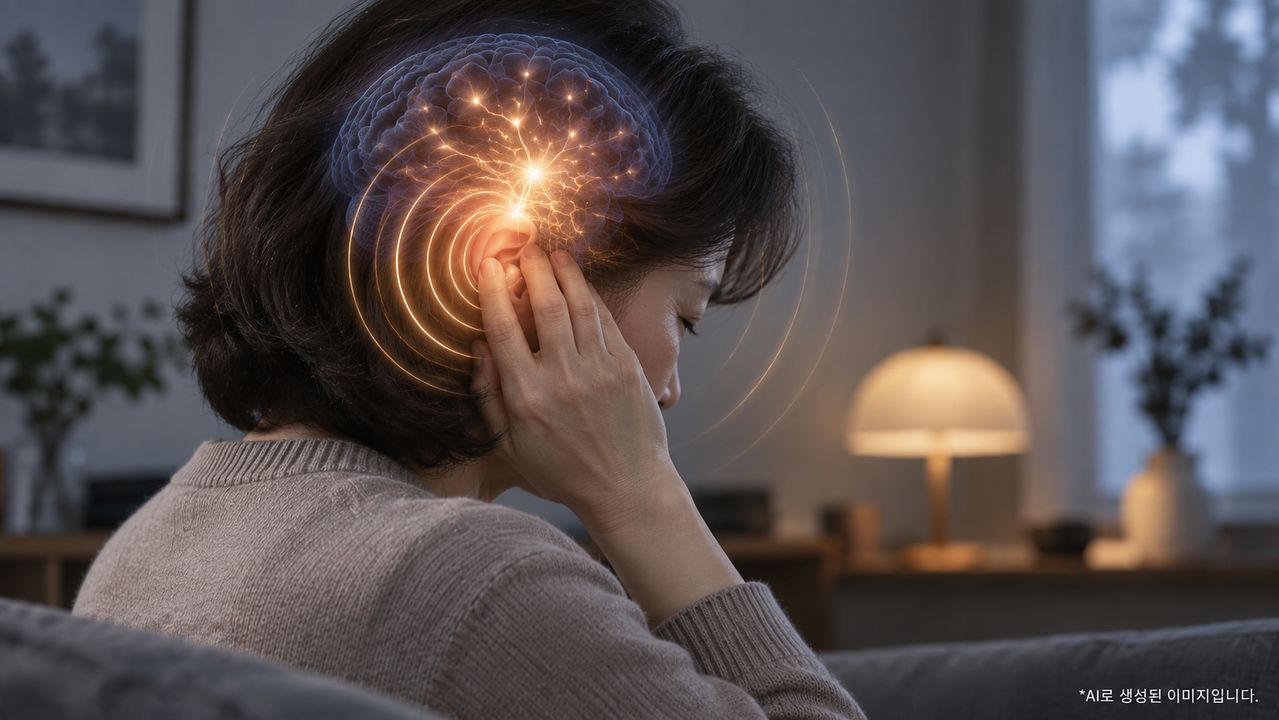
One day, a very faint tinnitus ringing sound suddenly begins to echo in your ears. Even when the surroundings become quiet or you cover your ears tightly with your hands, the sound does not disappear. No matter how much you search for where the sound is coming from, it is useless because there is no such sound outside in the first place.
This phenomenon is known as tinnitus, and it is surprisingly common. According to the National Health and Nutrition Examination Survey conducted from 2009 to 2011, 19.7% of South Koreans aged 12 and older experienced tinnitus. Global studies also estimate that about 14.4% of adults suffer from it.
However, there is one strange thing about tinnitus. Even though the sound is heard inside the ear, the actual place generating the sound might not be the ear at all.
Inside our cochlea, cells responsible for different frequencies are lined up from high to low pitches. When some of these cells are damaged due to aging or long-term exposure to loud noise, the signals for those frequencies do not properly reach the brain.
The brain then increases its sensitivity to compensate for the missing signals. This is similar to turning the volume knob all the way up when a radio signal is weak, which also amplifies a fuzzy static noise. During this process, nonexistent sounds like buzzing or ringing can be generated.
There is currently no proven medication guaranteed to eliminate tinnitus. Instead, a domestic evidence-based tinnitus clinical guideline introduced in July conditionally recommended one specific treatment for patients accompanied by hearing loss.
Ironically, this recommended tinnitus treatment is also the one that Korean patients are most reluctant to accept. However, rather than simply making sounds louder, this treatment works by re-delivering the specific frequency sounds lost due to hearing loss back to the brain.
The problem does not stop there. Even with the same degree of tinnitus, some people barely pay attention to it, while others suffer from sleep deprivation and ruined daily lives. Furthermore, having a louder sound does not necessarily mean the suffering is greater. Recent researchers explain this difference by connecting how the brain perceives the sound as a dangerous signal.
So, what is the treatment that one-third of Korean patients rejected? What brain functions must be targeted when tinnitus becomes debilitating? And how effective are zinc, vitamins, ginkgo biloba extract, and modern brain stimulation therapies?