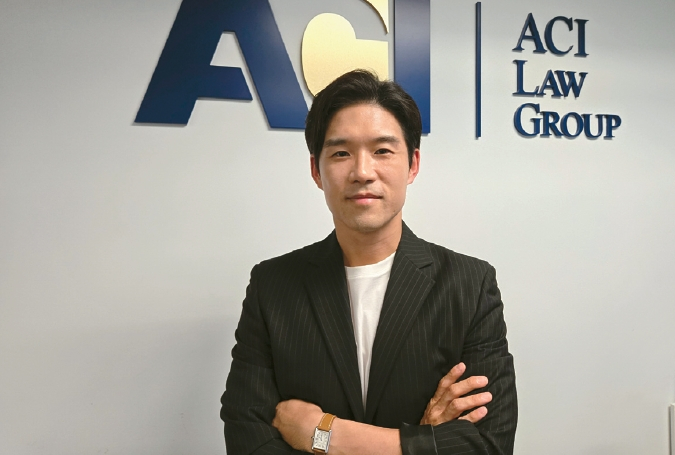
Attorney Young-il Lee, who handles patent and trademark operations at the Law Group of Jin-Jung Kim, was an engineer at a major South Korean corporate research institute just nine years ago. Today, he works closely with South Korean companies looking to enter the U.S. market, ranging from Amazon sellers to K-beauty brands. This transition from engineer to intellectual property expert began with an unexpected offer.
It was in 2017 when he received an offer to join the Law Group of Jin-Jung Kim. Although he had long-standing acquaintances at the firm, he turned it down, recalling that the field was entirely different and the decision to immigrate itself was not easy.
A year later, the same offer came again. This time, his mindset had changed. He had grown weary of life at the research institute and felt a growing desire to take on a challenge in a new field. After months of deliberation, he boarded a flight to Los Angeles.
He was not an intellectual property expert from the start. He learned the inner workings of the IP industry by taking on various responsibilities, ranging from customer acquisition and case management to marketing. Eventually, trademark application work caught his eye. Although it was an important pillar of intellectual property work, it was being outsourced to external experts at the time. He felt a desire to develop it into his own specialized field.
He also had the advantage of an engineering background. He prepared for and passed the U.S. Patent Agent examination.
Changes came rapidly after obtaining his credentials. Within a year, the intellectual property workload he handled grew to the point where hiring a dedicated staff member became necessary.
“Even though I didn’t aggressively market myself, clients kept coming through referrals.”
Initially, trademark filings were the core focus. However, existing clients continued to request assistance with patent filings as well. Complex matters involving trademarks, labor law, and commercial law are handled in collaboration with lawyers within the firm.
Recently, two distinct changes have become most prominent on his desk. One is the increase in ‘sellers’ operating on Amazon. After one of his early clients started selling on Amazon and subsequently launched a sales training business, he naturally connected with numerous sellers. As brand protection becomes increasingly critical in online sales, inquiries for trademark filings have steadily risen.
The second change is artificial intelligence (AI). Recently, patent consultations surrounding AI technology and software have seen a noticeable surge.
“We receive a tremendous amount of patent inquiries related to AI technology and software. In the past, people viewed patents themselves as difficult, but these days, many come in after using AI tools to flesh out their ideas to a certain extent.”
He explained that AI is lowering not just the threshold of invention, but also the psychological barrier to entry for patents.
The flow of South Korean companies entering the U.S. market has also shifted markedly in recent years. While inquiries for trademark filings from South Korean food brands were overwhelming until a few years ago, K-beauty is now the most prominent sector. There have even been cases where ordinary cosmetics and perfume brands started small, grew rapidly, and gained attention through large-scale pop-ups in Seongsu-dong, Seoul. He shared that “filing for a trademark before launching a brand is now practically common sense.”
Up until nine years ago, his desk was piled with engineering drawings and research materials. Today, Amazon seller brands, K-beauty trademarks, and AI technology patents have taken their place.
Although the field has completely changed, there is a common thread: understanding technology, analyzing problems, and finding solutions. Attorney Lee remarked, “Not a single day has been easy since choosing this path, but looking back now, it has been a time of turning that choice into the right answer.”
On his desk as he embarks on a new path from engineer to intellectual property expert, new ideas from South Korean companies challenging the U.S. market continue to pile up every day.