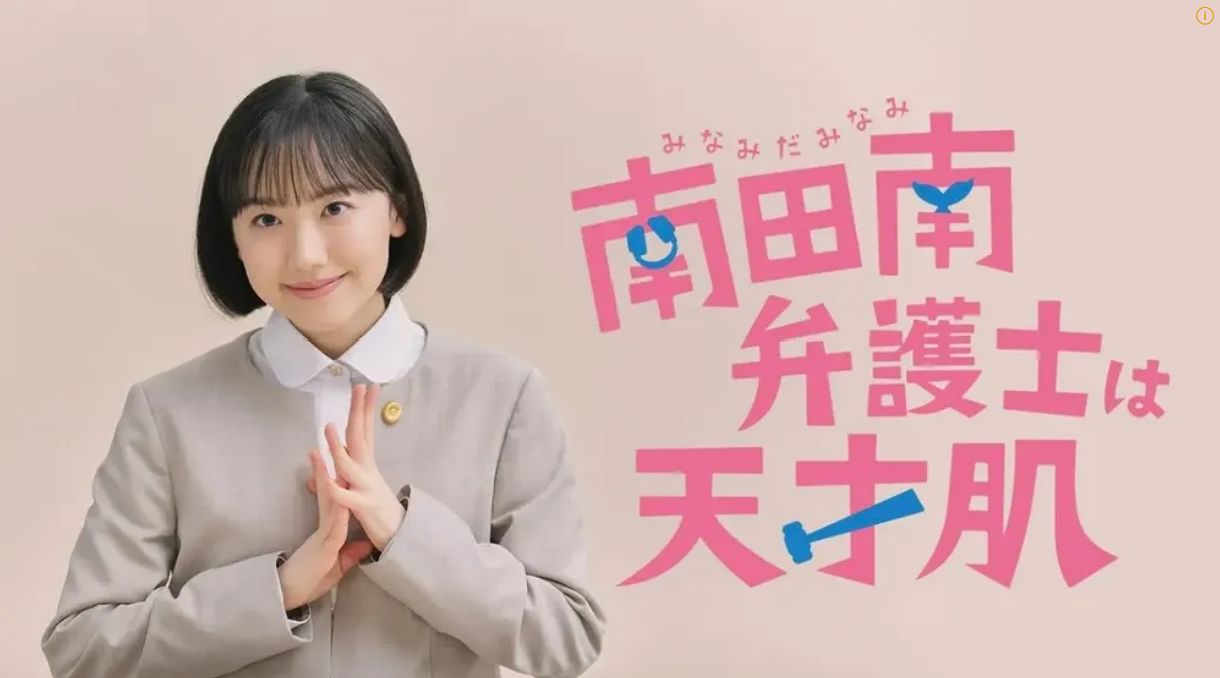
The Japanese remake of the hit ENA drama ‘Extraordinary Attorney Woo’, titled ‘Extraordinary Attorney Woo Minami’, premiered its first episode on the 19th via Japan’s OTT service TVer and Netflix. The Japanese title is ‘Minami Bengoshi wa Tensai-hada’, following the original Japanese translation style, while Korean Netflix uses the title ‘Extraordinary Attorney Woo Minami’.
‘Extraordinary Attorney Woo Minami’ reveals its connection to the original through its protagonist’s name, ‘Minidada Minami’. The name Minami reads the same forwards and backwards, and its Kanji writing (南田南) maintains a symmetrical palindrome structure.
Furthermore, Woo Young-woo’s friend ‘Spring Sunshine’ Choi Su-yeon (Ha Yoon-kyung) has been given the Japanese name Asahi Koharu, which literally translates to ‘Morning Sunshine of Spring’. Because this serves as her actual name in the remake, viewers are curious how the deeply moving scene where Woo says, ‘You are spring sunshine,’ will be handled.
Ashida Mana, who plays the lead role of Minami in the premiere, has received passing marks. She bears a strong visual resemblance to Park Eun-bin and boasts solid acting skills as a former child star. Minor adjustments, such as changing Woo’s favorite gimbap to onigiri and her fear of revolving doors to escalators, went over smoothly.
However, the pivotal first case scene where Minami showcases her extraordinary talent—a moment remembered fondly by many fans of the original—differs significantly between the Korean and Japanese versions. Let us examine this more closely.
The Legendary Scene That Started It All in the Original
In the Korean version, senior attorney Jung Myung-seok (Kang Ki-young) assigns Woo Young-woo a case where a grandmother is charged with attempted murder for striking her husband with an iron, predicting a suspended sentence. Here, Woo points out a loophole that Jung missed and submits an opinion arguing for innocence. Jung is captivated by her ability, hesitates for a moment after starting to say, ‘This is difficult even for a normal attorney,’ and then apologizes as Woo leaves the room: ‘I’m sorry, calling you a normal attorney was rude.’ To this, Woo calmly replies, ‘It’s alright. I am not a normal attorney.’
Many viewers, including myself, fell in love with the drama precisely because of this scene. Initially displeased that the firm hired an attorney with a disability, Jung assigns a very simple case. Though he shows mild annoyance when Woo raises an objection, he quickly recognizes the validity of her point and acknowledges his mistaken judgment.
At that moment, Jung belatedly realizes his words could imply that disabled individuals are inferior to ‘normal’ attorneys. Yet Woo responds, ‘I am not a normal attorney,’ displaying her confidence that she is a much better and more special attorney than ordinary lawyers.
A More Dry and Understated Tone in the Japanese Version
This scene effectively illustrates not only Woo Young-woo’s character but also the nature of Jung Myung-seok. Finding a senior who genuinely listens to a rookie’s input and immediately corrects their bias is rare. Thus, this scene foreshadowed that he would become her steadfast ally, and Kang Ki-young’s portrayal of Jung became the epitome of a ‘good senior.’
The Japanese remake features a nearly identical scene in the first episode, but the emotional tone is markedly different. The senior attorney is played by 50-year-old actor Yamaguchi Makiya, who is old enough to be Minami’s father. This senior does not react sensitively to Minami pushing back against his guidelines, nor is he particularly surprised by his own error. He dryly and calmly states, ‘This is difficult even for a normal attorney,’ offers a brief apology, and Minami responds, ‘I am not a normal attorney.’
Because the realization, regret, and apologetic warmth felt in the Korean version’s Jung are entirely absent, Minami’s retort lacks the confident spirit of brushing off societal prejudices. While some criticisms label the remake as a mere ‘copy’ due to identical hairstyles and similar dialogue, it is fascinating how the same lines can yield completely different interpretations. Naturally, Japanese viewers might react entirely differently.
Adapting content across borders is no easy feat. Currently, the Korean adaptation ‘Doctor X: Age of White Mafia’ is enjoying high popularity, serving as a remake of TV Asahi’s ‘Doctor X: Surgeon Michiko Daimon’, which ran seven seasons starting in 2012.
Differing Nuances in the Korean Remake of ‘Doctor X’
The Korean adaptation of ‘Doctor X’ stars Kim Ji-won as Gye Su-jeong, a surgeon with the golden touch who ‘never fails in surgery,’ boldly tearing down the privilege, hypocrisy, and hunger for power in Korea’s medical field. It garners positive responses through refreshing and comedic relief. However, subtle differences from the original protagonist are evident.
Michiko Daimon (Ryoko Yonekura) in the original ‘Doctor X’ can be summarized as someone with exceptional surgical skills and a fierce appetite, but lacking interest in anything else. She shows no particular human sympathy for patients, nor does she express outrage over hospital corruption. Because surgery is her sole focus and talent, she remains woefully out of touch with the outside world.
In contrast, the Korean counterpart Gye Su-jeong frequently delivers lecturing monologues fiercely criticizing factionalism and authoritarianism among Korean university hospital doctors. In short, she embodies a ‘socially conscious woman.’ While not inherently bad, the Korean production team has crafted a protagonist entirely distinct from the original Michiko Daimon. The inclusion of the Gwangju Uprising (May 18) as a plot point in episodes 5 and 6 suggests a strong desire by the Korean production team to infuse the Japanese original with deeper social significance.
When adapting drama source material into new productions, what matters most? Is it faithfully preserving the original characters, or modifying them to suit a new cultural backdrop? Although both ‘Doctor X’ and ‘Extraordinary Attorney Woo’ are still in their early runs, it remains intriguing to see what final scorecard the heavily localized Korean ‘Doctor X’ and the faithfully mirrored Japanese ‘Minami’ will achieve in their respective countries.