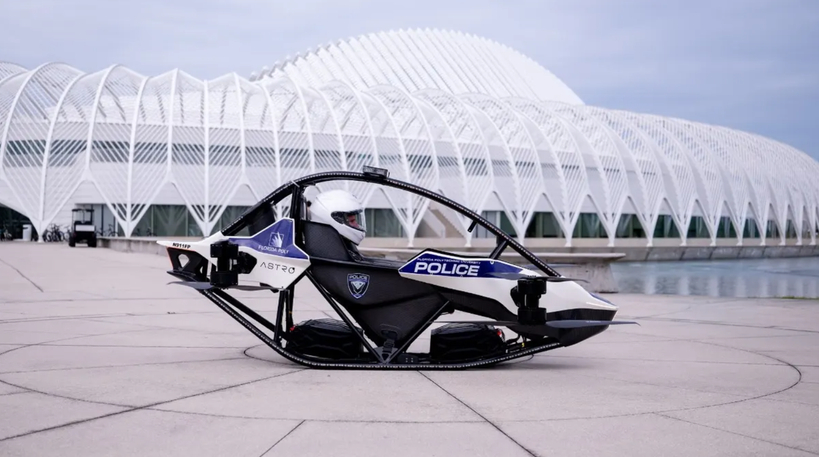
Florida Polytechnic University police have introduced an electric flying patrol car capable of reaching speeds up to 63 mph, marking the first time a US law enforcement agency has adopted this type of manned electric aircraft. Priced at $148,000, the vehicle requires additional approval from the Federal Aviation Administration (FAA) before it can be deployed for actual police patrols.
The aircraft adopted by the university police is the ‘Jetson ONE’ manufactured by Jetson, which the university has named ‘Astro.’ It utilizes an electric vertical takeoff and landing (eVTOL) system, allowing it to take off and land without a runway by using eight electric motors and propellers.
According to the manufacturer, the maximum speed is 63 mph, and the flight time on a full charge is approximately 20 minutes. Using a 240-volt power source, charging takes about 90 minutes, and the batteries can also be swapped for continuous operation. However, the maximum payload capacity, including the pilot, equipment, and emergency supplies, is limited to 210 pounds.
Police expect the vehicle to be useful for checking disaster-stricken areas from the air when roads are blocked by hurricanes and floods, or for delivering emergency supplies to hard-to-reach locations. However, because it is a single-seater, it cannot be used for rescue missions transporting injured persons.
The biggest obstacle is FAA regulations. The Jetson ONE was originally developed based on ‘Part 103,’ a regulation for recreational ultralight aircraft, which does not permit flights for operational purposes such as police patrols. The university is pursuing separate approvals required for police missions, and the official start date for patrols has not yet been determined.
Astro will be utilized not only for police equipment but also for the university’s aerospace engineering education and research. Students and faculty will analyze real flight data to study the performance, safety, and future public safety applications of electric aircraft.