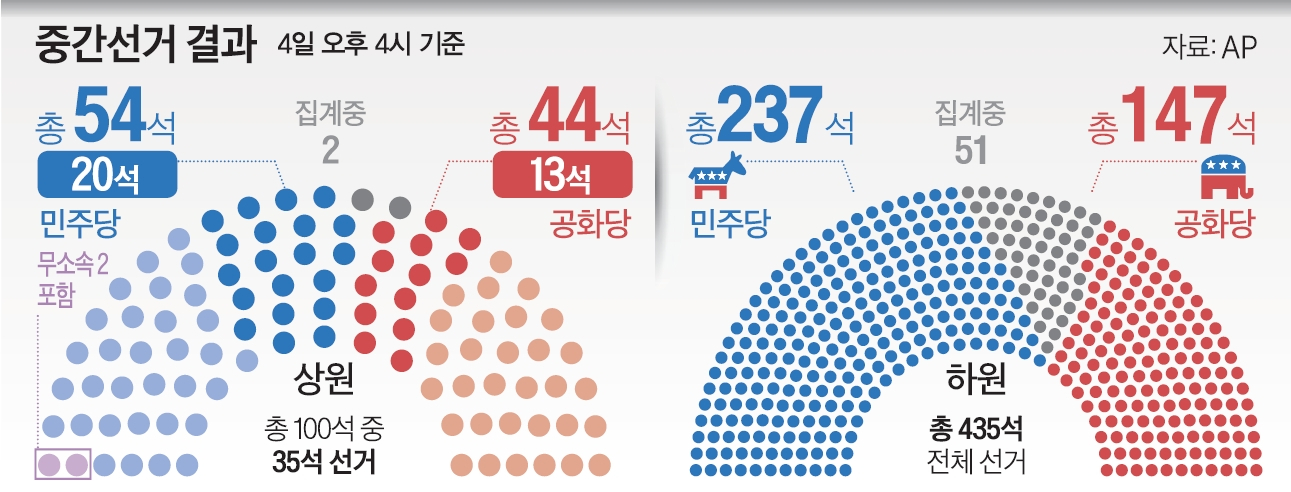
With the Republican Party losing its majority status in both the federal House and Senate, January 3 of next year has effectively become a policy deadline for President Trump administration. Until then, the majority is expected to rush personnel confirmations and accelerate policy implementation. This is because significant constraints are inevitable under a divided government where Democrats hold legislative power.
President Trump is expected to first expedite the confirmation of conservative federal judge candidates.
Because lifetime federal judges can exert influence long after a change in administration, Republicans are highly likely to rush their confirmations. Currently, 9 candidates are awaiting review by the Senate Judiciary Committee and 13 are awaiting a floor vote. With Democrats taking control of the Senate in January, the appointment of conservative judges could face roadblocks, prompting Republicans to speed up confirmation procedures before the new Congress takes office.
The possibility of a large-scale cabinet reorganization is currently low. President Trump dismissed the possibility of a cabinet reshuffle the day after the election. In particular, regarding Secretary of Defense Pete Hegseth, whom Democrats have discussed as a target for impeachment, he stated that he is "doing a very good job" and expressed his intention to retain him.
Immigration policies may instead become more stringent.
Cheon Kwan-woo, an immigration law expert, forecasted that "even if they lose both the House and Senate, the Trump administration can utilize executive orders and authorities under existing immigration laws to strengthen immigration crackdowns and visa screenings." He added that "future immigration policies may show a dual aspect of expanded legalization by the majority Democrats alongside intensified crackdowns by the Trump administration."
Reuters recently reported that White House Deputy Chief of Staff Stephen Miller and White House Office of Management and Budget Director Russell Vought, known as the architects of immigration policy, have been reviewing policies that can be implemented without congressional approval since April. The White House legal team is reportedly reviewing the scope of executive authority and preparing litigation response measures.
With the launch of a new Congress, the possibility is also being raised that President Trump may shift his focus toward diplomacy, where he can exercise relatively broad discretion. Although foreign policy is also affected by congressional budget and oversight powers, the basic direction is driven by the executive branch. In that respect, the prevailing outlook is that protectionist and high-tariff policy stances will be maintained.
The early termination of the Iran war could emerge as a major diplomatic card. Analyses suggest that the 9-month-long war drove up oil and inflation prices, leading to the Republican election defeat. President Trump may also accelerate peace negotiations to alleviate political burdens. In particular, he is likely to adopt a transactional approach with Middle Eastern nations to relieve war fatigue and highlight the achievements of his ‘America First’ agenda.
Starting next year, President Trump and Congress are expected to clash head-on over various bills. While acknowledging the election results, President Trump warned regarding bills pushed by Democrats, "If they send crazy things, I will exercise my veto." By signaling that the veto will be used as a bargaining chip, a fierce tug-of-war between the White House and Congress is anticipated over the next two years.