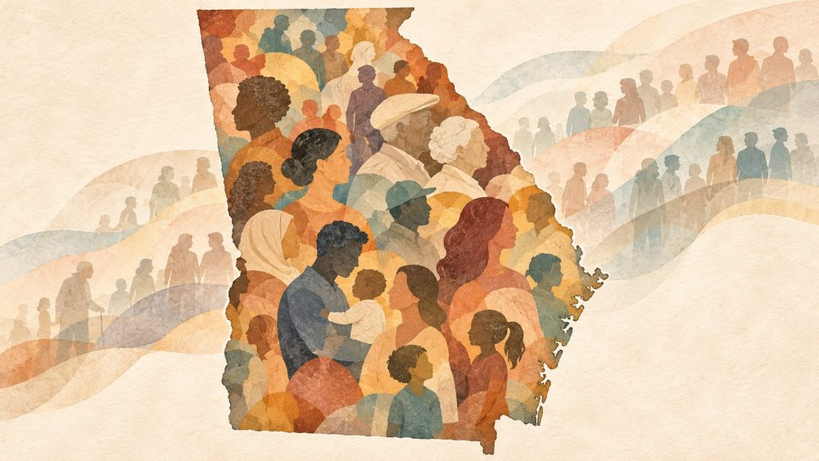
The demographic landscape of Georgia population growth is projected to undergo significant transformations over the coming decades. Alongside steady population expansion, the state is experiencing rapid aging, while an increase in Asian, Hispanic, and other minority populations is driving greater racial and ethnic diversity.
According to a recent long-term population projection report released by the Governor’s Office of Planning and Budget (OPB), current demographic trends in Georgia are expected to persist for decades to come. The report was prepared by the Carl Vinson Institute of Government at the University of Georgia (UGA) and outlines population projections through 2065. State agencies utilize this data to formulate long-term infrastructure and public service policies concerning transportation, schools, hospitals, and water resources.
The most striking shift highlighted in the report is racial diversity. Based on 2025 federal Census data, Georgia’s population stands at 11.3 million, with white residents comprising 48% of the total. Black residents account for 32%, and Hispanics make up 12%. Consequently, Georgia has become a ‘majority-minority’ state for the first time in its history, with non-white residents collectively making up the majority.
Recent population growth in Georgia has been predominantly driven by non-white residents. Between 2020 and 2025, Hispanics accounted for over 40% of population growth, while Black residents made up approximately 33%, and Asians represented about 20%. Conversely, the non-Hispanic white population declined by roughly 25,000 during the same period.
Asian residents emerged as the fastest-growing racial group in the state. This growth has been concentrated primarily in the northern metro Atlanta area, led by Gwinnett and Forsyth counties. Gwinnett stands out as a representative hub of racial diversification in Georgia, seeing its minority population increase by about 100,000 over the past five years while non-Hispanic white residents decreased by roughly 35,000. Forsyth County is transforming rapidly as well, with Asian population growth accounting for about 90% of its total population increase over the last five years. Such demographic shifts are projected to expand beyond metro Atlanta into other regions.
Alongside racial shifts, another major challenge facing Georgia is accelerated aging. Currently, about one in four Georgia residents is under the age of college/youth-level, but this ratio is projected to drop to less than one in five over the next 40 years. Conversely, the population of adults aged 65 and older is expanding significantly. While roughly one in six Georgia residents is currently a senior citizen, that proportion is expected to grow to about one in four by 2065.
These trends will substantially impact Georgia’s education and healthcare systems. A shrinking school-age population could spark serious discussions regarding school construction and educational funding distribution. Meanwhile, an expanding senior population will escalate the demand for healthcare facilities, physicians, medical cost management, and long-term care services. Because Georgia already grapples with physician shortages, healthcare workforce and facility expansion will become critical policy issues as aging progresses.
Although the overall rate of Georgia population growth is expected to slow slightly compared to the rapid pace of the past 40 years—during which the population nearly doubled—metro Atlanta’s population will continue to expand. Consequently, housing supply issues are taking center stage. Christine Alleyne, a senior planner at the Atlanta Regional Commission (ARC), pointed out that historical housing development in metro Atlanta has heavily favored single-family detached homes, worsening housing shortages and affordability challenges. Addressing future population growth will require supplying diverse housing types at various price points and actively developing vacant or underutilized land. Furthermore, expanding housing near transit hubs and employment centers can enhance residents’ economic mobility while curbing unmanaged urban sprawl.