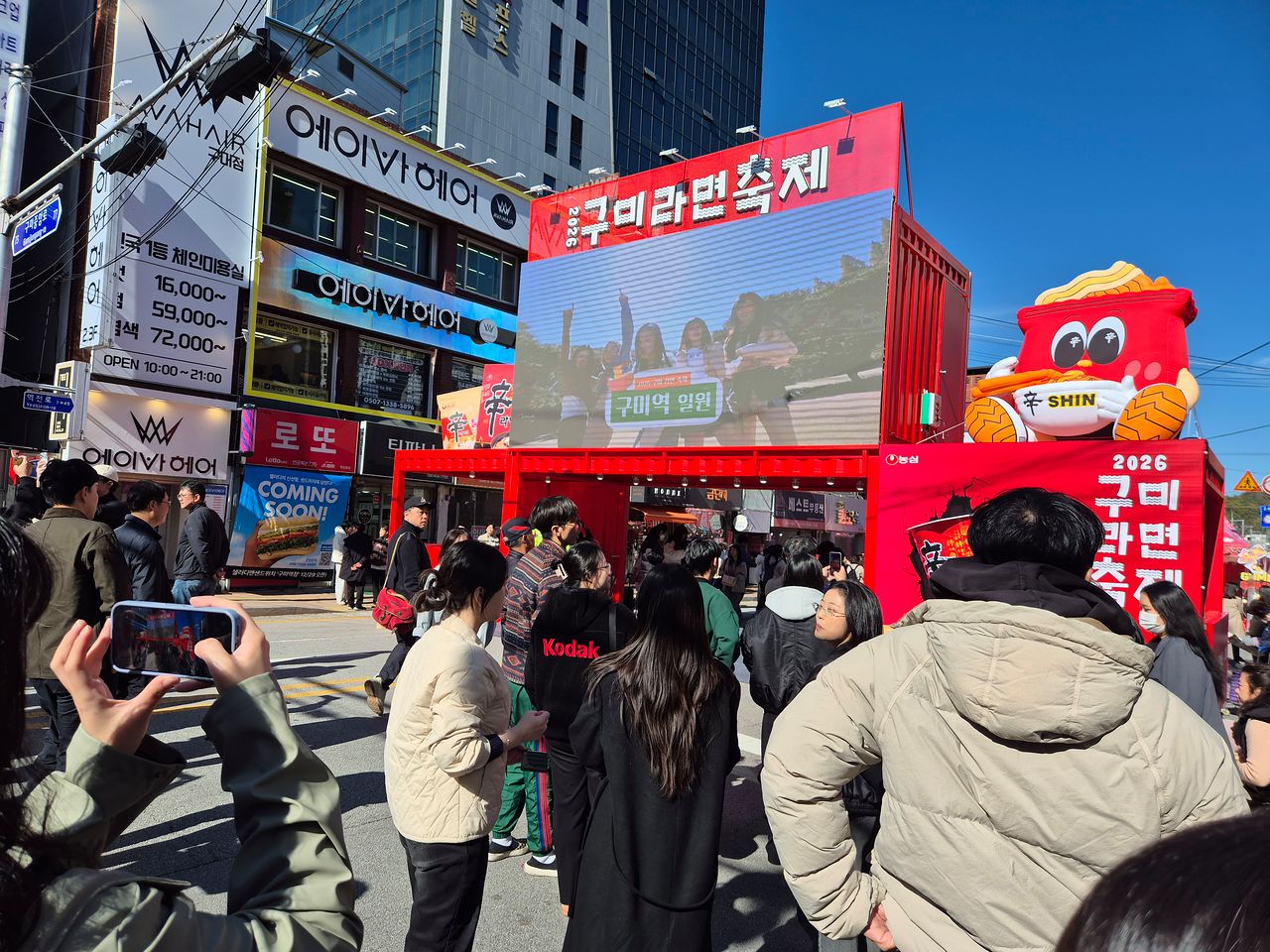
“Korean ramen is the best. The noodles are chewy with a fantastic texture, and the soup and sauces are very rich. It’s hard to eat just one,” said Nathan Risdon, 21, from the United States, after clean-sweeping a bowl of spicy soup ramen loaded with minced pork at the Gumi Ramen Festival held around Gumi Station in North Gyeongsang Province on the 6th. Without missing a beat, he headed off to order a cold ramen topped with boiled pork.
Stretching 4.57 meters and reminiscent of Seoul’s Myeong-dong district, the festival street was bustling with tens of thousands of people. Amid the chilly weather, foreign visitors could be seen blowing on and enjoying steaming hot bowls of ramen everywhere. Risdon shared, “After trying Shin Ramyun, I completely fell for the charm of Korean ramen, and since I was traveling to Korea, I definitely wanted to visit this festival where you can taste various fusion ramens.”
K-ramen is expanding its reach as a daily meal for people around the world. This is largely driven by a growing global food culture where consumers add their own local ingredients and tailor ramen to their personal preferences, shifting beyond traditional styles to diverse soup-based and stir-fried varieties. As the consumer base for K-ramen widens, ramen exports—which surpassed $1.5 billion (approx. 2.046 trillion KRW) last year—are projected to exceed $2 billion (approx. 2.728 trillion KRW) for the first time ever this year.
The secret behind this growth lies in the competitive edge of K-ramen. Experts note that the rising popularity of K-content, combined with the food industry’s efforts to enhance quality, develop new products, and implement localization strategies, is amplifying its presence in the global market. In fact, Nongshim’s Shin Ramyun brand—the top-selling domestic ramen brand including both soup and non-soup varieties—is sold in over 100 countries, including North America, China, Japan, and Europe. Last year, 66% of its 1.54 trillion KRW in sales came from overseas.
Amber Vinema, 26, from the Netherlands, met at the festival site, said, “Korean ramen is deliciously spicy, and because the noodles are thick, it keeps you full and satisfied.” Salvador Torar, 19, an exchange student from Uruguay in Korea, added, “The biggest charm is that depending on what toppings and sauces you add, it completely transforms into a totally different dish.”
This trend of Korean ramen evolving into gourmet dishes across the globe was also evident at the first-ever ‘Global Ramen Cooking Contest’ held during this year’s Gumi Ramen Festival. The preliminaries drew 1,263 applicants from 80 countries, among whom 13 finalists from 13 countries showcased their culinary skills at the main event on the 7th.
First place went to Jesús Manuel Ponce Ruiz, 38, from Mexico, who whipped up ramen topped with Mexican chipotle and charcoal-grilled chicken skewers. He remarked, “Korean ramen is versatile enough to be applied to various dishes, pairing exceptionally well with multiple Mexican-style sauces.”
As the popularity of K-ramen surges rapidly, the festival attracted over 350,000 visitors last year—more than double the previous year—with projections expecting attendance to top 400,000 this year. Pop-up stores showcasing fusion ramen made with Nongshim products and booths selling freshly fried ramen straight from the Nongshim factory drew massive crowds. The city of Gumi, home to a Nongshim factory, has been hosting this festival annually since 2022.
Responding to the skyrocketing demand for K-ramen, Nongshim has built its first export-dedicated plant in the Noksan National Industrial Complex in Busan and recently commenced operations.
Visited on the 5th, the Noksan New Plant spans a total floor area of 48,178 square meters (approx. 14,574 pyeong) and features fully automated production lines covering everything from dough mixing and noodle shaping to frying and packaging. By incorporating artificial intelligence (AI) technology, the plant operates at twice the speed of standard production lines, capable of producing over 600 ramen packs per minute and 500 million annually. Located just 4 km away from the Busan New Port, it also maximizes logistics efficiency for export volumes.
With the operation of this new plant, Nongshim’s annual production capacity for export ramen has climbed to 1.2 billion packs. This comes as a result of adding the Noksan plant’s 500 million capacity to the existing 700 million capacity from the Busan and Gumi plants. Combined with the 1.7 billion capacity of its local plants in the U.S. and China, Nongshim’s total production capacity for export and overseas sales has reached 2.9 billion packs annually.
Nongshim CEO Cho Yong-chul stated, “Leveraging this expansion in production capacity, we will accelerate our drive into the global market to elevate Nongshim’s total sales to 7.3 trillion KRW by 2030.”