Google has expanded its custom artificial intelligence (AI) chip lineup, the Tensor Processing Unit (TPU) series, to meet the soaring demands of the emerging AI agent era where automated assistants handle complex tasks on behalf of users.
Google Introduces New TPU Models: 8tx and 8i Max
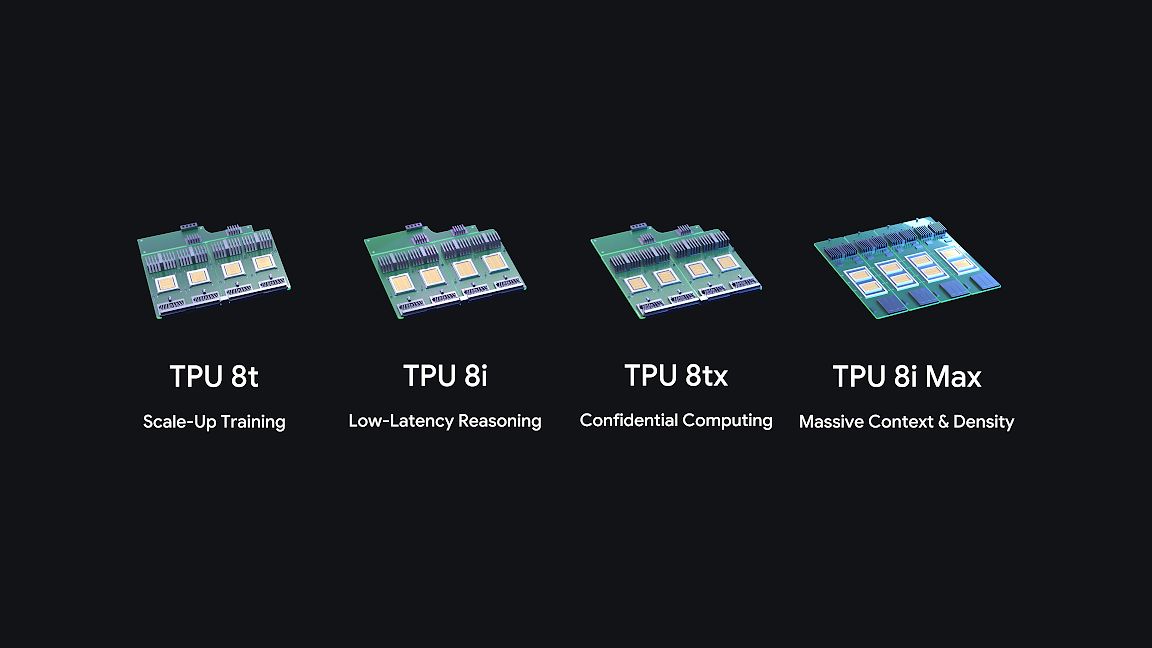
Google Cloud announced the addition of the Google TPU models ‘8tx’ and ‘8i Max’ to its 8th-generation lineup. Following the April launch of the TPU 8t and 8i optimized for AI training and inference, these new systems deliver specialized infrastructure rapidly. Google Cloud noted that introducing four TPU product families in a single year is a first for the company.
Google’s TPUs are application-specific integrated circuits (ASICs) tailored exclusively for AI training and inference. Because they are custom-designed for a single purpose, they offer higher efficiency than general-purpose graphics processing units (GPUs). Last November, Google gained major industry attention when it revealed that its 7th-generation TPUs were used to train the Gemini 3 model.
The expansion of the TPU lineup is driven by intense competition in the AI agent market. Unlike traditional AI chatbots that simply answer questions, AI agents execute tasks independently by interacting with corporate data and enterprise systems. This operational shift requires significantly more efficient computing chips. Mark Lohmeyer, Vice President of AI and Computing Infrastructure at Google Cloud, explained during a media briefing that in the AI agent era, a single user can trigger dozens, hundreds, or thousands of parallel tasks, driving unprecedented demand for specialized computing infrastructure.
Scaling Customer Base Beyond Gemini
Reflecting these market trends, Google Cloud is extending its TPU customer base beyond internal training for Gemini models to external enterprises. Lohmeyer noted that by operating its own apps—such as DeepMind, Search, Email, and YouTube—Google experienced these paradigm shifts firsthand, allowing the company to rapidly scale its product offerings. Amin Vahdat, Google’s Vice President of AI and Infrastructure, stated that the TPU business is growing rapidly and now serves about 100 enterprise customers.
Specifically, the 8tx model focuses on secure confidential inference, featuring enhanced security tailored for government agencies and businesses handling sensitive data. Meanwhile, the 8i Max combines two 8i chips into a single package, doubling computational performance and high-bandwidth memory (HBM) capacity to eliminate memory bottlenecks. Lohmeyer compared this architecture to widening highway lanes to allow more vehicles to travel simultaneously.
Google continues to challenge Nvidia’s dominance in the global AI chip market. Facing intense competition in frontier AI against rivals like OpenAI and Anthropic, Google emphasizes a full-stack strategy spanning AI models, hardware, and infrastructure. Amid rising demand, OpenAI has reportedly discussed purchasing Google TPU capacity to expand and diversify its computing resources. Furthermore, Google’s robust infrastructure growth was underscored in its third-quarter earnings, where cloud revenue surged 103% year-over-year to $30.7 billion.