There is a common prejudice that early bilingual education is harmful to a child’s emotional or cognitive development. It is a misconception that teaching multiple languages can fracture self-identity or lead to underachievement in basic education. The 2nd-generation immigrants who grew up without learning Korean have now become parents in their 30s and 40s. Grandparents who regret not being able to teach Korean to their children are now taking their grandchildren by the hand to find Korean schools. According to the Association of Korean Schools in the Southeastern America, 50% of incoming students are children of the ‘lost generation’ alienated from Korean language education.
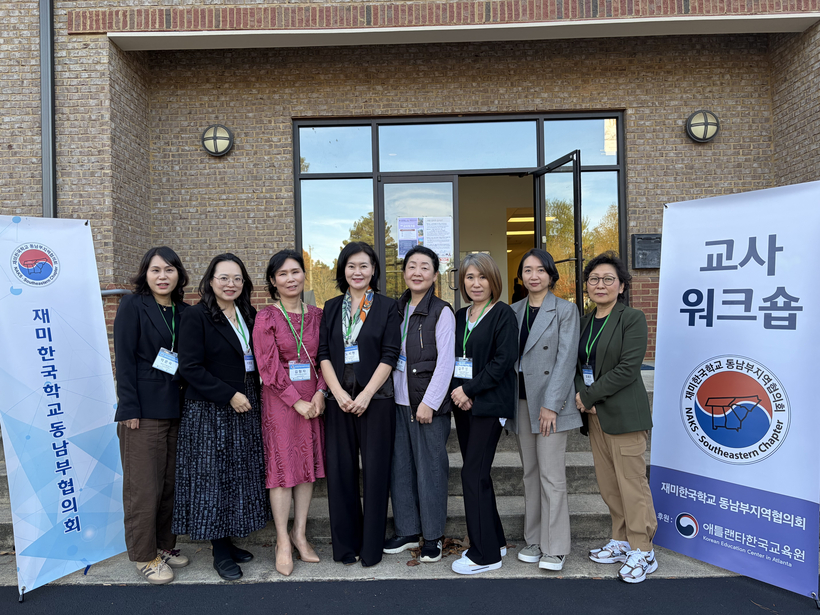
Roh Si-hyun, president of the Association of Korean Schools in the Southeastern America, who hosted a teachers’ workshop at the Sugarloaf Korean Church on the 7th, said, “Students who speak Korean as a heritage language passed down from their parents are gradually decreasing. Since parents also cannot speak Korean, they often cannot help with homework. New teaching methods suited to local realities are needed.”
The greatest difficulty is preventing Korean language education from ending as a rote or one-off education during early childhood. Few students continue learning Korean into middle and high school, as the regular curriculum has little relation to college entrance exams. President Roh noted, “Even though Korea’s cultural status has changed, it is not easy to persuade students and parents 'why they should learn Korean right away.' It is a pyramid structure where participation in Korean schools decreases as age increases, with a massive drop-off starting in the 5th and 6th grades. A systematic system is needed to retain them.” Society, which once pressured immigrants to abandon their heritage language and focus on English acquisition, now expects students to be fluent in two languages. However, bilingual speakers who use two or more languages in different areas and for different purposes cannot be expected to have the exact same linguistic knowledge and fluency as monolingual speakers. Lee Hee-won, a Korean professor at the University of North Georgia, explained, “Based on an understanding of incomplete bilingual speakers, we must draw interest in the Korean language through various games and activities.”
Currently, the Southeastern Regional Association includes about 40 Korean schools across five states, including Alabama and Tennessee. Twenty schools closed following the COVID-19 pandemic, which restricted offline classes. President Roh served as a teacher for 19 years at the Korean school under the Atlanta St. Kim Dae-gon Catholic Church and retired as principal. She said, “Beyond next-generation Korean language education, Korean schools help naturally foster a Korean-American identity by commemorating the March 1st Movement, Liberation Day, and National Foundation Day every year through history education. The experience of exploring my roots with peer friends during the growth period will be nourishment that allows them to stand tall as healthy individuals later in life.”