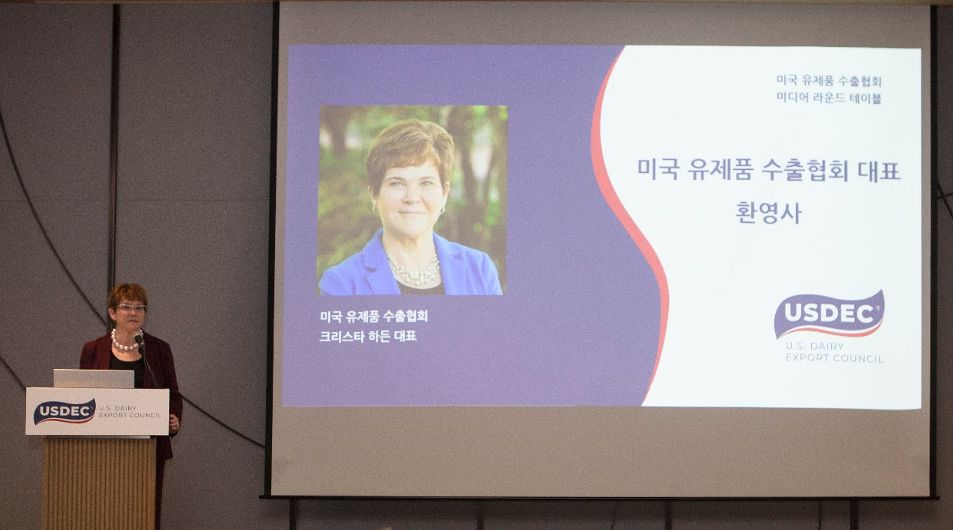
From gimbap and ramen to hot dogs, the various ways cheese is used in South Korea have captured the attention of American dairy farmers. The U.S. Dairy Export Council (USDEC) held a media roundtable on the morning of the 6th at Westin Seoul Parnas in Samsung-dong, Seoul, to discuss the current status of the U.S. dairy industry and potential cooperation with the Korean market. The event was attended by USDEC President Krysta Harden and Board Chair Becky Nyman, along with dairy representatives from various regions across the United States.
During the event, the delegation introduced the Korean food culture they experienced during their visit. They tried making cheese gimbap themselves and experienced how cheese is added to spicy ramen to make the flavor milder. They also noted as an impressive example that while hot dogs in the U.S. are centered around sausage, in Korea, they are enjoyed in various forms with cheese added. They also showed interest in importing U.S. cheese ingredients, processing them domestically in Korea, and selling them as new products.
This event was designed to introduce the production environment and operating methods of the U.S. dairy industry and to discuss cooperation plans with the Korean food industry. President Harden introduced Korea as an important partner market for the U.S. dairy industry, emphasizing that this visit is not just for product sales. The goal is to understand what Korean products consumers want and how food trends are changing to build a long-term cooperative relationship.
Time was also set aside for U.S. dairy farmers to share their farm operation experiences directly. Board Chair Nyman, who runs a fourth-generation family farm in California, shared her experience of returning to the family business after working in a different field following college graduation. Currently operating the farm with her family, she is reviewing new technologies and equipment to find ways to increase production efficiency. U.S. dairy farms also operate differently depending on region and climate. They manage their farms according to breeding environments and breeds, such as operating open-style barns where dairy cows can move freely or grazing them on pastures.
Marilyn Hershey, a Pennsylvania dairy farmer and chairman of Dairy Management Inc., introduced a facility that generates electricity using dairy cow manure and food waste. She also shared examples of making ice cream from milk produced on the farm and selling it locally. David Roberts, a USDEC board member from Utah, discussed family farms passed down through generations, while Tom Walsh, a dairy farmer from Minnesota and South Dakota, introduced barn management methods that adjust ventilation and temperature according to the season. They also shared examples of interacting with the local community by running farm tours and experience programs for students and youth.
The panel discussion, moderated by Allison Thomas, Chief Operating Officer of the USDEC, focused on changes in the Korean dairy market. The delegation showed interest in Korea’s aging population and growing demand for health management. Jennie McDowell, CEO of Dairy MAX, expressed interest in Korea’s health and wellness culture, explaining the nutrients and roles dairy products can provide across life stages, such as calcium during the growth period and protein needed for muscle maintenance in adults and the elderly.
The potential application of whey protein and milk protein was also discussed. They were introduced as ingredients that can be used in various foods such as protein supplements, snacks, convenience foods, and nutritional meals for the elderly. As the number of consumers looking for foods considering health and wellness grows, the application range of dairy ingredients is expected to expand further.
Butter and milk fat were also mentioned as items with growth potential in the Korean market. Currently, major U.S. dairy exports to Korea include cheese, lactose, and whey. The delegation explained that they confirmed the demand and utilization potential for butter while meeting with Korean food manufacturers and importers. Product development utilizing U.S. whey protein and cheese ingredients was also presented as a cooperative field.
The delegation presented the case of Korean companies importing U.S. dairy ingredients and processing them into new products as a direction for bilateral cooperation. Walsh stated that the export of U.S. dairy products is aimed at growing the market together with the Korean dairy industry. Furthermore, Quinton Bailey, Chief Operating Officer of Dairy Management Inc., emphasized that achieving sustained success in major markets like Korea requires long-term cooperation and trust-building rather than short-term activities.
Meanwhile, the U.S. Dairy Export Council is a non-profit organization representing U.S. dairy farmers and dairy processors. It collaborates with food manufacturers, the foodservice and distribution sectors, and nutrition experts in countries around the world, including Korea, to promote the quality and nutritional value of U.S. dairy products. In Korea, it supports the utilization of cheese and milk protein ingredients and plans to expand educational and marketing programs and industrial cooperation, including butter and milk fat products.