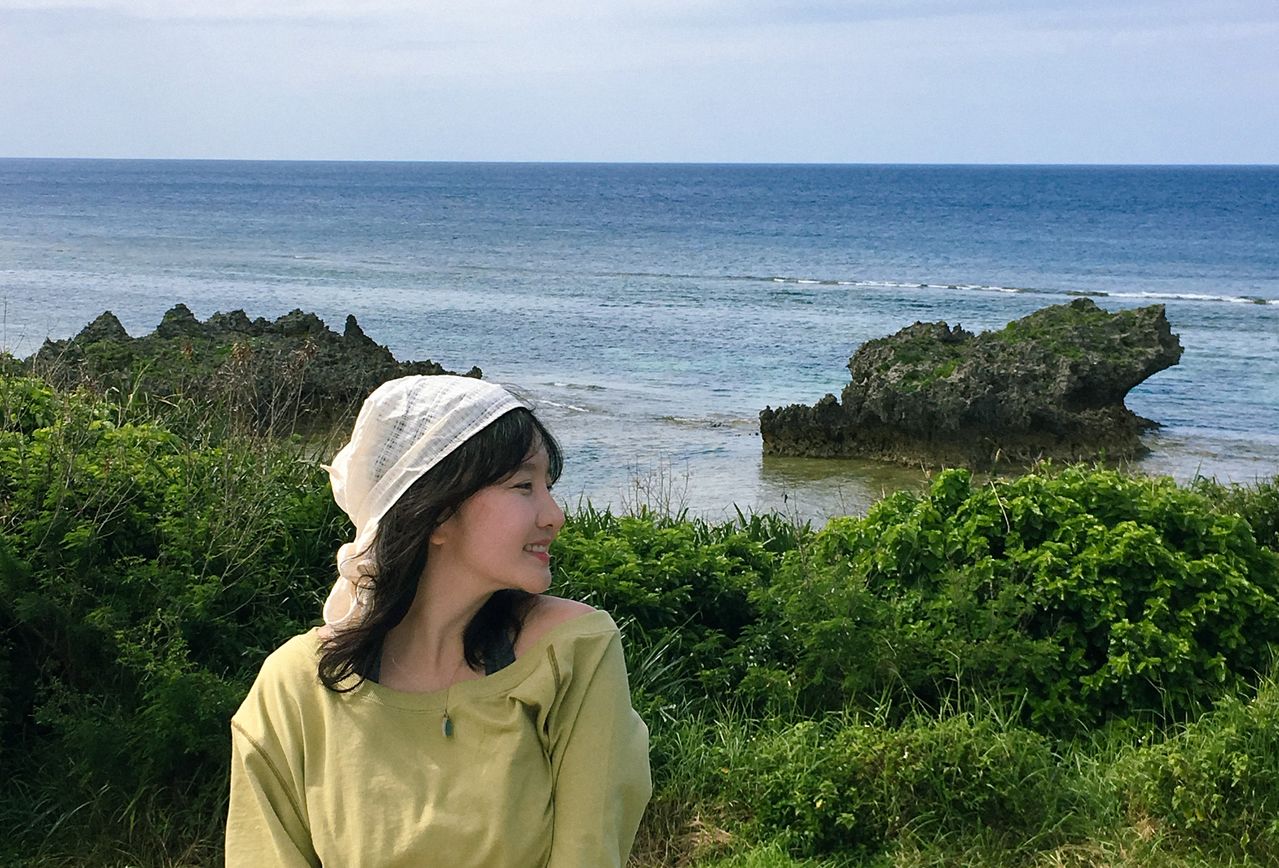
Ansi-nae’s Alone, But Well Traveled (⑤ Okinawa, Japan)
As 8 PM approached, a wave of anxiety washed over me. It was almost time for self-introductions. In Japan, you have to be careful with pronunciation. My name, Sine, when spoken a little too quickly, sounds like the Japanese word ‘sine’ (死ね), which roughly translates to ‘Die!’ After much deliberation, I decided to change my prepared greeting.
“My name is ‘Shin-chan’ from Korea. Please call me ‘Crayon Shin-chan’,” I announced.
Real names aren’t strictly necessary here anyway. People use ‘Musubiya nicknames.’ The staff member who picked me up was named ‘Onigiri,’ and a Korean staff member who worked here until recently was called ‘Kimbap,’ so ‘Shin-chan’ felt like a safe and friendly option.
If you take a bus north from Okinawa’s Naha Airport for nearly two hours, you reach the small village of Nakijin. I had come to spend two weeks at a guesthouse I had dreamed of visiting for a long time: ‘Musubiya (結家),’ arguably the best guesthouse in Okinawa, where you can find happiness for just about $22 a night.
I first learned about Musubiya from a video I watched about 10 years ago. It featured a young Korean woman living as a staff member at the property. Even though she didn’t speak much Japanese, her daily life in the unfamiliar countryside looked remarkably peaceful. She hung laundry in a village with sprawling blue seas, cooked with people in the shared kitchen, read manga, and fell asleep in a hammock. It looked as though the entire world consisted of just the ocean and this single house.
What caught my eye second was the people at Musubiya. Toddlers just starting to walk, elderly grandfathers, and Korean staff members who struggled with the language were all mixed together in one house without a second thought. At the center of it all was the owner, Yuine. Despite her small stature, she had traveled across Japan as part of a circus troupe before opening her guesthouse on this secluded Okinawa beach in 2003.
Mornings at Musubiya begin at 8 AM. Even those who stayed up drinking until dawn are forced to drag themselves out of bed because the dormitories are located right in the living room, and morning cleaning marks a mandatory wakeup call for everyone. Hearing that there was a free yoga class every morning, I even packed a yoga mat from Korea. Spreading my mat facing the ocean under the morning sunlight, I followed Yuine’s energetic chants.
“Ichi, ni, san~ hait!”
You don’t need to know Japanese; you just watch and follow along. The catch was that most of the movements involved jumping. Holding the hand of my nine-year-old yoga partner, we jumped high toward the sky. Finally, following Yuine, we stood in a handstand. Looking out at the ocean upside down made me realize that I was truly experiencing Okinawa’s vibrant mornings.
After morning yoga, everyone goes their separate ways. Some snorkel to spot fish in the sea, while others take a car to a hand-drip coffee shop halfway up the mountain. I was the only one who brought work along with me, though having the ocean as the backdrop for my office felt like an absolute privilege.
One day, I got lost while taking a solitary walk. Even with a map, the rural roads consisted of repetitive, low houses and fields. After wandering around for a while, I ran into two grandmothers in front of a house with a large garden. Pulling together every bit of Japanese I knew, I managed to convey that I was staying at Musubiya and had lost my way.
At the mention of ‘Musubiya,’ the grandmothers’ faces lit up instantly. I expected them just to point me in the direction of the accommodation, but before I knew it, I was sitting on their tatami porch. The grandmothers pulled out drinks from the refrigerator and laid out countless snack packages in front of me. They even brought out family heirlooms, showing me pictures of their ancestors. On my way back, they stuffed both of my hands with fresh tangerines.
To the villagers, Musubiya required no explanation; just saying the name was enough. Having welcomed travelers in the exact same spot for over 20 years, countless unfamiliar faces must have gotten lost and asked for directions in this small coastal village. I had simply added myself to that long lineage.
Because my stay overlapped with a Japanese holiday period, the guesthouse was packed with family travelers. It was fully booked almost every single day of my two-week stay. Among the guests were two couples who had first met and fallen in love right here at Musubiya. There were children everywhere, running around and occasionally pounding on my door in the mornings.
Having worked as a babysitter for four years during college, I knew exactly how to put that experience to use. I voluntarily became a nanny for the little ones. The children chattered away in Japanese even though they knew I didn’t understand a single word. My Japanese vocabulary was limited, but knowing simple phrases like “I’m hungry” or “I want to eat” was more than enough. You don’t necessarily need a shared language to play with kids.
After spending a few days there, I realized that everyone naturally adopts a role in this house. Good cooks prepare dinner, diligent people clean up, extroverts strike up conversations with newcomers, and lively spirits keep the alcohol flowing when the vibe dips. Someone even volunteered to act as an interpreter for me since I couldn’t speak Japanese.
About a week in, another dynamic became apparent. Sitting at the same table every day, washing dishes together, and drinking every night allowed me to notice the subtle romantic currents between people. In particular, young travelers would slip away to the beach at night under the guise of “stargazing.” It was obvious who had feelings for whom.
My role shifted organically. By day I was a babysitter for the kids, and by night I became a relationship counselor for the young adults. Once the drinking started, young people armed with translation apps instead of children would gather around me. They typed earnest messages of love into translation tools and showed each other their screens to discuss their feelings seriously. Even though we couldn’t speak the language well, others’ romantic intentions were crystal clear.
One couple I helped connect hadn’t even stayed at the same time—they missed each other by a few days. Realizing they were from the same hometown and both lived in Tokyo, I played matchmaker out of friendly meddling, and they genuinely became a couple. Recently, the two of them even visited Korea together. Not a bad success rate for a long-term stay.
At Musubiya, phenomena like this are referred to as “Musubiya Magic.” Because so many people meet here, marry, and have children, a running joke among travelers is that Musubiya single-handedly contributes to solving Japan’s declining birth rate. However, Musubiya Magic isn’t just about romance.
Even after returning home from my trip, I regularly receive warmly translated Korean messages from people I met there: the father of the child I looked after, the couple I brought together, and the people who drove me around to show me the sights because I couldn’t drive. Just the shared fact of having stayed at Musubiya forged a deep, lasting bond. True to its name—which means a house that connects human ties—Musubiya lives up to its identity completely.
‘Musubiya’ Usage Guide
Accommodation fees start at 3,600 yen (approx. $22 USD) per night. Both dormitories and private rooms are available, and ocean-view private rooms are highly recommended. Reservations can be made via Instagram direct message (@musubiyayui). Because a potluck party is held every evening, bringing one or two simple homemade dishes is encouraged. From Naha Airport in Okinawa, you can take the YKB888 bus directly without any transfers. If you inform the guesthouse of your arrival time in advance, they will pick you up at the bus stop.