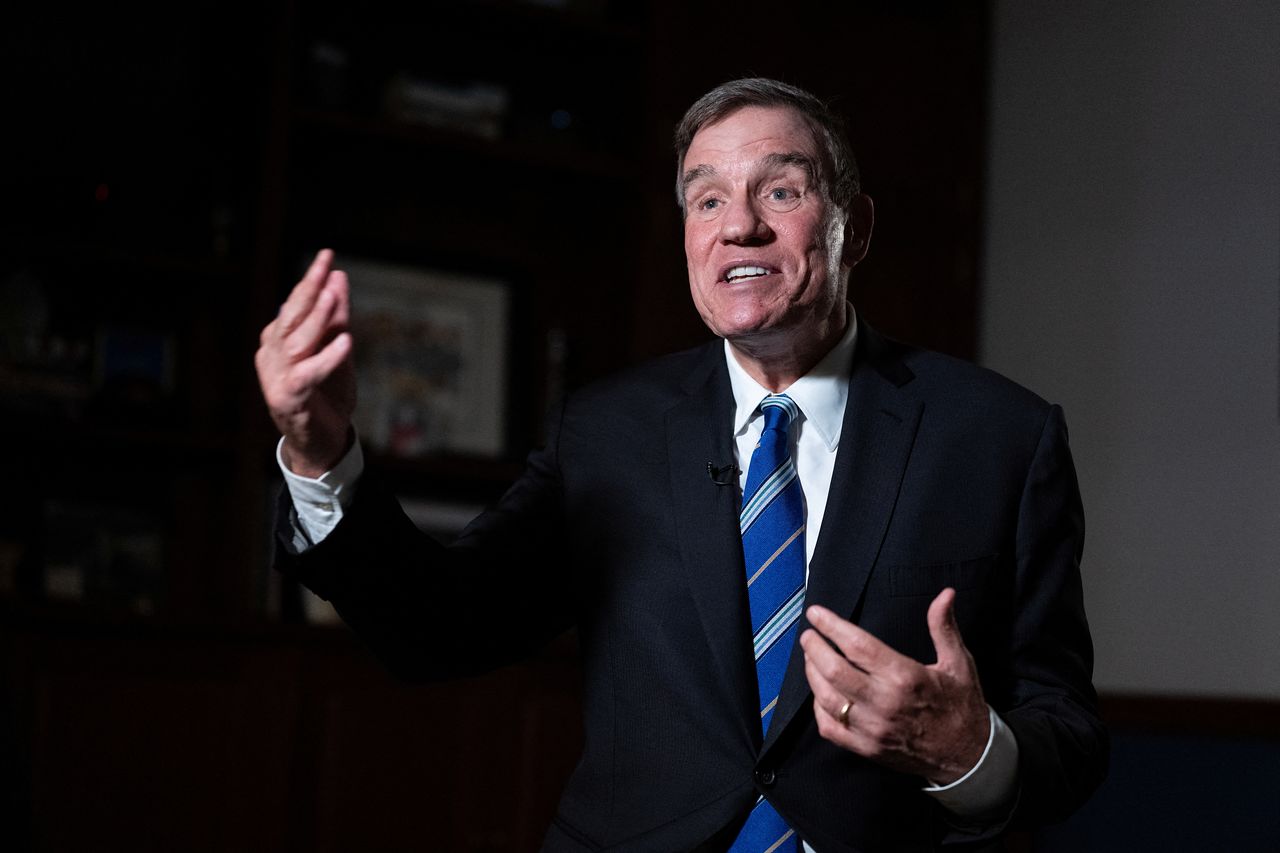
As the incoming ranking Democrat on the Senate Intelligence Committee, Senator Mark Warner stated on the 10th (local time) regarding suspicions surrounding Nvidia CEO Jensen Huang, that Huang’s sudden rejoining of Donald Trump’s entourage during his May visit to China—after previously drifting away from the president—cannot be seen as a mere coincidence and vowed to uncover the truth behind the matter, designating it as a national security concern.
Speaking during an afternoon press teleconference, Warner, currently the vice chair of the Senate Intelligence Committee, was asked about Congress’s response to the allegations surrounding Huang. He stated, “I don’t know if the president was briefed on the suspicions, but seeing Huang drift away from the president’s circle in the late spring only to rejoin him during the May China trip doesn’t look like a coincidence.” Asking how that decision was made, he added, “I intend to dig to the bottom of this issue.”
In connection with this, the New York Times (NYT) reported citing individuals familiar with the matter that Secretary of State Marco Rubio directly briefed Trump aboard Air Force One in May about intelligence linking Huang to Alice Huang, a female businesswoman suspected of ties to Chinese intelligence. The briefing reportedly occurred just before Huang, invited by Trump, joined the China itinerary.
This directly contradicts Trump’s remarks the previous day at the White House when asked if he knew about Huang’s relationship with the suspected Chinese spy during the trip, to which he replied, “I didn’t hear about that at the time.” The White House issued an email to the NYT denying the report’s accuracy but provided no specific explanation.
With Democrats recapturing majorities in both the House and Senate, party heavyweights like Warner are publicly highlighting the circumstances of Huang’s trip to directly link the controversy to Trump. Warner is a member of the “Gang of Eight,” consisting of congressional leadership and intelligence committee leaders who receive sensitive classified briefings from the administration. The Gang of Eight was briefed on the matter the previous day by CIA Director John Ratcliffe and Director of National Intelligence Jay Clayton.
Commenting on the briefing, he said, “We received some details, but the briefing was unsatisfactory.” Warner added, “I have no intention of diminishing Jensen Huang; he is an exceptional entrepreneur. However, I have many questions. The intelligence we received yesterday was neither complete nor comprehensive.”
Referring to Section 702 of the Foreign Intelligence Surveillance Act, which allows U.S. intelligence agencies to intercept communications of non-U.S. persons abroad for foreign intelligence purposes, Warner noted, “It appears that Alice Huang, a Chinese national, was a target of our intelligence collection. If it turns out she communicated with an American, our intelligence agencies are required under regulations to pass all such information to the Federal Bureau of Investigation (FBI). Yet, we have not received any briefings or information from the FBI.” He also expressed concern that “chaos in the company’s leadership could pose national security risks and create massive repercussions for the U.S. market.”
Warner’s remarks strongly suggest that Congress intends to examine not only the national security implications of this issue but also whether the administration fulfilled its reporting and oversight duties. Ultimately, the investigation may culminate in whether Trump received timely reports regarding the matter and took appropriate subsequent actions.
When asked the previous day when he precisely became aware of the relevant information, Trump replied, “I’ll have to check.” Asked if he had read the classified document in which Rubio was involved in drafting, he said, “I’ll check with the intelligence agencies. It might have been mentioned. It certainly didn’t leave a big impression on me.”
In Paris, France, Rubio declined to answer reporters’ related questions, stating, “I won’t comment on internal corporate issues.” When a reporter pointed out that this is not merely an internal corporate matter, he retorted, “You’ll have to ask the White House. I will not make any comments regarding the Nvidia case.” When asked again if this meant he did not view it as a national security concern, he repeated, “I will not comment.”
In Congress, there is a palpable atmosphere seeking to accelerate legislation limiting semiconductor exports to China in the wake of the Huang controversy. House Democratic Leader Hakeem Jeffries demanded a separate comprehensive briefing on the Nvidia allegations the previous day while expressing “strong support” for including restrictions on semiconductor sales to China in the final National Defense Authorization Act (NDAA) for fiscal year 2027.
According to Reuters, the bills being pushed for reflection in the Senate NDAA include three measures: the AI Overwatch Act, which strengthens congressional authority over advanced AI chip exports; the Chip Security Act, which mandates tracking shipped chips overseas to prevent smuggling; and the MATCH Act, which pressures allies like Korea to join the U.S. in export controls on semiconductor manufacturing equipment targeting China. These bills have passed the House Foreign Affairs Committee, though their final inclusion in the NDAA remains undecided.
This is also surfacing differences between Trump and China hawks within the Republican Party. U.S. political media outlet Politico reported that, unlike Trump’s defense of Huang, Republican lawmakers are reviewing congressional investigations and, much like Democrats, seeking to tighten regulatory controls on advanced semiconductor exports to China. House Foreign Affairs Committee Chairman Brian Mast, Intelligence Committee Chairman Rick Crawford, and U.S.-China Strategic Competition Select Committee Chairman John Moolenaar previously requested Huang to appear at a joint closed-door briefing on the 18th.