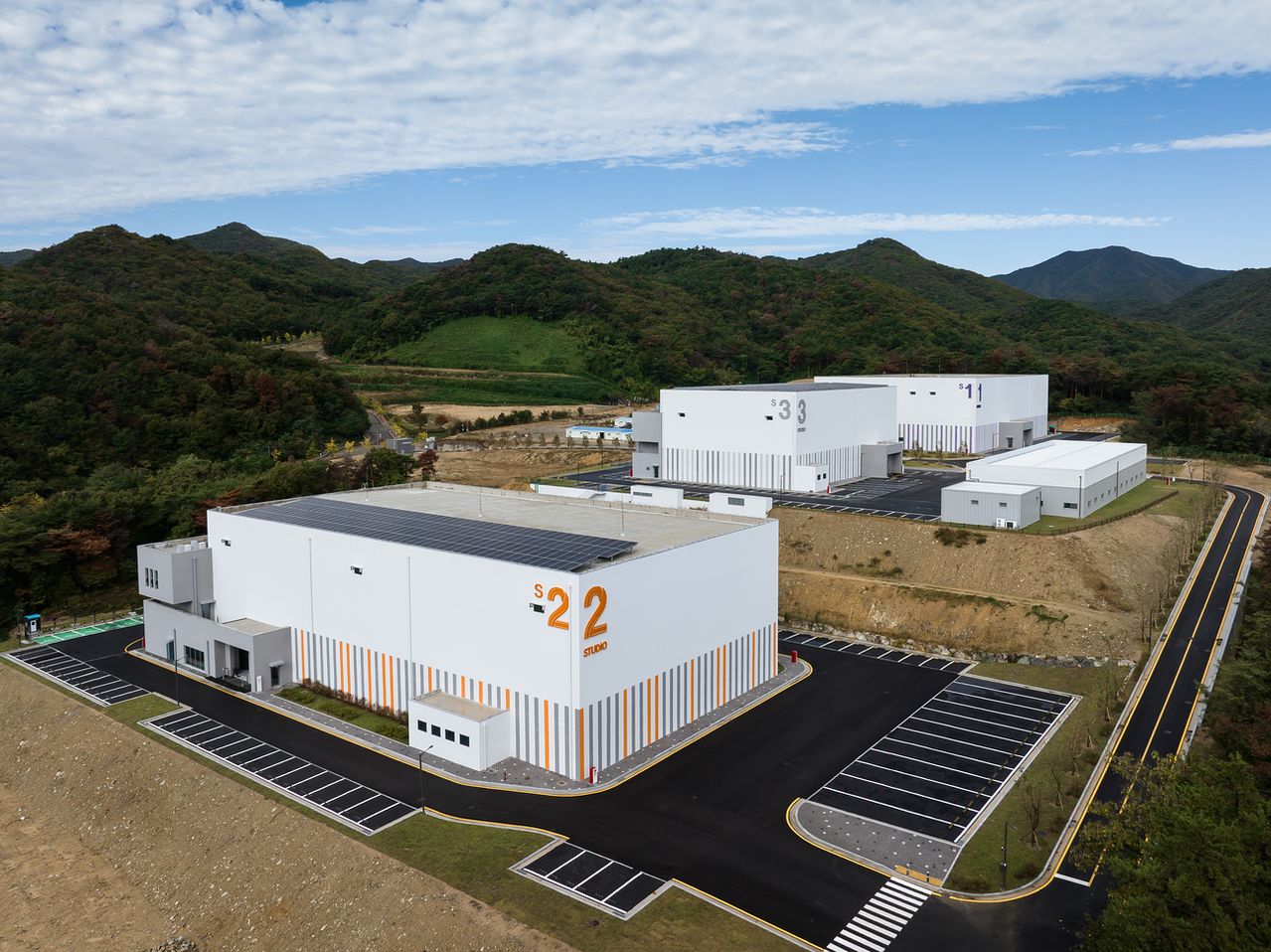
South Korea has officially unveiled its largest public comprehensive filming facility, the Busan Gijang Studio, representing an 85.3 billion won ($60 million) investment by the Korean Film Council (KOFIC). Located in Gijang-gun, Busan, the expansive 158,412-square-meter complex houses three large indoor soundstages and four outdoor shooting grounds designed to accommodate massive cinematic productions.
State-of-the-Art Facilities and Virtual Production
The facility features three primary indoor soundstages: Studio 1 spans 3,300 square meters, Studio 2 covers 2,149 square meters, and Studio 3 measures 1,488 square meters. Notably, Studio 1 stands as the largest soundstage in South Korea outside of the capital region. The ceilings are outfitted with advanced batten systems, allowing crew members to efficiently maneuver lighting and heavy set equipment with the push of a button.
Further technological upgrades are underway, with a virtual production studio scheduled for completion in the first half of next year. This cutting-edge setup will utilize massive LED screens to project digital backgrounds, empowering filmmakers to shoot complex scenes without traveling to dangerous or distant locations.
Star-Studded Opening and Affordable Rates
The complex is set to host its very first productions this December, featuring the historical action film The Execution List starring Jung Woo-sung and the thriller Two Piece starring Yum Jung-ah. Both projects were selected as pilot support works by KOFIC, granting them full rental fee waivers as they utilize Studios 1 and 2 respectively.
Beyond high-tech amenities, the studio boasts highly competitive rental pricing. Daily rates are set at 1.7 million won for the largest 1,000-pyeong studio, 1.1 million won for the mid-sized studio, and 600,000 won for the smallest, with outdoor grounds available for 100,000 won per day.
Future Outlook and Industry Challenges
Originally planned to succeed the former Namyangju Studios following KOFIC’s relocation to Busan in 2005, the project took nearly 20 years to complete after facing numerous administrative delays. Moving forward, the studio aims to achieve a 50% utilization rate in its first year and 75% by its third year.
While production companies and streaming services have shown strong interest, KOFIC plans to prioritize short-term film projects to maximize accessibility for diverse creators. Additional measures, such as rental discounts for independent filmmakers, are also in place to foster regional film industry growth despite lingering shortages in local post-production personnel.