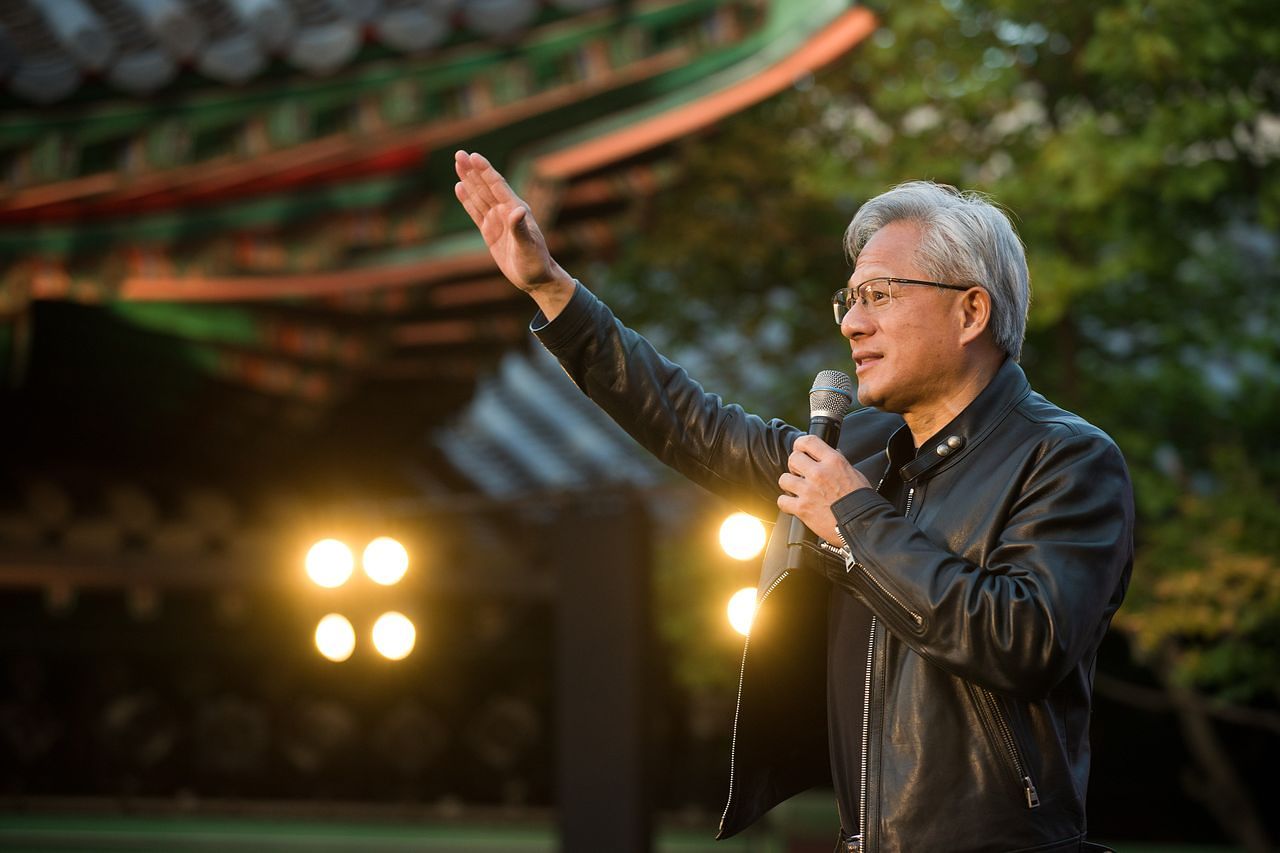
The potential resignation of Nvidia CEO Jensen Huang, a key figure in the global artificial intelligence (AI) industry, marks a major turning point for the AI semiconductor market, which has long been dominated by Nvidia. Analysts suggest that the era of Nvidia-led AI investment ecosystems is coming to an end, paving the way for a ‘Warring States period’ where multiple chipmakers compete.
On the 11th (local time) in the U.S. stock market, the Philadelphia Semiconductor Index surged by up to 7% during trading, leading to a broad rally in AI and semiconductor stocks. NAND flash maker SanDisk (13.69%) and memory semiconductor maker Micron (11.89%) both jumped over 10%. Nvidia competitors such as Intel (7.46%) and AMD (7.32%), application-specific integrated circuit (ASIC) leader Broadcom (3.99%), and global foundry giant TSMC (4.25%) also saw synchronized gains.
Despite the ‘Jensen Huang Gate’ controversy, the market remains optimistic about global AI demand and data center expansion. Swiss investment bank UBS recently projected that spending on high-bandwidth memory (HBM) and server double data rate (DDR) memory for AI data centers will increase next year compared to this year. Meanwhile, TSMC announced plans to invest up to $1 billion (approx. 6.67 billion KRW) each in Anthropic and OpenAI.
As the AI industry continues to grow, the potential breakdown of Nvidia’s monopoly creates major opportunities for 2nd-tier AI accelerator players like Intel and AMD. Google recently unveiled its 8th-generation tensor processing units (TPUs), ‘8tx’ and ‘8i Max,’ designed for low-power, low-cost AI processing. To enhance security, Google integrated AMD’s 5th-generation server CPU, ‘Epyc,’ with its TPUs—the result of aligning interests to counter Nvidia.
Amazon has also joined the anti-Nvidia front. Through Annapurna Labs, a chip design firm acquired in 2015, Amazon developed the ‘Trainium’ AI training and inference chip for Amazon Web Services (AWS), securing Anthropic and OpenAI as clients.
Strong financial results from ‘neocloud’ provider CoreWeave further heightened expectations for AI market growth. The company builds specialized GPU data centers for AI training, inference, and computing, renting out processing power to Google, Meta, and Microsoft (MS).
CoreWeave’s third-quarter revenue reached $3.661 billion (approx. 4.87 trillion KRW), up 168% year-over-year, while its order backlog surged 138% to $132.5 billion (approx. 176.17 trillion KRW). The company raised its full-year revenue outlook to a maximum of $13.3 billion (approx. 17.68 trillion KRW) and increased its minimum capital expenditure budget to $37 billion (approx. 49.19 trillion KRW).
Jeon Byung-seo, head of the China Economic and Financial Research Institute and former head of research at Daewoo Securities, explained, “CoreWeave’s capital expenditures directly translate into revenue for GPU, memory, and network chip manufacturers, as well as power infrastructure companies. When demand and financial capability are simultaneously proven through performance, the entire semiconductor sector reacts.”
The biggest variable is the potential collapse of the ‘circular financing’ ecosystem built by CEO Huang. Historically, Nvidia has stimulated GPU demand by providing purchase agreement-based investments or credit guarantees to AI companies and neoclouds. It has essentially acted as a bank, supplying liquidity to the AI industry to ensure chip-purchasing power. If Nvidia’s new management reduces investments and guarantees for clients, AI companies could face soaring financial burdens, potentially stalling data center investments.
CEO Huang’s departure is also expected to significantly impact U.S. AI policies. According to the Wall Street Journal (WSJ), bipartisan lawmakers in the U.S. Congress are pushing to include a package of three anti-China semiconductor bills (the AI Overwatch Act, Semiconductor Security Act, and MATCH Act) in the National Defense Authorization Act. WSJ noted, “While the Trump administration closely aligned with tech firms and delayed AI regulations, the situation changed after Democrats captured both the House and Senate in the midterm elections. Jensen Huang’s resignation has further fueled momentum for stricter AI regulations.”