If you take a bus north for nearly two hours from Naha Airport on Japan’s southernmost island of Okinawa, you will arrive at the small village of Nakijin. I came here to spend two weeks at a guesthouse I had dreamed of for a long time: the Okinawa guesthouse known as ‘Musubiya’ (結家), a place where true happiness can be found for just 30,000 won (approx. $30) a night.
I first learned about Musubiya a decade ago through a video of a Korean woman working there as a staff member. Though she spoke little Japanese, her daily life in the unfamiliar countryside looked peaceful. She hung laundry in a village with sweeping ocean views, cooked with people in the shared kitchen, read manga, and fell asleep swaying in a hammock. It felt as though nothing existed in that video except the ocean and this house.
The second thing that caught my eye was the people at Musubiya. From toddlers just starting to walk to elderly grandfathers and a Korean staff member struggling with the language, everyone mixed together under one roof. At the center of it all was the owner, ‘Yuine.’ Small in stature like me, she had once belonged to a circus troupe, wandered across Japan, and finally opened this lodging on a secluded Okinawa beach in 2003.
Morning at Musubiya begins at 8 AM. Even those who stayed up drinking until dawn are forced to stumble out of bed because the dormitory is located right in the living room, meaning morning cleaning brings an all-hands wakeup call. Hearing that there was a free morning yoga class every day, I even packed a yoga mat all the way from Korea. I rolled out my mat facing the ocean, caught the morning sunshine, and followed Yuine’s commands.
“Ichi, ni, san~ hait!”
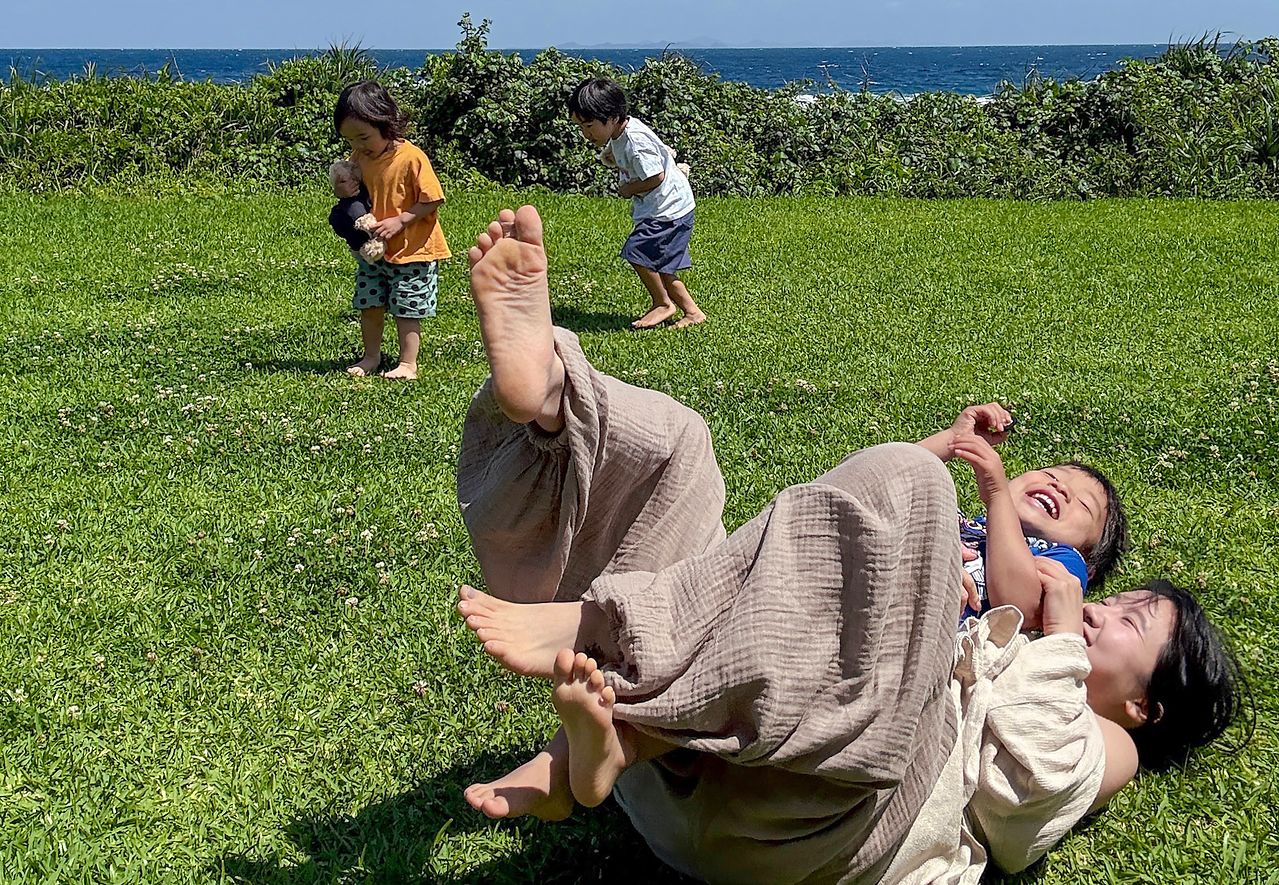
Not knowing Japanese does not matter. You simply watch and follow along. At the very end, everyone attempts a handstand following Yuine. Standing upside down and looking out at the sea made me truly realize I was experiencing Okinawa’s vibrant morning.
After morning yoga, everyone goes about their own business. Some snorkel to see fish, while others take cars to a hand-drip coffee shop halfway up the mountain. I was the only one who brought work along with me. Still, having an office facing the ocean was nothing short of a blessing.
One day, while out for a walk alone, I lost even my sense of direction. Even with a map, the rural roads consisted of identical houses and fields. After wandering for a while, I ran into two grandmothers. Gathering every Japanese word I knew, I managed to communicate, “I am staying at Musubiya and I’ve lost my way.”
The moment they heard the name ‘Musubiya,’ the grandmothers’ expressions lit up instantly. I thought they would simply point out the way, but somehow I ended up sitting on their porch. The grandmothers brought out drinks and tore open snack packets, piling them high in front of me. They even pulled out various family heirlooms so I could see pictures of their ancestors. On my way back, they stuffed both my hands full of tangerines.
The accommodation was packed with family travelers. For the two weeks I stayed, it was almost fully booked. Two couples had actually met and married after first meeting at Musubiya. Naturally, there were plenty of children as well.
When else could I put my four years of college babysitting experience to use if not now? I voluntarily became the little ones’ nanny. The kids chattered away in Japanese to me even though I couldn’t understand a single word. My Japanese was short, but speaking isn’t strictly necessary when playing with children.
After staying a few days, I noticed that roles naturally emerged for everyone in this house. Good cooks prepared dinner, while diligent people handled cleaning.
Around a week in, I began noticing other dynamics. Sitting at the same table for meals every day, washing dishes together, and drinking every night made the underlying current between people visible. Particularly, young travelers would slip away to the beach every night claiming they were going to “see the stars.” It was unlikely that that many people genuinely loved astronomy. It was painfully obvious who had feelings for whom.
Thus, my role subtly shifted. By day, I was the kids’ nanny; by night, I became the youths’ relationship counselor. As the drinking sessions started, young people holding smartphones would gather around me. They would plug sentences into translators, show each other their screens, and discuss love with utmost seriousness. Though I spoke the language the least, others’ hearts were the easiest for me to see.
Among the couples I helped connect, there were even two people whose stays had overlapped without them ever crossing paths. Realizing they were from the same hometown and both lived in Tokyo, I meddled out of friendly curiosity, and they truly became a couple. Not long ago, the two of them even traveled to Korea together.
At Musubiya, events like this are called ‘Musubiya Magic.’ Because people meet, marry, and even have children here, a running joke among travelers is that Musubiya contributes to solving Japan’s declining birth rate. However, Musubiya Magic does not solely mean falling in love with someone.
Even after returning to Korea, thoughtfully translated Korean messages arrive. They are sent by the father of a child I looked after at Musubiya, the couple I helped unite, and people who took me sightseeing because I couldn’t drive.
Merely having stayed at Musubiya creates an unbreakable bond. ‘Musubiya’ (結家) literally means a house that ties together human connections. It is a place that truly lives up to its name.