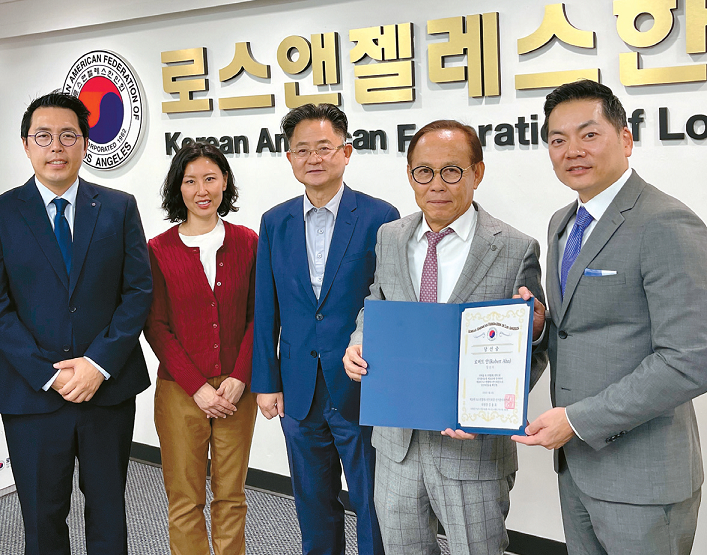
The uncontested election of Robert Ahn, the sole candidate for the 38th president of the LA Korean American Federation, was finalized on the 12th.
With this, the federation continues its record of electing its president without a contested race for 20 consecutive years, dating back to 2006 when the late Nam Moon-ki was elected. This stands in stark contrast to the past, when multiple candidates fiercely campaigned throughout Koreatown.
Behind this trend are the changing roles and functions of the federation, internal challenges, and apathy within the Korean American community. Voices are emerging that the federation must boldly lower the barriers to running and draw the participation of the younger generation if it is to recover its representation and develop sustainably.
Ahn visited the LA Korean American Federation office on this day to submit his candidate registration documents and registration fee to the election management committee. After reviewing the documents and qualifications for about 30 minutes, the committee promptly issued a certificate of election to Ahn.
Regarding the 20-year streak of single-candidate races, Ahn stated, “We need to take a close look at the causes. Since there are criticisms that the presidential election bylaws are more complex than necessary, discussions on amendments are also needed.”
According to the bylaws, presidential candidates must have resided in LA County for 10 years or more, and served as a federation board member for at least 2 years or as an executive in a California nonprofit organization for at least 3 years. The registration fee also amounts to $50,000. Although this is half of the previous $100,000 fee reduced in 2016 to lower the entry barrier, the hurdle remains high.
Jeff Lee, the federation’s administrative director, explained, “There were times in the past when presidential elections escalated into legal battles, so bylaws were strengthened across several administrations to prevent this.”
However, critics point out that as the generations and environment of the Korean American community have rapidly changed, strict qualification requirements and hefty registration fees originally created to prevent past side effects are now acting as shackles, blocking fresh new faces and the influx of the younger generation.
Kim Yong-ho, chairman of the election management committee, also voiced concern, saying, “I am worried whether a candidate will even show up in the next election two years from now.” He emphasized, “A consensus was formed among the election committee members this time regarding the need to revise the bylaws. Under Ahn’s second term, we will gather opinions through public hearings and amend the bylaws so that the presidential election can draw more interest than it does now.”
Along with institutional improvements, drawing the interest and participation of the younger generation is cited as an urgent task. This is because cynical reactions exist among young people who either do not know the federation exists or fail to feel its necessity.
According to the LA Korean American Federation, the current board of directors consists of a total of 26 members. Among them, only one is in their 30s. Although a large influx of directors in their 40s recently brought a current of change, a substantive generational shift remains a long-term task.
Hwang Sun-woo, 28, who lives in Koreatown, said, “I didn’t even know there was a Korean American Federation in LA. The younger generation has a lot of information and few language barriers, so they tend to depend less on specific organizations.”
An analysis suggests that changes in the identity and role of the federation according to the times have also influenced the uncontested trend. While the early days of the Korean immigrant society desperately needed a focal point to represent the rights of first-generation immigrants, today the federation’s functions are being reorganized around practical community service.
A leader of an organization in the LA Korean American community pointed out, “Unlike the past, today the federation president must form networks with the city government and secure funding, so the presidency has long shed its honorary title status.” They also diagnosed, “As the size, character, and generational composition of the Korean American community have changed, the federation has transformed into a practical nonprofit service organization, significantly altering perceptions of the presidency.”