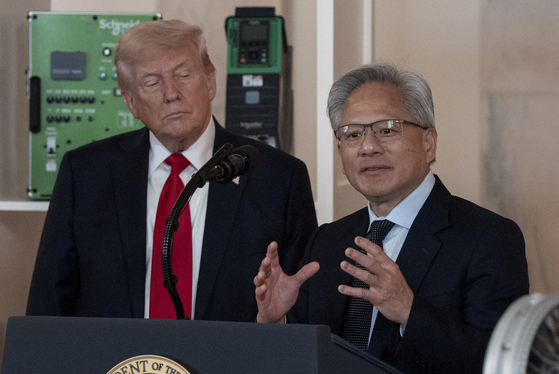
U.S. President Donald Trump reportedly encouraged former Nvidia CEO Jensen Huang to hold onto his position until the very moments before his resignation, which followed controversy over alleged ties to a Chinese spy.
Reports indicate that Trump viewed Huang’s personal controversies more as a private infidelity matter rather than a national security threat, while also worrying about the potential negative impact his departure could have on the U.S. artificial intelligence industry.
Trump Urged Huang to Fight Amid Spy Allegations
The New York Times reported on the 12th (local time), citing multiple sources, that President Trump called Huang on the 10th and urged him to keep fighting to protect his position. This came to light even after inappropriate relations with Alice Huang—suspected of being recruited by Chinese intelligence—became public.
President Trump had received reports regarding their relationship late last year and this spring, but took no special action. He even brought Huang along during his visit to China last May. During a White House briefing on the 9th, Trump publicly mentioned his call with Huang, stating, ‘He said he didn’t know Alice Huang was a spy, and I believe him,’ while praising Huang as an ‘honorable figure.’
Valuing the ‘Modern Henry Ford’ of AI
According to Trump’s aides, the president viewed the issue primarily as a personal affair rather than a national security threat. He reportedly placed little significance on intelligence agency warnings that Alice Huang could pose a risk to U.S. security.
Huang’s high standing was another key reason for Trump’s support. Aides shared that Trump considered him the ‘modern Henry Ford’ leading 21st-century core technology industries, seeing the AI industry as an engine for U.S. manufacturing revival and economic growth, with Huang at the center.
Business Impact and Sudden Downfall
Huang delivered on Trump’s expectations through massive investments and international business expansions. In April of last year, he announced plans to produce up to $500 billion (approx. 700 trillion won) worth of AI infrastructure in the U.S. He also accompanied Trump on his Middle East tour last May to support semiconductor purchase agreements with Saudi Arabia and the United Arab Emirates.
Huang reportedly influenced U.S. export policies toward China as well, persuading Trump with the argument that Nvidia’s semiconductor sales needed to expand for U.S. technology to outpace Chinese tech. Despite opposition from hardliners concerned about national security, Trump permitted Nvidia to sell certain semiconductor models to China.
Ultimately, Huang stepped down after revelations surfaced that he had engaged in romantic relationships not only with Alice Huang but also with company employees. President Trump is said to remain deeply concerned that his resignation could negatively impact the U.S. AI chip industry.