Major theaters in Los Angeles are igniting controversy within the regional performance community by staging productions featuring non-union actors.
In particular, even non-profit theaters with a public mission have begun hosting non-union shows, escalating the debate into a broader clash over the enforcement of labor rights for actors and the social responsibilities of theater institutions.
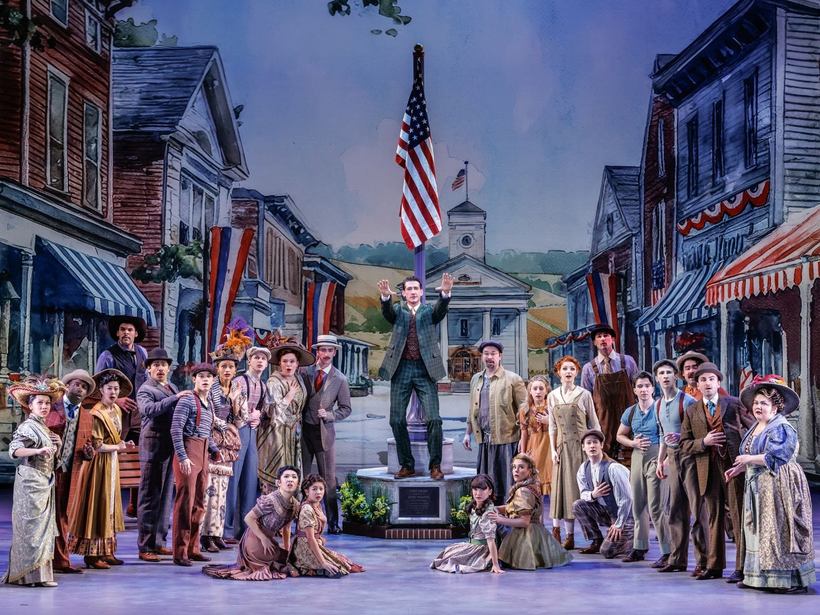
Late last month, the musical ‘Tommy’ opened at the Hollywood Pantages Theatre, while ‘The Music Man’ premiered on the same day at the Ahmanson Theatre in Downtown LA. Both productions are non-union national tours that do not operate under the collective bargaining agreements of the Actors’ Equity Association (AEA).
Established in 1913, AEA is the premier theater labor union in the United States, representing the rights and welfare of over 51,000 actors, singers, dancers, and stage managers nationwide. It operates as a distinct organization from SAG-AFTRA, which represents film and television actors.
AEA exerts significant influence across the entire performing arts industry, including Broadway, major national tours, and regional non-profit theater productions. Through collective bargaining agreements, it guarantees actors’ minimum wages, working hours, rest periods, health insurance, and pensions. For non-union productions, these agreements do not apply, leaving compensation and benefits to be determined independently.
The controversy intensified when Center Theatre Group (CTG), LA’s prominent non-profit theater organization, opened the non-union production of ‘The Music Man’ at the Ahmanson Theatre. CTG operates three major theaters in the LA area, supporting production, the cultivation of emerging artists, and community arts education. Consequently, fierce criticism emerged questioning whether it was appropriate for a non-profit arts organization to choose a non-union show over union productions that guarantee actor labor standards.
Kiki Ramos Gindler, former chair of the CTG board of directors, took to Facebook to point out that CTG’s past commitment to union shows—even at a higher cost—stemmed from prioritizing values over mere profits. She warned that the organization must not abandon its core values merely to ensure its survival.
Conversely, CTG maintained that its selection of available productions was severely limited by practical circumstances.
According to the Los Angeles Times, Snehal Desai, CTG’s artistic director, stated that out of 25 national tours operating under actor union contracts this year, over 20 were booked at rival Pantages Theatre, leaving CTG with a very narrow range of choices. He also explained that the costs of securing union versus non-union productions showed little difference.
For CTG, the priority has been to secure box-office revenue by filling theater schedules despite limited options. Previously, CTG suffered severe financial distress in 2023, forcing a roughly year-and-a-half suspension of operations at the Mark Taper Forum—a venue dedicated to new and experimental plays—and currently operates with a staff reduced by over 20% compared to pre-pandemic levels.
To counter this, CTG aims to generate strong box-office revenue at the Ahmanson Theatre, a 2,000-seat large-scale venue, to sustain self-produced shows at the Mark Taper Forum and the Kirk Douglas Theatre. Productions directly produced by CTG remain bound by actors’ union contracts. Desai admitted that the organization had to approach production selection with extreme caution, as failing to meet box-office goals could result in financial devastation worth millions of dollars.
Evaluations regarding the artistic quality of non-union productions have also been sharply divided.
Charles McNulty, theater critic for the Los Angeles Times, harshly criticized ‘The Music Man’ as a community theater-level production, arguing that CTG is actively eroding its prestige as a non-profit institution by granting such works its main stage.
On the other hand, audience responses were relatively favorable. According to CTG, ‘The Music Man’ scored higher satisfaction ratings in internal audience surveys than certain union productions previously showcased at the Ahmanson Theatre.
In the midst of this debate, AEA focused less on artistic quality and more on the poor treatment of actors. David Levy, an AEA spokesperson, told the Los Angeles Times that while non-union tour actors are not necessarily less talented than union actors, the real issue is whether fair wages, benefits, and safe working conditions are guaranteed.
However, actors participating in non-union productions pushed back against external perceptions that their working environments are unilaterally substandard. Savannah Stevenson, an actress who appeared in ‘The Music Man,’ rebutted the notion that non-union national tours inherently involve unfair treatment.
Stevenson explained that while non-union shows tend to operate on shorter schedules compared to union productions, the actors are fully aware of this beforehand and enter contracts knowingly. She added that this operational model actually offers the advantage of bringing performances to a much wider array of local communities.
AEA representatives also acknowledged the necessity of non-union regional tours to some extent. While Levy noted that non-union touring might be the only viable option for small towns lacking access to live performances, he drew a firm line regarding Los Angeles, emphasizing that as a major metropolitan area with abundant cultural choices, the situation is entirely different.