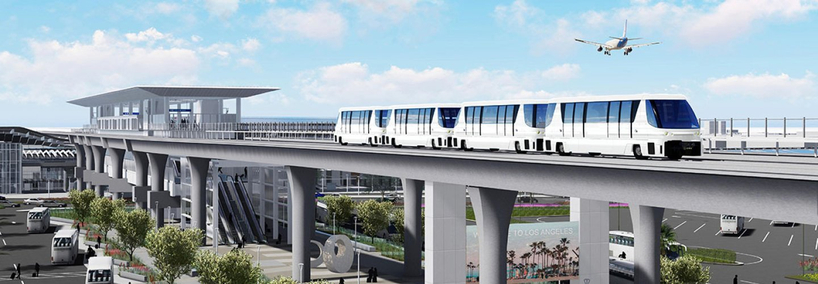
Controversy continues to surround the LAX People Mover, the automated train project at Los Angeles International Airport (LAX).
As openings have been repeatedly delayed and project bond credit ratings have been further downgraded, the risks of business contract termination and default have come to the surface.
Credit rating agency Fitch Ratings recently downgraded the credit rating of approximately $1.2 billion in senior revenue bonds issued by ‘LINXS,’ the construction consortium for the LAX People Mover, from ‘BB’ to ‘B-.’
Fitch stated that the downgrade reflects the fact that it is now virtually certain the People Mover will not begin normal operations by the contractual final opening deadline of the 8th of next month. The agency added that if the deadline is missed, it will constitute an event of default, giving both the contractor LINXS and the issuing authority, Los Angeles World Airports (LAWA), the authority to notify a contract termination.
Conflicts between the contractor and airport authorities also show signs of prolonged stagnation. Consultations between the two managements, which had been ongoing since last year, were suspended in August. Previously, LINXS filed a lawsuit against the City of Los Angeles in July, claiming that the responsibility for construction delays lies with the airport, thus taking legal action.
Originally targeted to open in 2023, the People Mover’s opening schedule has already been postponed more than five times. To make matters worse, a power facility explosion occurred at three tracks during test runs in September. In the wake of this, the scheduled opening date was pushed back once again to February 5 of next year, but actual operation remains unclear even then. As the construction drifts, total project costs have also surged to $3.3 billion, a $1.4 billion increase from the initial plan.