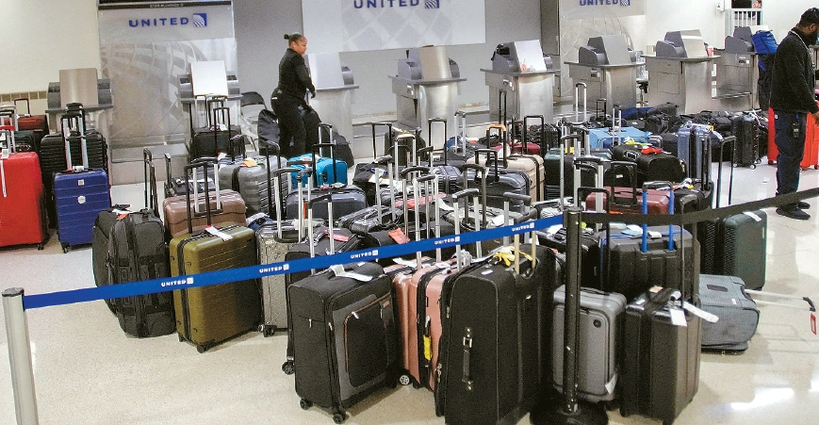
The ripple effects of a communication network failure that grounded flights nationwide continued for a third consecutive day. Although the ground stop order was lifted after about four hours on the 13th, flight cancellations and delays cascaded through major airports including Los Angeles International Airport (LAX) over the weekend as aircraft and crew schedules became severely tangled. Warnings have also emerged that similar chaos could repeat unless aging air traffic control networks are modernized.
According to Reuters citing flight tracking service FlightAware, total flight cancellations and delays exceeded 40,000 over the three days starting from the 13th, with approximately 18,000 cancellations and 23,000 delays. On the 15th alone, more than 2,300 flights were canceled and over 7,700 were delayed nationwide. Even though the ground stop order was lifted, ongoing disruptions in connecting flights and re-bookings kept passengers stranded throughout the weekend.
The nationwide ground stop, which lasted for about four hours, marked the longest recorded suspension since the September 11 terrorist attacks in 2001.
Southern California airports were not spared from the chaos. According to an NBC4 morning report on the 15th, LAX recorded 73 cancellations and 246 delays. When including Orange County’s John Wayne Airport as well as Burbank and Long Beach airports, four Southern California airports alone saw 101 cancellations and 354 delayed flights.
Korean-American travelers also had to abandon their travel plans due to the consecutive cancellations. Kim Seung-min (28), a resident of Koreatown in Los Angeles, planned to visit Pittsburgh on the 14th and 15th, but ultimately called off the trip after his flights were canceled twice.
“My flight scheduled to depart on the morning of the 14th was canceled and automatically rescheduled for the following morning, but that one was canceled too,” Kim said. “I only received an email notification from American Airlines stating that it was due to the Federal Aviation Administration’s (FAA) ground stop order.”
Resuming operations did not immediately mean a return to normalcy. Airlines had to reschedule canceled flights while repositioning misplaced aircraft and crews. Acting U.S. Transportation Secretary Sean Duffy projected on ABC News on the 15th that full normalization could take until the 16th.
The incident began during equipment replacement work on air traffic control communication networks. Initial FAA investigations confirmed abnormal data transmissions at a communication facility in El Dorado, Arkansas, and a radar facility in Amarillo, Texas. In El Dorado, the telecommunications contractor L3Harris was installing a new router.
During this process, about 1,000 connection requests flooded the network every four seconds, destabilizing communication and radar data across 17 of the nation’s 22 air traffic control centers. The FAA cut off access to the problematic points and suspended related functions on about 60 similar routers. No signs of cyberattacks have been found, and authorities are currently investigating whether the issue stemmed from equipment defects or installation and configuration errors.
Even after resolving this disruption, the risk of recurrence remains. The Government Accountability Office (GAO) pointed out last September that the FAA’s modernization project lacks integrated timelines and total cost estimates. The watchdog warned that rushing replacement work could cause operational disruptions, while project delays might force the continued use of aging, failure-prone legacy systems.
A 2024 GAO investigation also revealed that more than 75% of the 138 air traffic control systems are struggling with or likely to face difficulties in sustained maintenance and operation. The target for completing the first phase of the modernization project is the end of 2028. The FAA has announced it will review daytime remote facility maintenance practices and urged passengers to check flight statuses before heading to the airport.