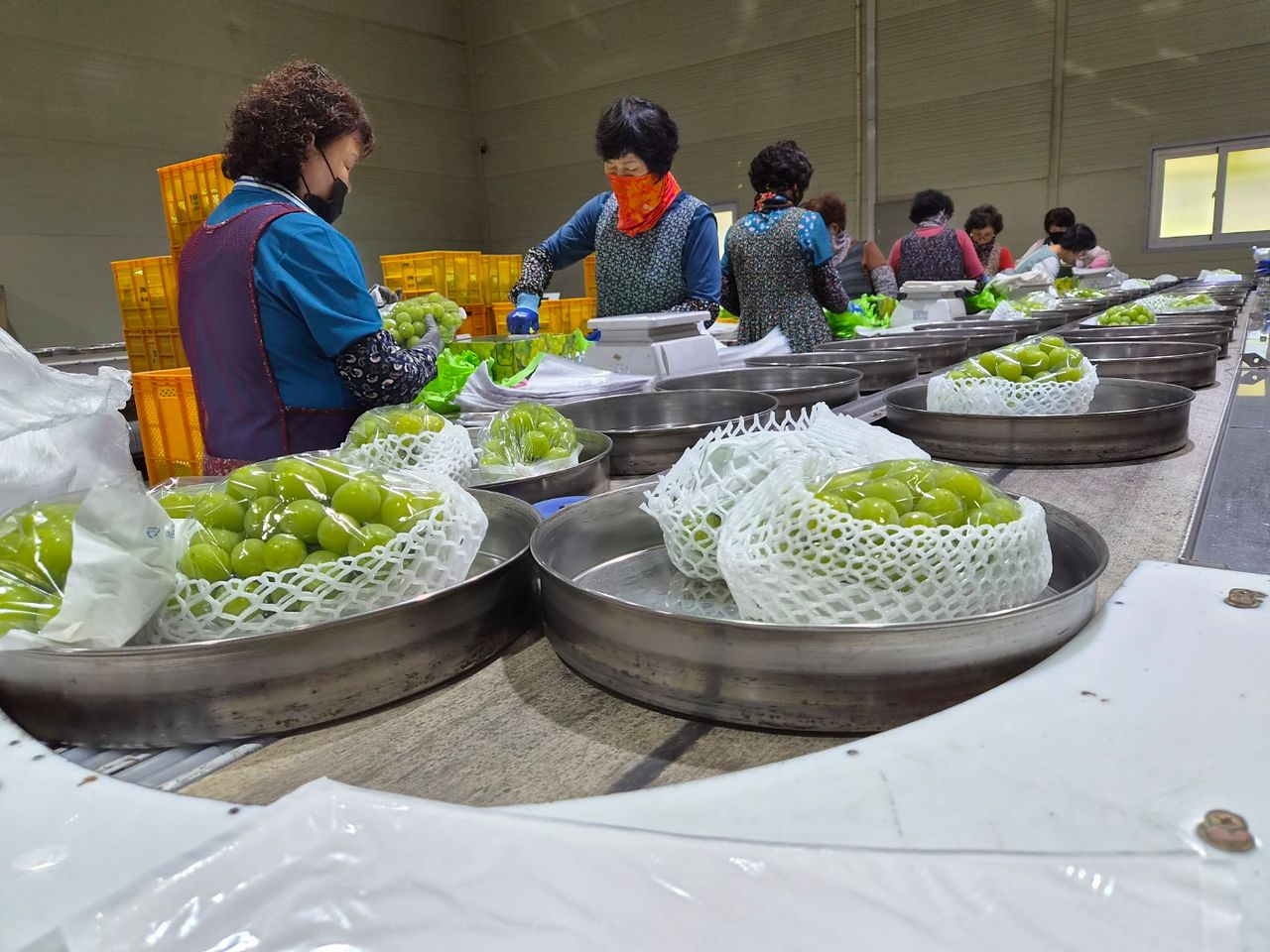
South Korea grape exports have surpassed $100 million for the first time in history, marking a major turning point for an agricultural sector that once faced overwhelming import dominance. This historic turnaround, achieved in about a decade, has been fueled by premium strategies centered around the Shine Muscat variety and diversified overseas markets.
The Rise of Shine Muscat and Record $100M Milestone
The Ministry of Agriculture, Food and Rural Affairs held a commemorative shipment ceremony for reaching $100 million in grape exports at the Sangju Agricultural Products Processing and Distribution Center in North Gyeongsang Province. Ministry data shows that cumulative grape exports through October jumped 85.2% year-on-year to $90.65 million, before officially breaking the $100 million threshold in the second week of November.
This achievement marks the first time a single fresh agricultural produce item has exceeded $100 million in exports. Taiwan emerged as the leading destination, accounting for more than half of the total with $51.3 million—a staggering 114.5% increase from the previous year. The United States followed at $16.44 million, bolstered by direct entries into major retail chains like Costco, alongside steady growth in Hong Kong, Vietnam, and Canada.
From Trade Deficit to Export Success Story
Following the implementation of the South Korea-Chile Free Trade Agreement in 2004, grapes were widely classified as a vulnerable agricultural sector due to an influx of foreign imports. As recently as 2016, import values ($145.01 million) overshadowed export values ($5.12 million) by roughly 28 times. However, aggressive variety innovation centered on Shine Muscat, high-end branding, and export support have successfully flipped the trade balance.
Ministry officials noted that the export boom also helped stabilize domestic farmgate prices by dispersing excess supplies overseas during a period of heavy seasonal yields. Building on this momentum, authorities plan to target the U.S. market aggressively during South American grapes’ off-season in December and January, while rolling out customized marketing campaigns across Asian markets to achieve their annual target of $112.5 million.