Mercedes-Benz is challenging Tesla’s dominance in the autonomous driving market by introducing technology that navigates independently not only on highways but also in urban environments.
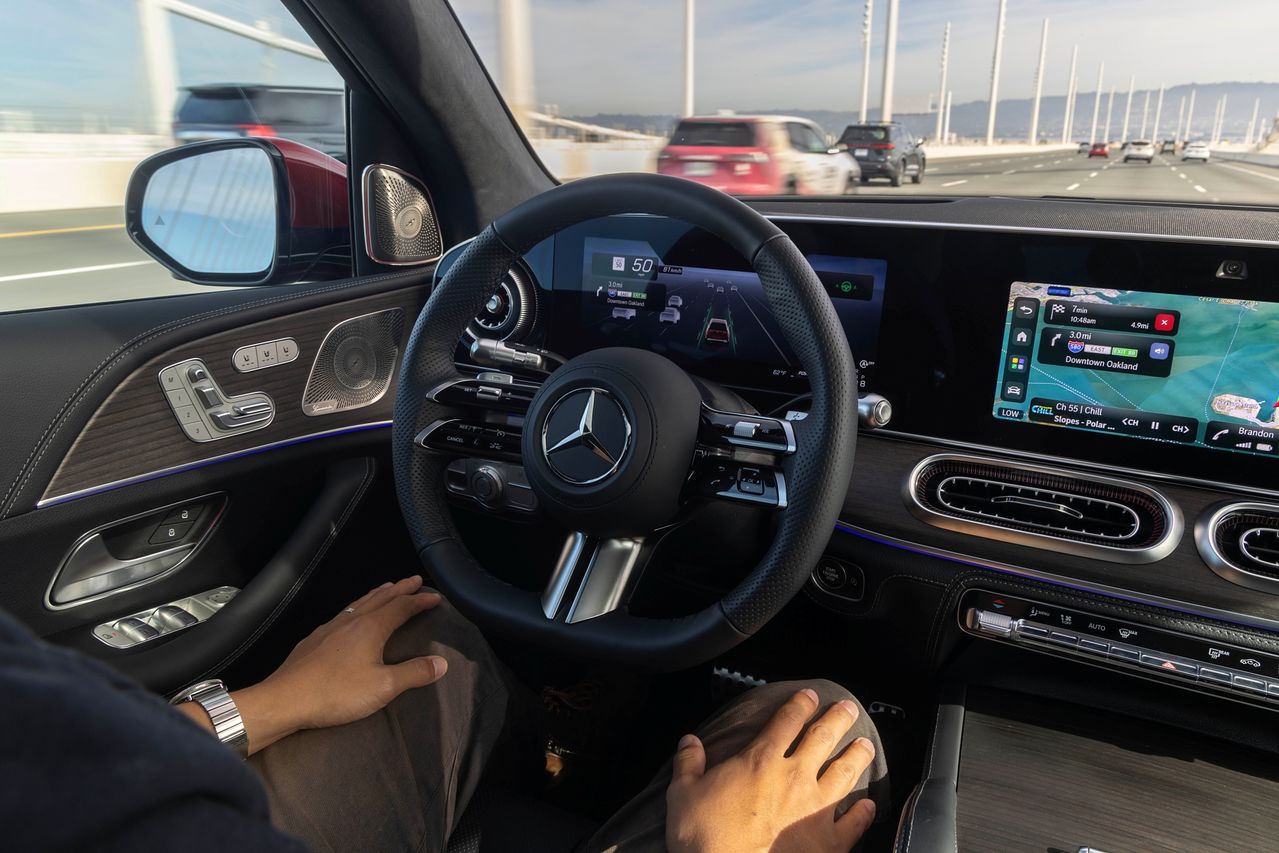
On November 16 (local time) in San Francisco, Mercedes-Benz unveiled new features for its advanced driving assistance system, ‘MB.Drive’. Starting in Germany at the end of this year, the ‘Hands-Free Assist’ feature will allow drivers to take their hands off the steering wheel at speeds up to 130 km/h on highways. The vehicle will automatically overtake slower cars, change lanes, and navigate to the desired highway exit.
Early next year, ‘Point-to-Point’ navigation will be introduced, allowing cars to automatically navigate to destinations entered into the navigation system not just on highways, but on city streets as well. The release is targeted for the US and Germany early next year, with a South Korea launch planned for the second half of next year, pending the easing of domestic autonomous driving regulations.
The newly unveiled features fall under ‘Level 2++’, similar to Tesla’s Full Self-Driving (FSD). While the car navigates autonomously to the destination, it remains a ‘supervised’ system where the driver retains ultimate responsibility.
Mercedes-Benz has integrated Nvidia’s automotive platform ‘Hyperion’ and artificial intelligence software ‘AlphaMayu’ into its proprietary operating system. Similarly, Hyundai Motor Group plans to leverage Nvidia’s systems to mass-produce Level 2++ vehicles capable of urban driving by the second half of 2028. Mercedes-Benz has effectively beaten them to the punch with its Nvidia-powered autonomous vehicles.
While Tesla established a standalone autonomous driving ecosystem, rival automakers are increasingly joining forces with Nvidia. Alongside Mercedes-Benz and Hyundai Motor Group, major global automakers such as Volvo, Toyota, and Volkswagen have also aligned with the Nvidia network, accelerating its expansion.