With the 2027 College Scholastic Ability Test (CSAT) approaching in South Korea, controversy over artificial intelligence cheating continues to grow. Meanwhile, in the United States, an AI cheating agent has emerged that not only solves college assignments but even submits them on behalf of students.
Created by Wyoming-based startup Eldorado Ignition, the tool is called ‘Silent Student.’ About two months ago, the company began recruiting college student members with the slogan ‘Your nights, back,’ immediately triggering a major backlash within the U.S. educational community.
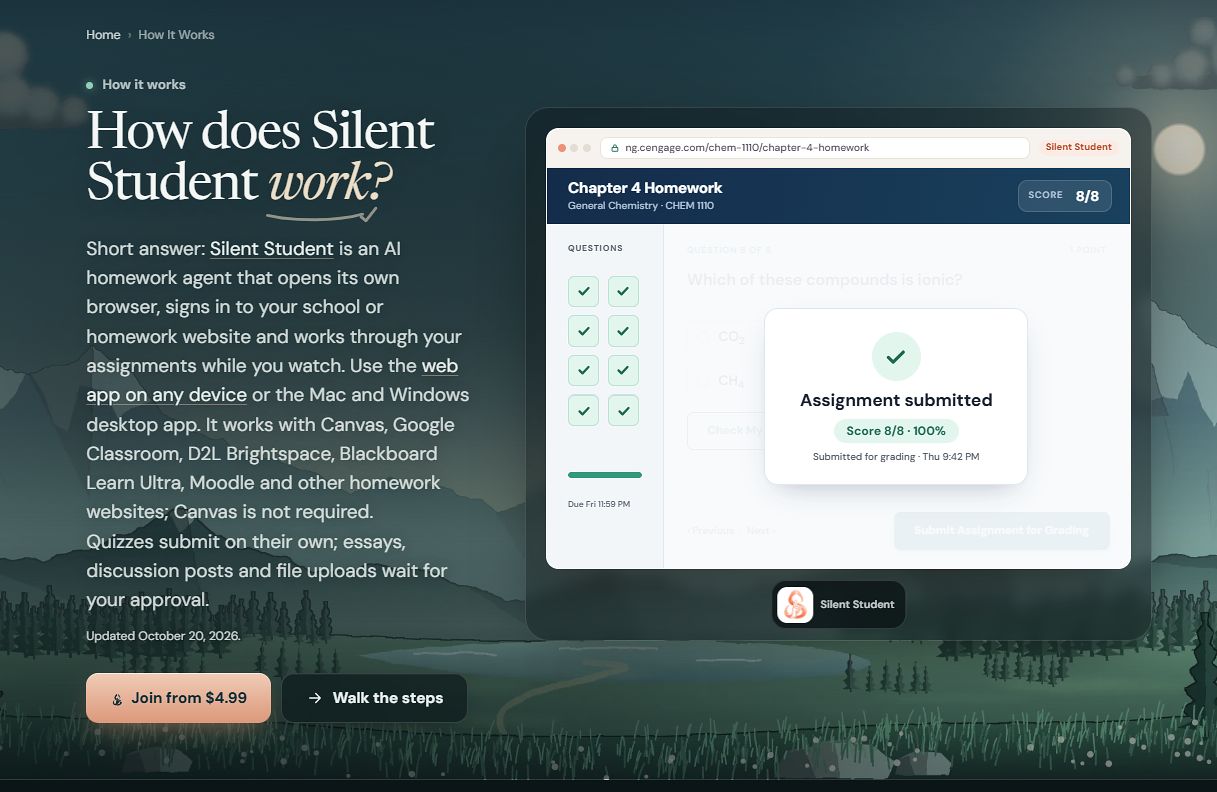
According to the company, students do not even need to copy and paste homework questions into ChatGPT or Gemini. After signing up, users simply log in to their school account through the Silent Student app and select their course. From there, the AI automatically finds assignments uploaded to the online classroom and inputs the answers. The tool integrates seamlessly with popular platforms like Canvas—used by universities such as Harvard and Stanford—as well as Google Classroom. On Canvas, it can even write essays, requiring only a final approval from the student before submission.
The company brazenly posted videos on its website demonstrating the AI completing college homework. In the footage, the AI reads a chemistry problem graph, inputs numerical answers, and solves circuit diagrams to calculate current flowing through a specific resistor. The entire process, from launching a mock assignment to seeing ‘Submission Complete’ displayed on screen, took just 3 minutes and 33 seconds, scoring a perfect 8 out of 8 on graded items. Effectively, it functions as an advertisement for academic cheating. Monthly subscription fees vary by usage volume, with packages ranging from $11.99 (approx. 16,000 KRW) for one or two subjects to $49.99 (approx. 67,000 KRW) for an unlimited personal plan.
Lia Berman Williams, a mathematics professor at the University of Alaska, shared the company’s website link on social media on November 14, writing that she was ‘appalled as a professor.’ Mark Watkins, director of the AI lab at the University of Mississippi, also criticized the service in a newsletter on November 13, stating that ‘anyone can now build a cheating tool using AI.’
In response to the criticism, the company pointed the finger back at the educational system. During an email inquiry by JoongAng Ilbo on November 18, company representatives argued, ‘Under the current educational system, students memorize information just to pass tests and forget it immediately,’ adding that most repetitive assignments take hours yet yield little actual learning. They claimed, ‘Many students have already been using AI for these assignments, and the final responsibility lies with the students.’ However, the company actively restricts professors from joining. In a revised policy updated on November 17, the firm explicitly stated it reserves the right to suspend or terminate accounts belonging to professors or teaching assistants without prior notice.
Universities are far from sitting idly by. In May, Canada’s Queen’s University announced a policy stating that even in classes permitting AI usage, delegating assignments entirely to AI will be treated as ghostwriting. Similarly, Korea University advised professors in August to evaluate the drafting process and whether students can explain their work in their own words. Despite these measures, keeping pace with rapidly evolving AI cheating technology remains a daunting challenge. Philip Dawson, an education professor at Monash University in Australia who has researched digital academic dishonesty for over a decade, expressed his frustration on LinkedIn on November 13, stating he is uncertain whether universities can successfully block such AI homework-proxy services.