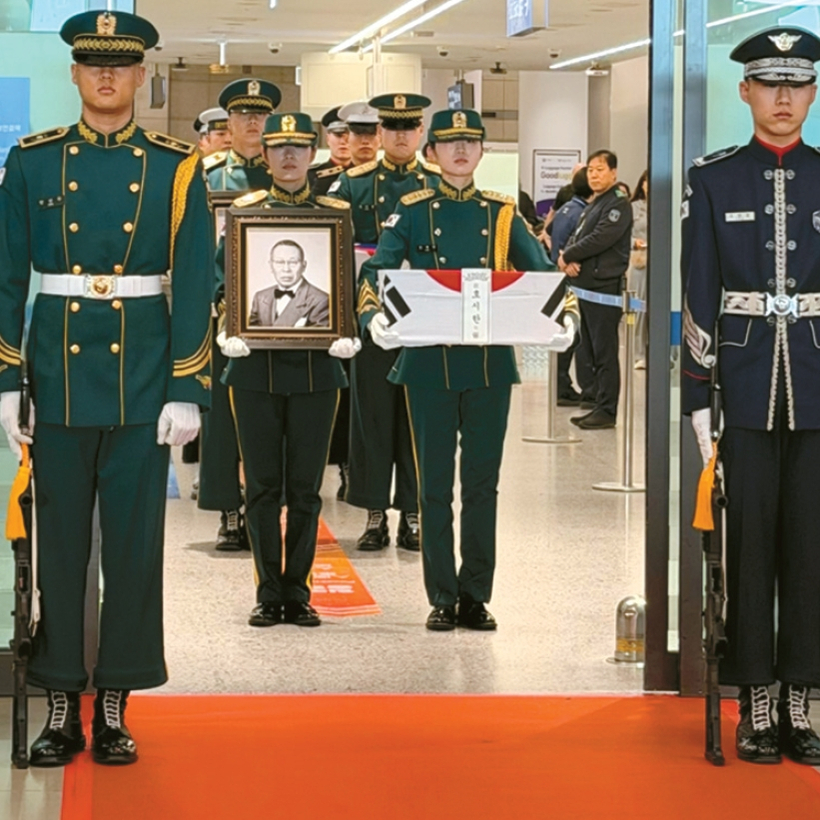
The remains of independence activist Ho Si-han (1885–1956), who had been resting at the LA Rosedale Cemetery, have returned to his homeland after 70 years.
According to the South Korean Ministry of Patriots and Veterans Affairs, the burial ceremony for Ho and his wife, Lee Jung-soon (1899–1988), was held on the 16th (Korea time) at the Daejeon National Cemetery. The final journey was attended by bereaved family members, including his eldest grandson, Ho Yoon-jin. Previously, a welcoming ceremony for the remains was held at Incheon International Airport on the 15th, followed by a government-supervised repatriation ceremony at Seodaemun Independence Park in Seoul the next day.
During the repatriation ceremony, actress Jung Ae-ri read a letter written by Ho’s daughter, Ho Jae-sook, addressed to her father. She expressed in the letter, “Father, it has been a long time since I called out the word ‘father’ out loud,” recalling her brief encounters and long separation from her father during childhood. She concluded her final farewell by saying, “Please rest in peace now in the embrace of the homeland you missed so dearly.”
This repatriation of remains was initiated by the “Project to Find the Graves of Independence Patriots,” jointly hosted last year by this publication, the Daehan Ingukminhoe Memorial Foundation, and the Hwarang Youth Foundation, with sponsorship from Bank of Hope.
Ho devoted himself to the independence movement starting in 1908. In 1920, he was arrested by Japanese imperialism while carrying out fundraising activities for the Provisional Government of the Republic of Korea. He also dedicated himself to the liberation of his homeland by supporting anti-Japanese movement funds and Liberation Army sponsorship funds while in America.