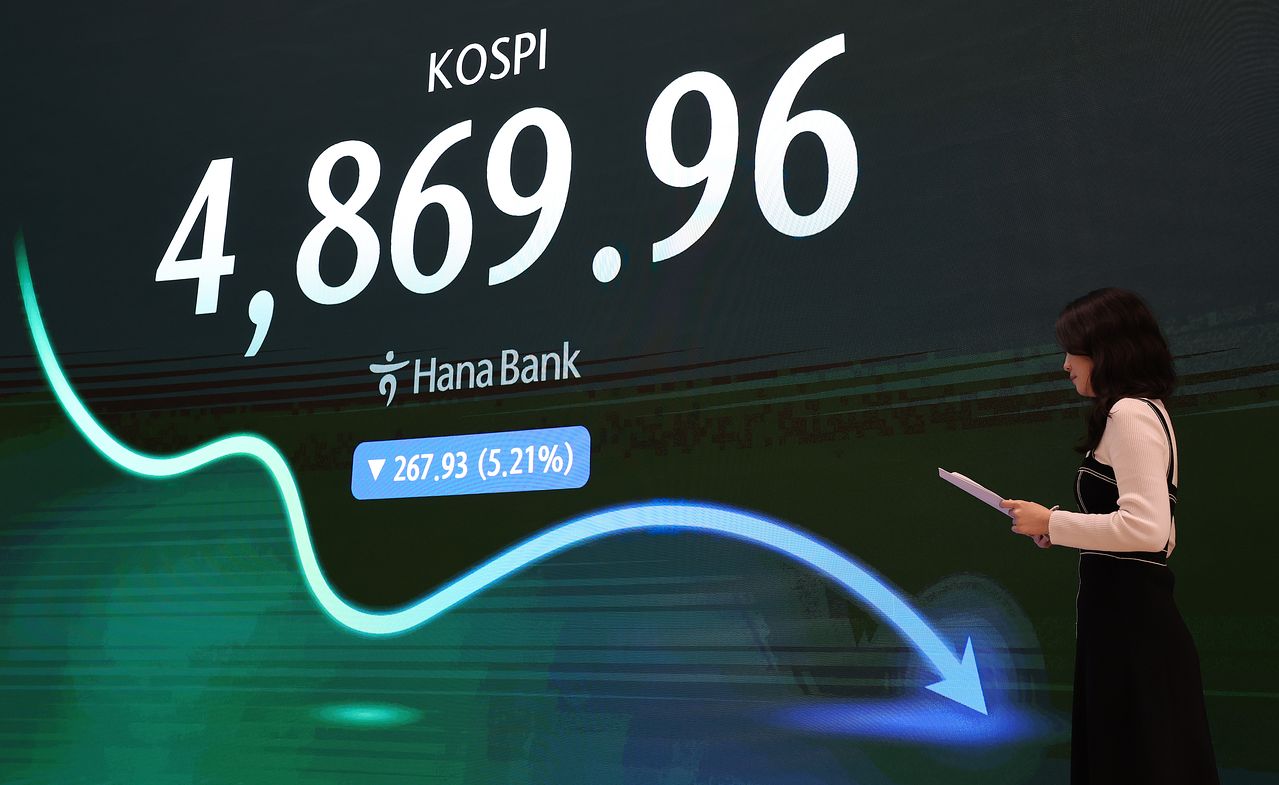
As concerns over a local stock market ‘Black Monday’ escalate, the South Korean government has initiated preparations to deploy the Securities Stabilization Fund and implement emergency market stabilization measures. Starting from the 24th, regulations on treasury stock purchases by listed companies will be relaxed for three months, and a special intensive monitoring period for illegal short-selling will also be operated.
Deputy Prime Minister and Minister of Finance and Economy Lee Hyung-il held an emergency market situation inspection meeting (F4 meeting) on the 22nd at the Government Complex Seoul, attended by Bank of Korea Governor Rhee Chang-yong, Financial Services Commission Chairman Lee Eok-won, and Financial Supervisory Service Governor Lee Chan-jin, where these market stabilization measures were announced.
The meeting was convened amidst growing instability in domestic financial markets triggered by a global stock market plunge. On the 20th, the KOSPI and KOSDAQ indexes plummeted by 5.21% and 5.71%, respectively. Following the close of the domestic market, the U.S. Nasdaq index also crashed by 5.28% and the Philadelphia Semiconductor Index dropped by 10.73%. With major semiconductor stocks like Nvidia (-14.01%) and AMD (-13.25%) suffering steep declines, anxieties grew over a potential further drop in the domestic market on the 23rd.
Attendees, including Deputy Prime Minister Lee, diagnosed that volatility in domestic and global stock markets has sharply amplified due to uncertainties surrounding the profitability and funding of the artificial intelligence (AI) industry, alongside U.S. data center regulations and tightened semiconductor export controls. However, they agreed that the mid-to-long-term growth expectations for the AI industry remain valid, calling for vigilance against excessive anxiety and panic selling.
The primary measure prepared by the government is the Securities Stabilization Fund. This mechanism involves financial institutions and other entities pooling capital to purchase index-related products to counter sharp market declines. The government decided to inspect related procedures so that the fund can be deployed immediately depending on market conditions. The specific scale and timing of the deployment have not yet been finalized. Previously, during the COVID-19 pandemic in 2020, a securities stabilization fund amounting to 10.76 trillion won was formed, though actual funds were not deployed as the stock market rebounded.
The daily treasury stock purchase order limits for listed companies will also be relaxed for three months starting on the 24th. Under current regulations, the daily purchase order limit is based on the larger of 10% of the acquired shares or 25% of the average daily trading volume over the past month, not exceeding 1% of the total issued shares. By temporarily relaxing this rule, the government aims to expand corporate capacity for treasury stock purchases and reduce downward pressure on stock prices.
Monitoring of illegal short-selling will likewise be intensified. The Financial Supervisory Service and the Korea Exchange will operate a special intensive monitoring period for three months and take stern action against any illegal activities detected. Trends in credit financing, margin transactions, and forced liquidation will also be closely inspected.
Amidst these developments, retail investors are increasingly demanding restrictions on short-selling due to fears that it could act as a catalyst for a domestic stock market crash. Short-selling involves borrowing shares to sell them first and buying them back later to return, yielding higher profits the cheaper the shares are bought back. Consequently, a surge of short-selling orders during a sharp market downturn can exacerbate losses.
According to the Korea Exchange, short-selling trading value on the 20th reached 1.4113 trillion won, an increase of 222.2 billion won from the previous trading day. Short-selling was primarily concentrated in AI-related stocks. The top five stocks by short-selling trading value on the 20th were SK Hynix (159.7 billion won), Samsung Electronics (133.8 billion won), Samsung Electro-Mechanics (94.3 billion won), Hanmi Semiconductor (41.1 billion won), and SK Square (39.7 billion won).
Taiwan, which shares a high semiconductor weighting like South Korea, has gone a step further to strengthen short-selling regulations. The Taiwan Financial Supervisory Commission announced five major measures to stabilize the stock market on the 21st. Starting on the 23rd, regardless of the previous day’s price fluctuations, listed stocks and Taiwan Depositary Receipts cannot be shorted at prices lower than the previous day’s closing price, with exceptions for hedging transactions by securities firms and futures houses. The minimum short-selling margin ratio was also raised from 130% to 150%.