Automotive industry competition has expanded far beyond traditional vehicle manufacturing and sales into charging infrastructure, advanced technology, and mobility services. At this year’s LA Auto Show, global automotive brands showcased not only new vehicles but also innovative business models and technologies tailored to industry shifts. During interviews with key corporate figures on the media day floor on November 19, we explored each company’s differentiated competitiveness and business strategy.
Global automaker-backed electric vehicle charging network IONNA EV charging network is challenging established networks like Tesla Supercharger by leveraging high-output fast charging, price competitiveness, and rapid infrastructure expansion.
Established in 2023, IONNA is an EV charging station company formed as a joint venture by eight major global automakers: Hyundai, Kia, BMW, GM, Honda, Mercedes-Benz, Stellantis, and Toyota.
In an interview at the LA Auto Show on November 19, IONNA CEO Seth Cutler stated that their goal is to build a charging network that every EV driver can trust, access at reasonable prices, and use conveniently.
Currently, IONNA chargers support outputs of up to 400kW. This is 60% higher than Tesla’s V3 Supercharger (250kW) and 14% higher than fast chargers from Electrify America and EVgo (350kW).
For popular Korean models like the Hyundai Ioniq 5, charging from 10% to 80% battery takes approximately 20 minutes.
Charging rates have been set with a nationwide ceiling of 39 cents per kilowatt-hour (kWh) to secure price competitiveness. There are no separate membership sign-up fees or charging surcharges.
According to EV charging rate tracker DCFC Tracker’s November figures, the average non-member peak-time charging rate for Tesla Superchargers in California is 76 cents, making IONNA’s price ceiling 49% cheaper.
The company is also heavily focused on minimizing charger reliability issues, which many EV drivers cite as a major frustration. Utilizing monitoring and diagnostic software to track charger status, the network boasts a 99% uptime rate.
Cutler noted that based on this reliability, IONNA was named top provider in J.D. Power’s public charging service evaluation this year.
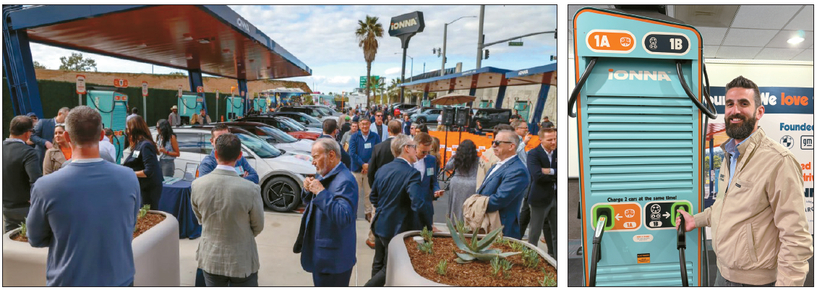
The company is also accelerating its infrastructure expansion. Three years after its launch, it has secured 230 charging stations nationwide and opened its first flagship charging facility in Westminster on the 18th.
Cutler stated that they currently operate three to four charging stations in Southern California and plan to expand that number two- to threefold, aiming to increase station density and become the preferred charging network for drivers.
Collaboration with Hyundai and Kia is also moving forward closely. He mentioned that they are strengthening technical and commercial cooperation by deploying chargers and EVs at both sides’ facilities for interoperability testing.
IONNA supports a Plug & Charge service for joint venture vehicles like Hyundai and Kia models, enabling automatic vehicle authentication and payment simply by plugging in the charger.
Recently, the company has also expanded access for non-affiliated brand customers, allowing Tesla drivers to use similar services via the Presto charging service platform.
Improving the charging station environment is another differentiation strategy. In addition to installing canopies over charging spaces, some locations feature dedicated lounges and convenience stores so drivers can spend their waiting time more comfortably.
Meanwhile, despite the recent slowdown in EV sales growth, Cutler remained optimistic about the growth potential of the charging infrastructure business.
He noted that there are currently about 6 million EVs on the road requiring a charge, and while EV sales have slowed compared to last year, they appear to be bottoming out. He forecasts that sales will pick up again after 2027 as new models are released.