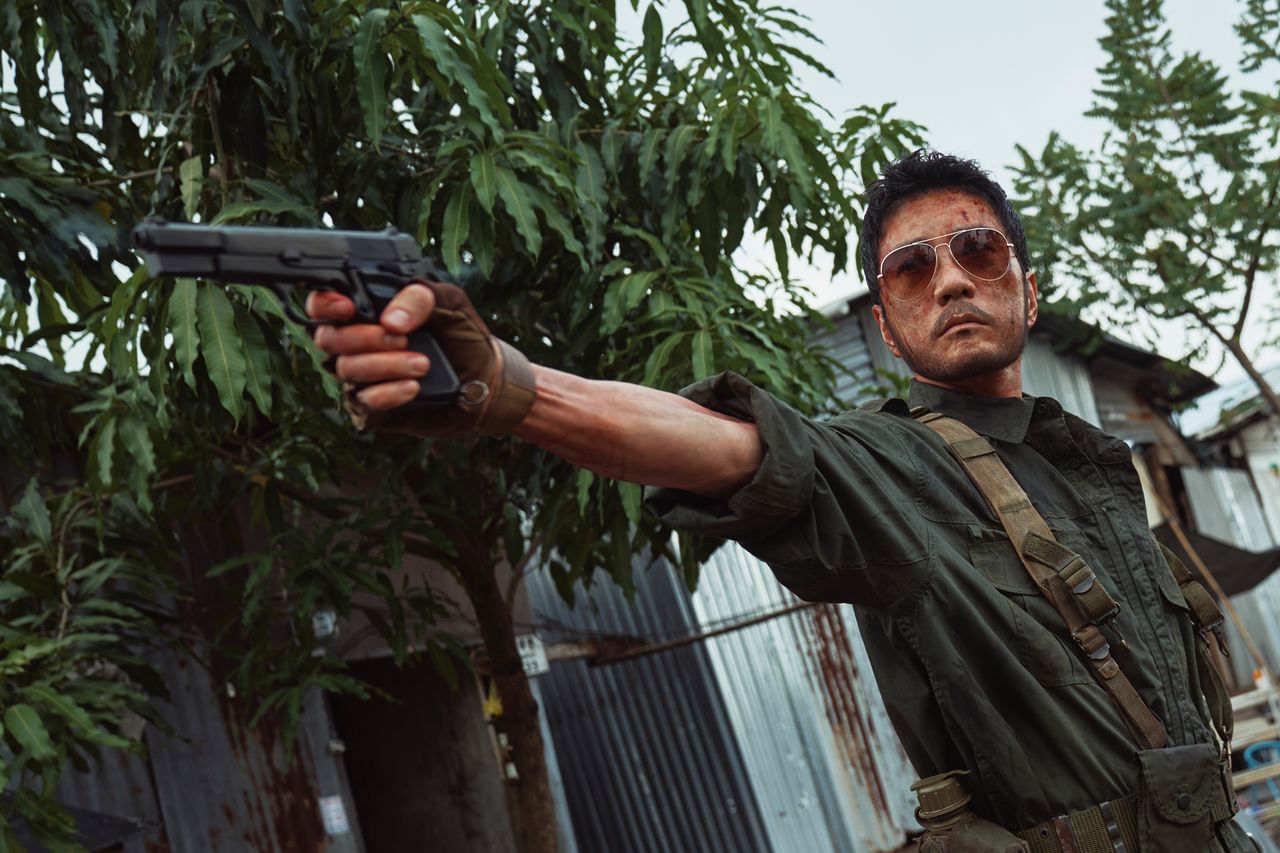
Method-acting master Sad Tropes star Kim Myung-min (54) takes on the role of ‘Sabu,’ a warrior of a fictional Southeast Asian minority, in his first silver-screen comeback in seven years since ‘Jangsa-ri’ (released on the 25th). For the first time in his 30-year acting career, he tackled 100% English dialogue. ‘Sabu,’ who raised abandoned children in the jungle into assassination machines, sparks chaos throughout the syndicate upon the sudden news of his assassination.
“A blank expression like a ‘sage of the jungle’ whose emotions cannot be read,” and “graceful and dignified action.” These were the demands of director Park Hoon-jung, who handled both the script and direction.
The two, who first met on the film ‘V.I.P.’ (2017) and became close enough to visit each other’s families, teamed up once again for this “contemporary martial arts” style film.
“I am not even good at basic action, so I was having a mental breakdown wondering how to pull off graceful-lined action. I lost 8 kg [in 3 weeks] and practiced so hard my body felt like it was breaking down with martial arts director Kim Jung-min in Bangkok [the filming location],” Kim Myung-min revealed.
Kim shared this during a press conference and Q&A session after the ‘Sad Tropes’ press screening on the 19th. In a separate interview on the 23rd, he added another behind-the-scenes story.
“I finished shooting the ENA drama ‘Your Honor’ at the end of July 2024, and filming for ‘Sad Tropes’ started in September. Originally, my son and I planned a family trip to Hawaii before his military enlistment, but the director asked me out to eat and suggested, ‘Can’t you go to family vacation in Thailand instead?’”
This meant he received the casting offer just two months before filming. Park explained that he struggled to cast the role because “Sabu is such a stoic and challenging character” and only belatedly realized that the right actor was “unexpectedly close by.”
‘Sad Tropes’ borrows both its Korean title and original title (Tristes Tropiques) from French anthropologist Claude Lévi-Strauss’s book of the same name. Director Park had long envisioned a story where jungle survivors collapse under the another barbarism of the city, ultimately engraving themes of the cycle of violence and intergenerational distrust.
In this film, where he aimed to “showcase violence rather than action,” the sparse gaps in the narrative are filled with a certain emotion: the emptiness of inescapable violence and heavy fatigue. It feels like a concluding chapter closing the book on the world of human weapons he has built through sensory action, starting from his Hong Kong noir-homage ‘New World’ (2013) to ‘The Witch: Part 1. The Subversion’ (2018), ‘The Childe’ (2023), and ‘The Tyrant’ (2024).
A line delivered by ‘Sabu’ to the organization’s youngest member ‘Lu’ (played by Lee Shin-young) drives the point home: “The world has changed, Lu. Our work no longer holds much business value. Human lives aren’t what they used to be. They’re trivial….”
Kim Myung-min described the film as an “emotional noir” possessing an intensity distinct from previous Park Hoon-jung noir projects. He added, “While the motives behind why they must fight so fiercely are omitted, that cruel life felt sorrowful throughout the viewing experience.”
Filming took place in a remote area three hours away from downtown Bangkok during Thailand’s rainy season. Enduring the relentless tropical rain and scorching heat reaching 45 degrees Celsius, he stated, “I bottled up Sabu’s boiling emotions into flat, uninflected English dialogue.” Even when prop guns malfunctioned and expelled flying bullet shrapnel, he maintained a poker face, terrified that blinking his eyes incorrectly would trigger an NG.
“When fighting with big jungle machetes, your hands inevitably collide. Bruises and swollen fingers are a given. Still, I didn’t let out a single ‘ouch.’ Because it’s a long-take scene, making a mistake would mean sending all those people back to be killed from the beginning. There was no such thing as patchwork filming on the set of ‘Sad Tropes.’”
While Sabu embodies the film’s core theme, the emotional weight of the action rests on his star pupil, Lu—a hearing-impaired, clumsy rookie of the organization. Named after the Chinese character for tears (淚), he is a crybaby, yet no student has followed Sabu’s principles as faithfully as Lu. Lu also possesses the ability to anticipate enemy movements through microscopic air vibrations. Lee Shin-young, known for ‘Crash Landing on You’ (JTBC, 2019) and ‘Rebound’ (2023), successfully portrayed the martial-arts-master-like character Lu with pure yet piercing eyes.
This marks another discovery by Director Park Hoon-jung, following Kim Da-mi from ‘The Witch’, Kang Tae-joo from ‘The Childe’, and Jo Yoon-su from ‘The Tyrant’. Actress Park Yu-rim, known for her sign language performance in the Japanese film ‘Drive My Car’ (2021), also exuded exotic charm as Jojo, a Japanese syndicate member.
Alongside them, characters like the Korean organization’s eldest big brother ‘Jang’ (Park Hee-soon) and Taiwanese actor Greg Hsu playing the second-in-command ‘Lane’ showcase unique multilingual dialogue in ‘Sad Tropes’, ranging from Lu’s sign language to English, Korean, Japanese, and Taiwanese. Children raised together regardless of nationality understand each other’s different languages just by looking into their eyes. In this film, communication breakdown stems not from language barriers, but from distrust and violence.
Kim Myung-min added that scenes explaining the characters’ backstories were filmed but ultimately edited out by Director Park. He explained, “It seemed he excluded elements that might veer into melodrama and distort the theme of violence, creating a film concentrated on the true worldview Director Park wanted to convey.”