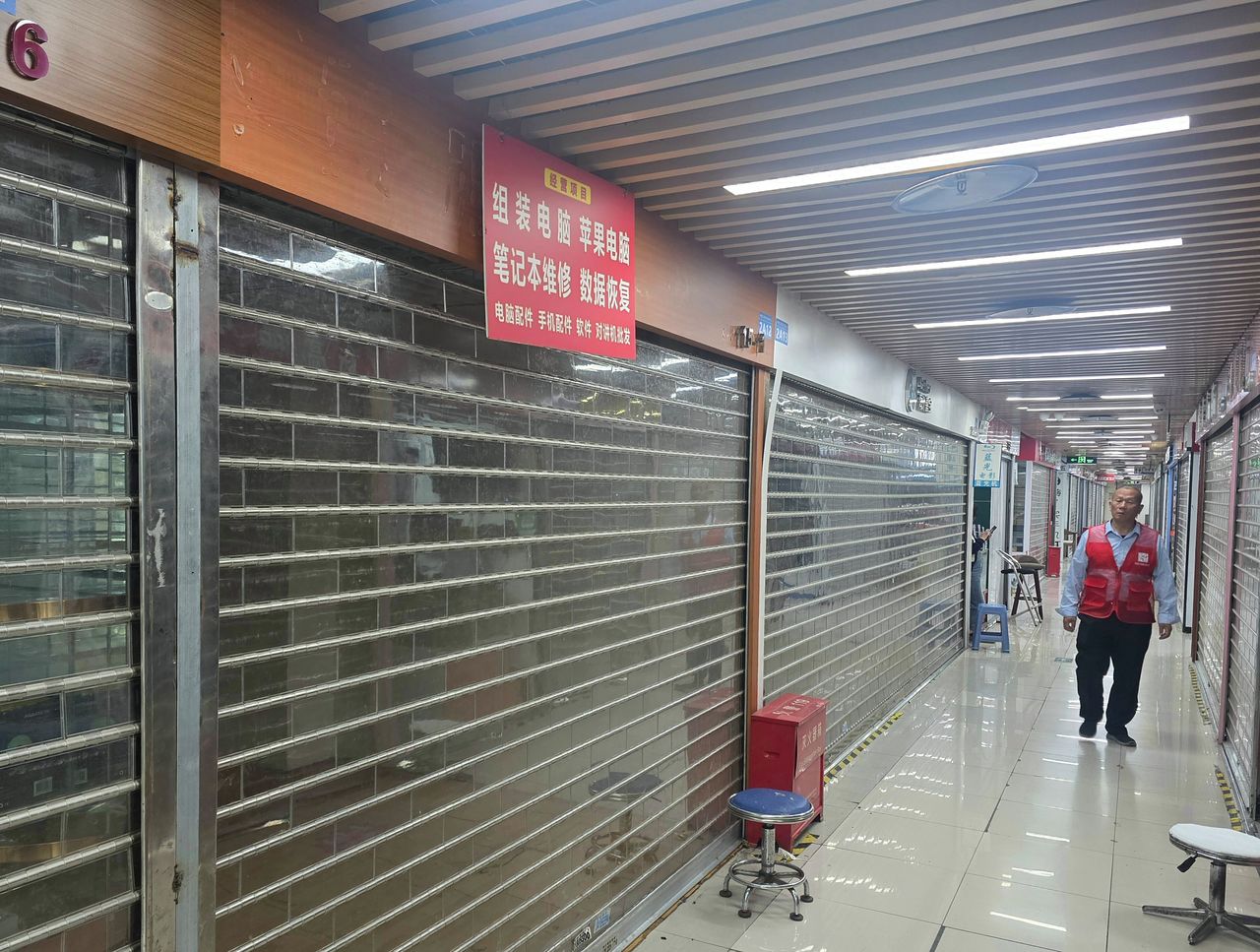
On November 10, the Shenzhen Huaqiangbei electronics market—known as China’s largest electronics hub—revealed a stark downturn. Walking into one of the shopping complexes, rows of rolling shutters were pulled down beneath signs reading ‘Custom PC and Laptop Repair.’ While building management claimed the closures were due to ongoing construction, the reality reflects a chilling global consumer market driven by a sudden memory semiconductor price surge that has unexpectedly benefited memory giants like Samsung Electronics and SK Hynix.
PC shops bearing the ‘Custom Computer One-Stop Solution’ sign had half of their display counters covered with gray cloth. When inquiring about purchasing a laptop, a merchant advised that graphics processing unit (GPU) prices had skyrocketed so much that buyers needing only basic document work should purchase models without dedicated external GPUs, adding that prices were at their lowest point right now and could surge again at any moment. As costs escalated, foot traffic dwindled. According to China Central Television (CCTV), memory merchants in Huaqiangbei reported a 20% to 30% drop in sales entering October. Rising component costs are actively subduing the finished goods market, and South Korea is no exception, with global market research firm IDC projecting a 7.1% contraction in South Korea’s domestic PC market compared to the previous year.
In front of mobile phone stores, signs advertising ‘High-Price Used Phone Purchasing’ outweighed new product promotional banners, showcasing another side of the memory crisis. Huaqiangbei vendors were actively stripping memory chips from discarded smartphone motherboards, sending them through cleaning, recycling, and repackaging processes before returning them to the market. With prices surging to 40% to 60% of brand-new chips, discarded smartphones have suddenly become precious commodities. According to China’s National Business Daily, used smartphone acquisition prices that hovered around 20 yuan (approx. $3) last year spiked to 200 yuan (approx. $28) by March.
The situation shows few signs of immediate relief. Market research firm Counterpoint Research forecasts global smartphone shipments to drop 13.9% this year, with an additional 6% decline next year. Xiaomi, the world’s third-largest smartphone maker, saw its third-quarter net profit plunge 68.4% year-over-year. Xiaomi President Lu Weibing noted that the ‘winter for the smartphone industry’ will persist for some time. Even Samsung Electronics, which ushered in an era of 100 trillion won operating profits, saw its Mobile Experience (MX) and Networks division post an operating loss of 600 billion won in the third quarter, marking its second consecutive quarter in the red.
Conversely, prime display counters were densely packed with smart glasses (AI glasses), smart rings, and robot dogs. In front of an ‘AI Trend Toy Wholesale Center’ sign, robot dogs were lined up along the floor, while a digital signboard at the market entrance alternated between smart glasses and smart ring advertisements. Price served as the primary weapon. One store sold a button-activated photo-taking smart eyewear for 69 yuan (approx. $10), a 24-hour heart rate-monitoring smart ring for 100 yuan (approx. $14), and a blood pressure-tracking variant for 200 yuan (approx. $28). These affordable ‘shells’ kept production costs low by offloading AI processing tasks directly onto smartphones and cloud networks rather than handling them locally. According to Huaqiangbei administrative statistics, the proportion of AI products among electronics in the commercial district surged from 41% last year to 61% by July.
For the South Korean electronics industry, this creates a dual challenge: rising component costs erode the profitability of existing finished products, while China rapidly spearheads the next-generation device market using aggressive price competitiveness. A report by the Korea Institute for Industrial Economics and Trade (KIET) on South Korea-China competitiveness in advanced industries highlighted China’s low pricing, capture of new AI device markets, and component self-sufficiency as major threat factors. The traditional strategy of widening the technological gap with China is now facing fundamental limitations.