Growing up, ADHD was a daily struggle for Dae-soo, a boy who constantly found himself distracted and unable to focus. He never finished taking notes, routinely forgot to do his homework, and occasionally showed up to school wearing mismatched shoes or his mother’s pants by mistake.
Despite trying hard to keep up, Dae-soo typically scored only 60s and 70s on his exams. The stinging remark, “You lack concentration,” haunted him constantly. This cycle repeated itself through middle and high school as the world’s standards continually clashed with his unique mind. Dreaming of university life, he failed to enter any school in Seoul and even failed to gain admission to local universities.
If someone had told him back then that he would grow up to become a renowned brain scientist, publish papers in elite journals like Nature, Science, and Neuron, become a KAIST professor, and even launch a biotech startup to conquer brain disorders, it would have been hard to believe.
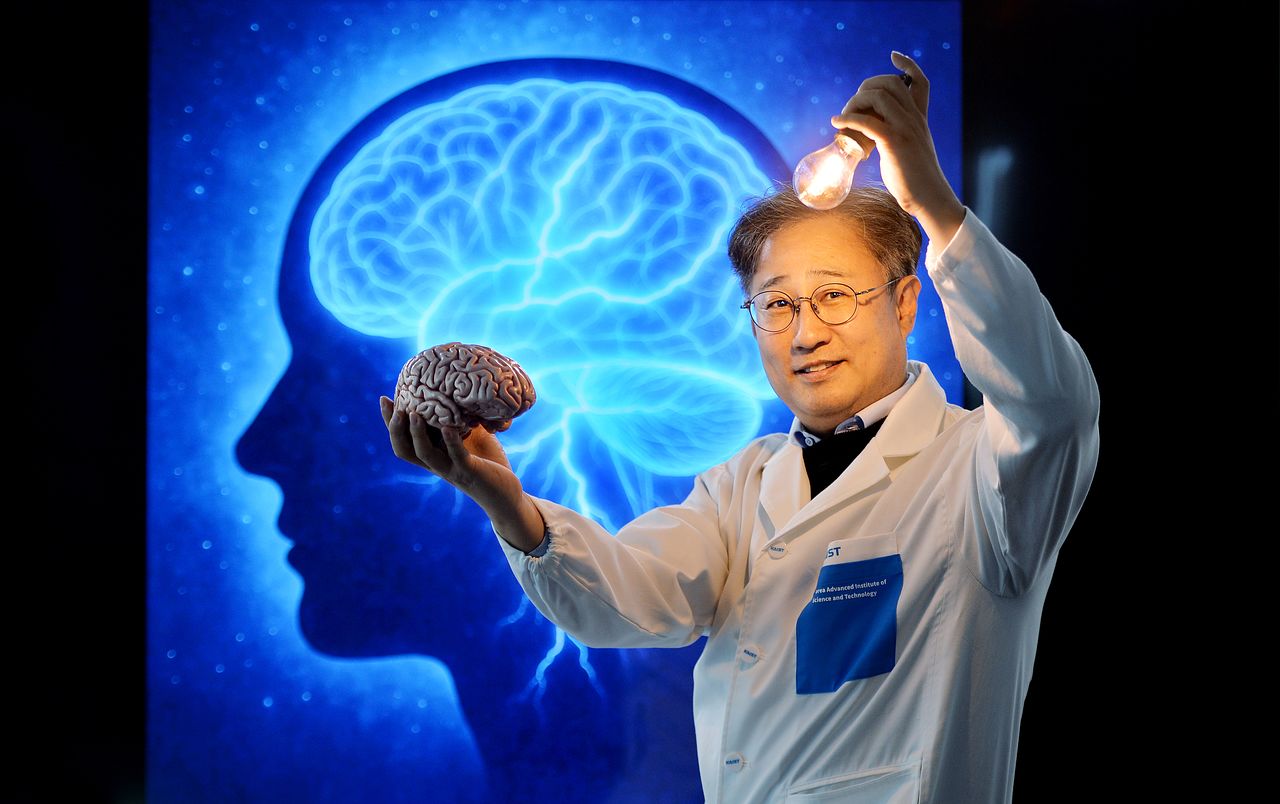
The life of Kim Dae-soo (57), a professor in the Department of Brain and Cognitive Sciences at the Korea Advanced Institute of Science and Technology (KAIST), is nothing short of a dramatic plot twist.
From Distracted Problem Child to Brain Scientist
What changed the life of a ‘problem child with poor concentration’ into a leading brain researcher? Surprisingly, it happened while attending a repeat-student academy for college entrance exams. Once he grasped the “principle of immersion,” it felt like a light finally turned on in his brain. His academic potential exploded when he went on to study biology at Sogang University and earned his master’s and Ph.D. in life sciences from POSTECH.
While studying brain science, Professor Kim eventually realized that he had been suffering from attention deficit hyperactivity disorder (ADHD).
Reflecting on his journey, he noted that taking medication made him remarkably calm, but he soon stopped taking it because he had already learned how to harness his ADHD brain effectively and live a happy life.
Embracing the ADHD Mind for Success
Reflecting on his early education, Professor Kim admits he never completed a single homework assignment because his mind would wander whenever teachers spoke. Yet, he was far from a delinquent; he deeply wanted to succeed and become a scientist. To catch up, he would frantically copy friends’ homework during recess or slip away to the restroom to finish assignments just before class inspections.
When asked why he struggled to pay attention, he explained that jotting down notes caused him to lose the train of thought. Because he could not follow lectures properly, he had to study entirely on his own throughout middle and high school, only to find his scores hovering around 60 and 70.
He never considered ADHD during his youth, simply viewing his behavior as something he needed to fix. It was only while studying neuroscience that he recognized his own symptoms. Later, when his second child was diagnosed with ADHD at age 26, Kim underwent testing out of shared symptoms and was diagnosed with severe ADHD.
Today, Professor Kim shares his hard-earned study methods and daily routines to help individuals unlock their concentration levels, proving that it is entirely possible to leverage the brain’s unique potential without relying on medication.